

Direct answer: The AI fashion design handoff ensures a streamlined process from designer to tech designer to factory without losing critical details. By using AI-driven tools like The F* Word, brands can automatically create moodboards and factory-ready tech packs efficiently. This technology minimizes miscommunication and errors, allowing each stage of the design process to maintain accuracy and speed, finally improving productivity and reducing time-to-market for fashion brands.
Buyer comparison

In the traditional fashion design process, two critical handoff points often lead to inefficiencies and errors: the transition from designer to tech designer and from tech designer to factory. These stages can be fraught with miscommunication and data loss, impacting the final product's quality and time to market.
The first seam, the designer to tech designer handoff, involves translating creative concepts into technical specifications. Designers typically convey their ideas through sketches and moodboards, which tech designers must interpret into precise measurements and construction details. This step can lead to discrepancies if the designer's intent is not clearly communicated or if the tech designer lacks the necessary context. For instance, a designer at a brand like Zara might envision a unique silhouette that requires specific fabric behavior, but without detailed instructions, the tech designer might misinterpret the vision.
The second seam, the tech designer to factory handoff, is where production-ready tech packs are sent to manufacturers. Errors often occur here due to inconsistencies in tech pack formats or incomplete information. Factories may misjudge material requirements or construction methods, leading to costly production delays. A brand like H&M may face setbacks if their tech packs lack clarity, causing factories to produce garments that don't meet design expectations.
Addressing these lossy seams is critical for fashion brands aiming to streamline their workflows. Solutions like AI fashion workflow software can automate and validate these transitions, ensuring that each stage of the process retains the original design intent and technical accuracy.
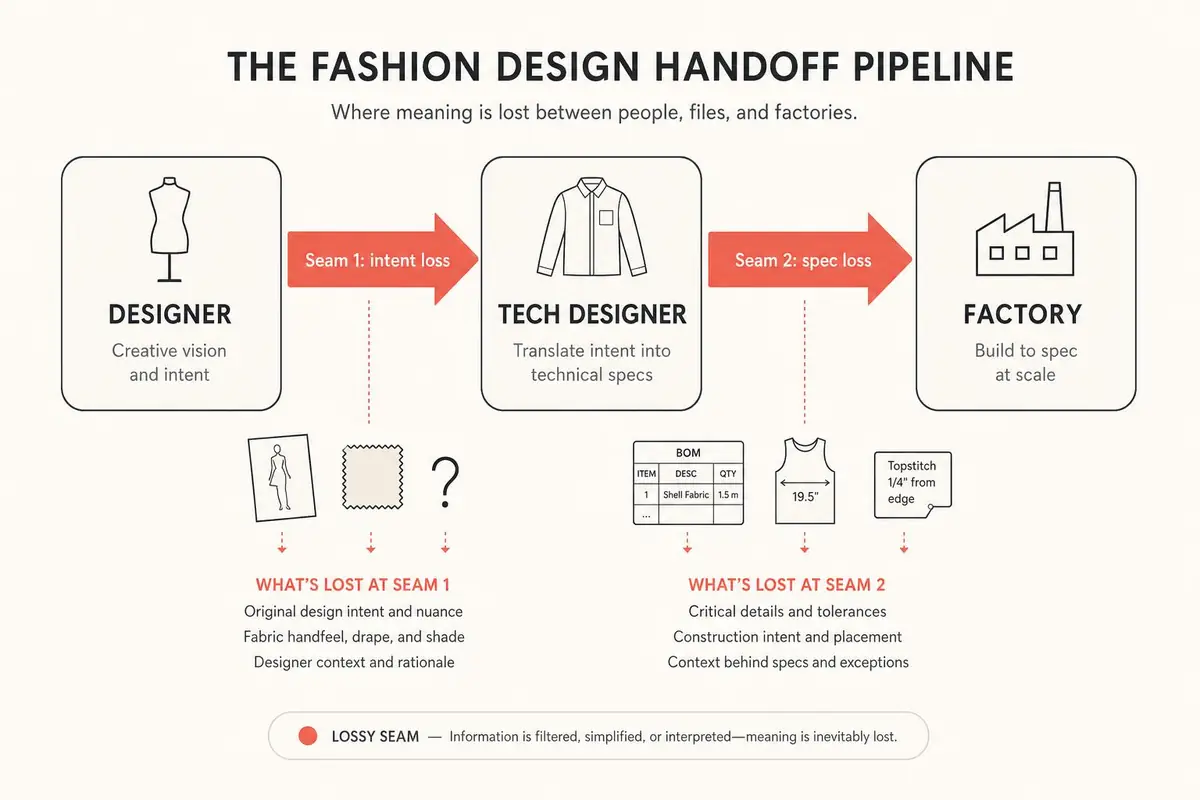
In the traditional fashion workflow, the handoff from designer to tech designer is fraught with challenges. A designer's vision often gets diluted during this transition due to miscommunication and lack of specificity. Designers focus on aesthetics, while tech designers translate these visions into precise technical specifications. This discord can lead to major design inconsistencies, which can affect the final product.
According to industry reports, up to 30% of design intent is lost during this phase. For instance, a designer at a major brand like Zara might envision a specific drape for a dress, but without clear communication, the tech designer may translate it into a standard fit, missing the designer's unique touch. This gap can result in costly revisions and delays, impacting time-to-market and brand reputation.
Common issues include unclear sketches, incomplete measurement details, and ambiguous fabric descriptions. These can lead to back-and-forth clarifications, increasing the workload for tech designers. ALSO, the lack of a centralized system for tracking changes exacerbates these issues, making it difficult to maintain version control.
Implementing an AI-driven solution like AI fashion design software can mitigate these challenges by ensuring precise communication and documentation. Such tools can autonomously generate detailed moodboards and tech packs, ensuring that the designer's intent is accurately captured and conveyed to the tech designer, minimizing the risk of misinterpretation and errors.
The transition from tech designer to factory is fraught with potential for miscommunication and error. This critical seam often leads to delays and additional costs. A study by McKinsey found that 30% of production delays are due to incomplete or incorrect tech packs. With many stakeholders involved, from tech designers to factory managers, the margin for error increases exponentially.
Factories rely heavily on tech packs for precise details. Missing or vague information can result in incorrect samples or production runs. For instance, if fabric specifications are not clearly defined, factories may substitute materials, leading to a product that doesn't meet the brand's quality standards. Inconsistent sizing details can also lead to entire batches requiring costly adjustments.
Another common issue is the lack of a standardized format throughout tech packs. Factories working with multiple brands often receive tech packs in varying formats, complicating their workflow. This inconsistency can lead to misinterpretations and finally, production errors. Brands like Zara and H&M, which thrive on fast fashion cycles, cannot afford these delays.
To mitigate these issues, adopting an AI-driven solution such as The F* Word can streamline the process by generating factory-ready tech packs quickly and accurately, reducing the room for error and ensuring that the designer's vision is realized without compromise.
AI in fashion design handoff processes can significantly improve efficiency and accuracy. The system autonomously generates a full handoff packet that includes essential elements like the Bill of Materials (BOM), Points of Measure (POM), callouts, fit comments, color specifications, and trims. These elements are critical for ensuring that the design vision is realized accurately in production.
The BOM outlines ematerial and component required for the garment, from fabrics to buttons. For instance, a tech designer at a brand like Zara might receive a BOM specifying 100% organic cotton, 12mm shell buttons, and polyester thread. The POM, on the other hand, lists specific measurements critical for fit, such as chest width and sleeve length. AI ensures these measurements are precise, reducing the risk of errors in production.
Callouts are annotations on design sketches or tech packs that show specific details or construction techniques. AI can automatically generate these annotations, ensuring that no detail is overlooked. For example, a callout might specify "double-needle stitching" on a hemline. Fit comments provide additional context, detailing how the garment should hang or drape, which is critical for brands like H&M that prioritize fit throughout several body types.
By structuring these elements efficiently, AI minimizes misunderstandings between designers and factories. For more on how AI optimizes tech packs, visit our AI tech packs overview.
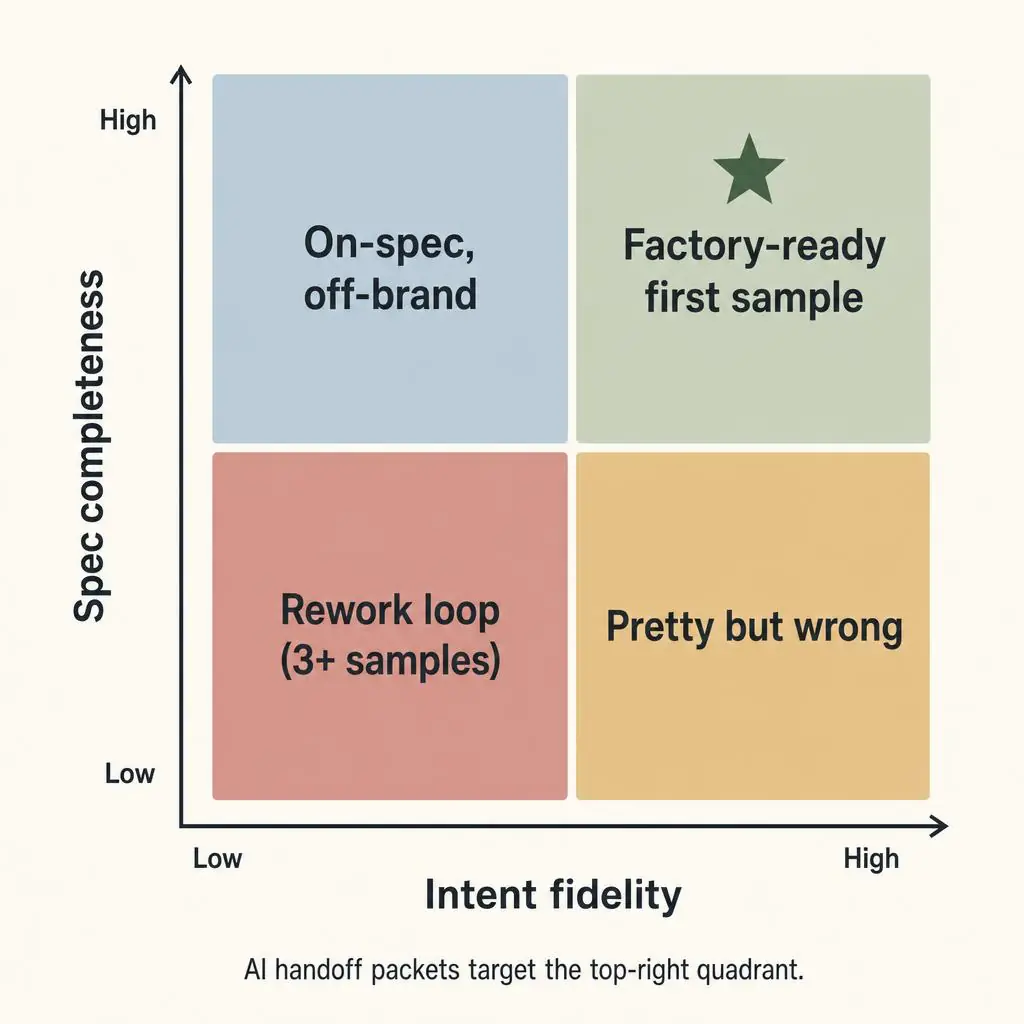
In the fashion design process, the transition from designer to tech designer and subsequently to the factory is critical. Traditional methods often lead to miscommunication and inefficiencies. Here, we compare the traditional handoff approach with the AI-driven method throughout six key dimensions to show the advantages of AI in ensuring a smoother workflow.

The AI fashion design handoff offers major improvements over traditional methods. By reducing the time and resources required to produce factory-ready tech packs, AI accelerates the design process and improves accuracy and communication. This shift allows fashion brands to scale operations efficiently while maintaining high-quality outputs, finally transforming the way fashion workflows are managed.
In the traditional fashion design process, it's common for brands to create multiple samples before finalizing a design. Each iteration can result in additional time and cost, often a major burden. By implementing an AI-driven fashion design handoff, brands can substantially reduce the number of samples needed.
Consider a typical scenario: a brand like Zara or H&M might require 5 to 7 samples to reach the final version of a garment. With an AI-improved workflow, such as The F* Word's solution, this can be reduced to as few as 2 to 3 samples. The precision of AI-generated tech packs ensures that the initial samples are closer to the desired final product, cutting down on unnecessary revisions.
For instance, if each sample costs approximately $500 and takes 2 weeks to produce, reducing from 6 samples to 3 saves $1,500 and 6 weeks per garment. Scale this throughout a collection of 50 garments, and the savings quickly escalate to $75,000 and 300 weeks of production time. This efficiency optimizes resources and accelerates time-to-market, a critical factor in fast fashion.
Key elements contributing to these savings include:
By integrating AI tech packs, brands are empowered to make informed decisions swiftly, ensuring that each sample produced is a step closer to the final product with minimal waste.
The handoff packet in AI fashion design is a critical component for ensuring the smooth transition of information from designers to tech designers and subsequently to factories. Assigning clear ownership using the RACI model (Responsible, Accountable, Consulted, Informed) can streamline this process. Typically, the primary responsibility lies with the tech designer, who is tasked with translating creative ideas into precise technical specifications.
In a typical fashion brand, the designer is often responsible for the initial concept and moodboard creation. The tech designer is accountable for converting these designs into detailed tech packs, ensuring eelement is factory-ready. For instance, at brands like Zara or H&M, the tech designers work closely with pattern makers and fabric specialists to ensure accuracy and feasibility.
Consultation is critical during this handoff. Product managers and merchandisers are usually consulted to match the tech packs with market trends and consumer demands. It's also essential to inform the supply chain managers and factory liaisons, who need to be aware of any updates or changes in the tech packs to prevent production delays.
Understanding who owns each part of the handoff packet is critical for efficiency. For more findings on AI-powered tech packs and workflow solutions, explore our detailed guide on AI Tech Packs.
The AI fashion design handoff process involves transitioning design concepts from the initial designer to a tech designer and then to the factory. The F* Word platform automates this workflow by generating moodboards and tech packs that are ready for factory production. This ensures that all design details are accurately communicated, minimizing errors and maintaining the integrity of the original design vision throughout the production process.
A designer focuses on the creative aspects of fashion, developing the initial concepts and aesthetics for a garment. A tech designer, on the other hand, is responsible for translating these creative ideas into technical specifications that can be understood by manufacturers. This includes creating detailed tech packs with measurements, construction details, and material specifications, ensuring that the design can be accurately produced.
The F* Word platform uses advanced AI algorithms to autonomously generate tech packs that are precise and factory-ready. By analyzing design inputs and incorporating industry standards, the platform creates full documentation that includes all necessary details for production. This reduces the risk of miscommunication and errors, ensuring that the final product meets the designer's expectations and quality standards.
Yes, The F* Word platform is designed to complement existing design workflows. It can easily be integrated with popular design tools used by fashion brands. This compatibility allows designers and tech designers to smoothly incorporate the platform into their existing processes, improving efficiency and reducing the time spent on manual documentation tasks.
Using The F* Word platform offers several benefits for fashion brands, including a major reduction in time spent on creating moodboards and tech packs. By automating these processes, brands can accelerate their production timelines, reduce errors, and maintain consistency in design communication. This finally leads to improved workflow efficiency, cost savings, and the ability to bring products to market faster while maintaining high quality standards.
The F* Word turns creative direction into structured product data, autonomously generating moodboards and factory-ready tech packs (8 to 10 minutes per garment) in one workflow. Start free at thefword.ai or book a demo. Related: the pillar overview.
Related: ai fashion design streetwear · Read the related article · Try The F* Word · AI colorway generation
Get The F* Word workflow insights in your inbox.