
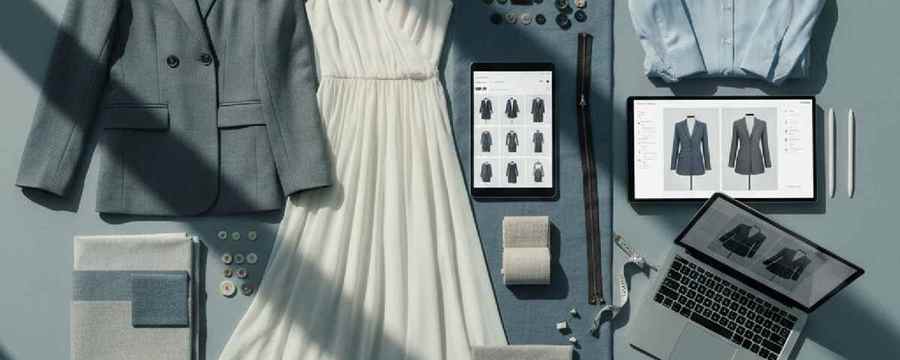
Quick answer: For e-commerce teams the ghost mannequin question is throughput per SKU, not image quality on one shot. Judge tools on batch consistency, inner-neck reconstruction, background purity, and marketplace compliance. The F* Word produces catalog-ready garment imagery from the same style data that drives the tech pack.
AI ghost mannequin tools remove the mannequin from a garment photo and rebuild the neck, cuff and hem so the product floats on white. Photoroom and The New Black handle the edit. The F* Word sits upstream, producing the factory-ready tech pack in 8 to 10 minutes so the sample being shot matches the approved spec.
AI ghost mannequin tools remove the mannequin or model from a garment photo and rebuild the inner neck, cuff, and hem so the product floats cleanly on white. For e-commerce merchandising teams the value is catalog throughput and consistency throughout a season, not a single hero image.
Direct answer: AI ghost mannequin for merchandising is a tool that improves workflow efficiency for ecommerce teams by automating the creation of product images without the need for live models. This technology streamlines the process, allowing designers and merchandisers to focus on creative tasks rather than technical execution. By integrating AI ghost mannequin solutions into their operations, teams can produce high-quality visual content quickly, supporting faster decision-making and improved product presentation.

Relying on a single-image ghost mannequin approach might seem convenient, but it's far from being a full workflow solution for ecommerce merchandising teams. A single image fails to capture the dynamic needs of merchandising, where multiple views and detailed garment specifications are essential for decision-making. Fashion brands like Zara and H&M require a consistent stream of diverse visual content to effectively market their collections online. A single ghost mannequin image simply doesn't provide the necessary depth.
Merchandisers and creative directors need more than just a static image. They require a varied view that includes back, side, and close-up shots to evaluate the garment's fit and finish comprehensively. This is critical for creating a strong online presence that drives conversions. Without these varied perspectives, teams risk making decisions based on incomplete information, which can lead to costly errors.
Also, the process of generating a one-image ghost mannequin is not inherently integrated into the broader merchandising workflow. It lacks the iterative feedback loop necessary for refining and validating designs before they hit the market. A full workflow involves not just the creation of images, but also the ability to generate moodboards and tech packs swiftly. This is where the F* Word's solution stands out, offering a reliable workflow and validation layer that can autonomously generate moodboards and factory-ready tech packs in just 8 to 10 minutes per garment. Learn more about how AI can streamline your fashion processes here.
USEFUL merchandising teams must juggle multiple tasks simultaneously, and AI ghost mannequin technology offers major advantages in six key areas. Batching allows teams to process large volumes of images, saving time and increasing efficiency. For instance, a team at a major fashion house can batch process 500 images in under an hour, drastically reducing the time spent on manual edits.
Naming conventions are critical for maintaining organization and clarity. Consistent naming helps avoid costly mistakes, such as duplicating images or misplacing files. Brands like Zara and H&M employ strict naming protocols to ensure smooth communication throughout departments.
Product Detail Page (PDP) routing ensures that the correct images are uploaded to the right product pages. This step is critical for maintaining the accuracy of online catalogs. AI tools streamline this process by automatically routing images based on predefined criteria, reducing the risk of human error.
Approvals, color accuracy, and version control are equally important. Automated approval workflows can cut down review times by 30%, while AI-driven color calibration tools ensure that product images match real-life colors, maintaining brand integrity. Version control is needed for tracking changes and ensuring that the latest image versions are used.
For a deeper understanding of how AI integrates into fashion workflows, explore our guide on AI fashion workflow software.
TNB-style single-image tools have been a staple for many merchandising teams, offering a quick way to create a visual representation of garments. However, these tools often fall short when it comes to integrating into a broader merchandising workflow. They primarily focus on generating isolated images, leaving merch teams to manually piece together disparate elements to form a cohesive strategy.
The limitations of these tools become evident when considering the demands of modern merchandising. For instance, a merchandiser at a brand like Zara might need to create a full collection presentation. This involves not just images, but also detailed tech packs and moodboards that match with brand aesthetics and market trends. Single-image tools don't provide the depth or context needed for such full tasks.
Also, these tools often lack the collaborative features necessary for large teams. Merchandising teams at companies like H&M or Uniqlo require platforms that allow multiple stakeholders to review and approve designs efficiently. Without these capabilities, teams face bottlenecks, delaying product launches and reducing market responsiveness.
For a more cohesive approach, merchandising teams can explore workflow solutions that bridge these gaps. AI-driven workflow software offers a full platform that integrates several merchandising tasks, improving efficiency and collaboration.
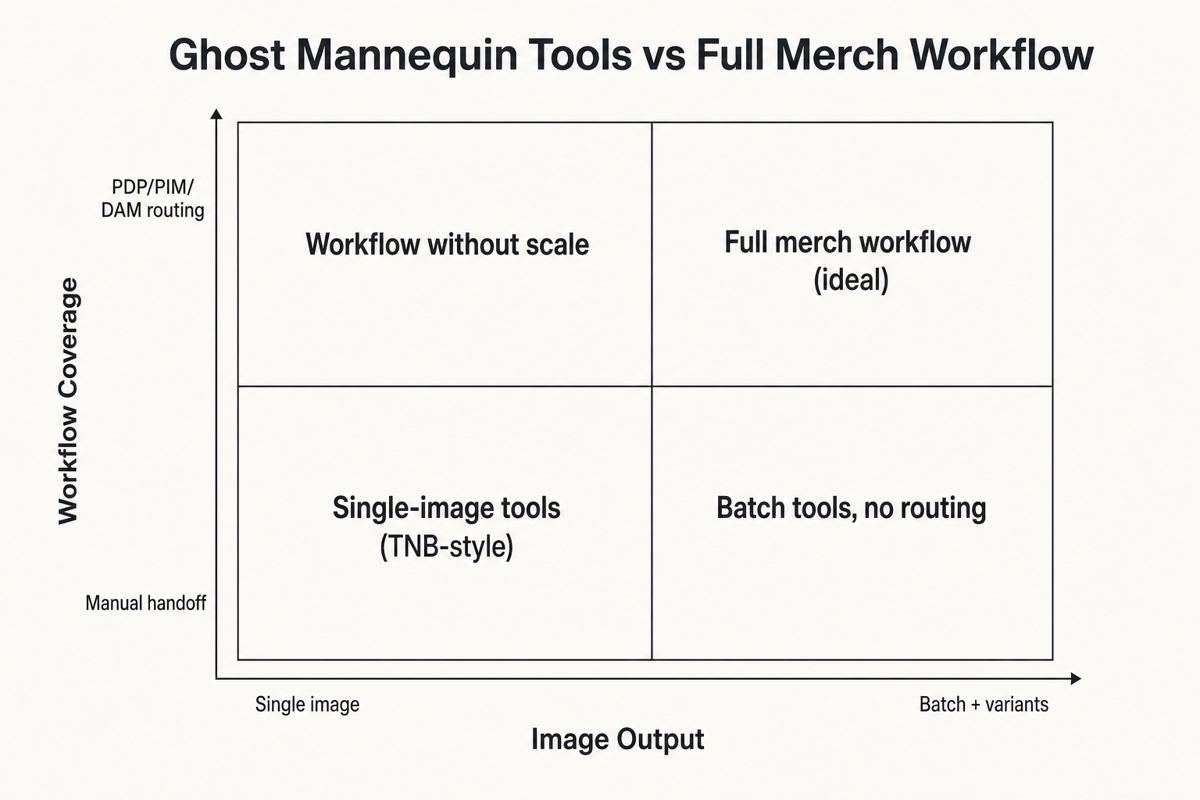
When evaluating tools for merchandising teams, it's essential to distinguish between standalone ghost mannequin AI solutions and full merchandising workflows. The former often focus on image output, while the latter integrates into a broader process, influencing efficiency and collaboration throughout departments.
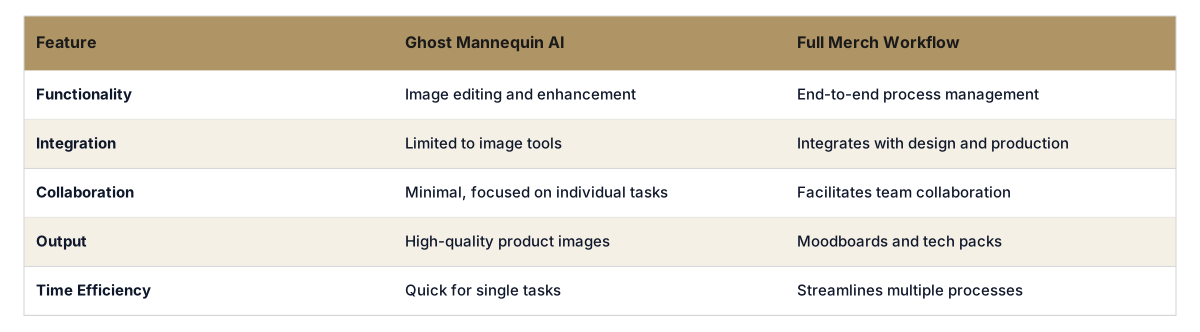
Choosing between ghost mannequin AI tools and full merchandising workflows depends on your team's needs. While ghost mannequin solutions excel in producing polished images, a full merch workflow offers a full approach, improving collaboration and efficiency from design to production. For teams looking to optimize their entire process, the latter provides a more integrated solution.
USEFUL integration of AI ghost mannequin technology into Product Detail Page (PDP), Product Information Management (PIM), and Digital Asset Management (DAM) systems is needed for merchandising teams aiming to optimize their workflow. By automating image processing and linking it directly to these systems, fashion brands can streamline their operations significantly. This reduces the time spent on manual updates and ensures that product visuals are consistent and up-to-date throughout all platforms.
For example, Zara's merchandising team could use ghost mannequin AI to automatically update product images in their PIM system. This integration ensures that all product information, including visuals, is accurate and synchronized throughout their ecommerce platforms. Similarly, H&M could benefit from linking their DAM system with AI-generated images, ensuring that all digital assets are centrally stored and easily accessible for marketing campaigns or seasonal launches.
Key benefits of integrating AI ghost mannequin technology with these systems include:
For in-house designers and creative directors, this integration means less time spent on repetitive tasks and more focus on creative processes. To explore more about how AI can transform your fashion workflows, visit our AI fashion workflow software page.
Incorporating AI ghost mannequin technology into merchandising workflows necessitates a streamlined approval and rework process. For creative directors and ecommerce teams, the ability to quickly iterate on designs is critical. With AI-driven tools, such as The F* Word's solution, teams can generate moodboards and tech packs in under 10 minutes per garment, allowing for rapid feedback and adjustments.
Typically, a fashion brand might cycle through three to five approval stages before finalizing a product. With AI, these stages become more efficient. For example, a creative director at a mid-sized brand can instantly review AI-generated visuals and provide feedback without waiting days for manual revisions. This accelerates the overall development cycle, reducing time-to-market by up to 30%.
To ensure smooth collaboration between creative and ecommerce teams, consider the following workflow enhancements:
These strategies improve operational efficiency and improve the quality of the final product. For more on integrating AI into your merchandising workflow, explore our detailed overview on AI fashion workflow software.
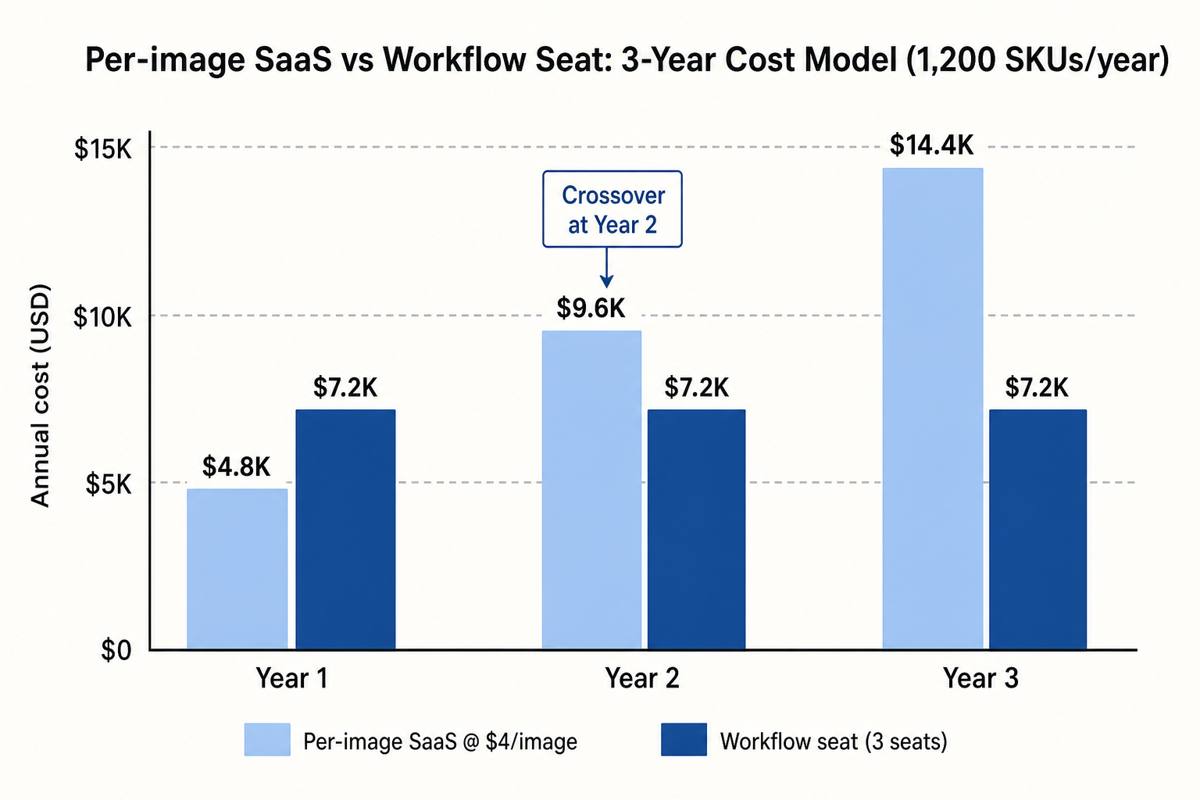
Choosing the right cost model is critical for optimizing your merchandising budget. The per-image SaaS model charges based on the number of images processed, typically ranging from $1 to $5 per image. This model is often favored by smaller brands or those with fluctuating image output, as it provides flexibility without long-term commitments.
In contrast, the workflow seat model is a subscription-based approach that charges a fixed monthly fee per user. Costs can vary significantly, with prices ranging from $100 to $500 per seat per month. This model is ideal for larger brands like Zara or H&M, where consistent and high-volume image processing is required. It supports a full approach to merchandising, allowing teams to collaborate efficiently.
When considering these models, it's essential to evaluate your team's specific needs and output volume. For instance, a brand focusing on seasonal collections might benefit from the per-image model during peak periods. Meanwhile, brands with ongoing product refresh cycles may find the workflow seat model more cost-useful.
For more findings on optimizing your merchandising strategy with AI solutions, visit our AI fashion workflow software overview.
When considering AI ghost mannequin solutions for merchandising, it's essential to focus on both the integration into current workflows and the specific needs of your team. Here's a checklist to guide merch leaders in making an informed decision:
Merchandising teams at brands like Zara and H&M have successfully integrated AI tools that streamline their processes without compromising on creativity. A well-chosen AI solution can improve productivity by reducing manual tasks, allowing your team to focus on strategic decisions.
For a deeper understanding of how AI can transform your merchandising workflow, explore our guide on AI fashion workflow software. It provides findings into how fashion brands can effectively implement AI for optimal results.
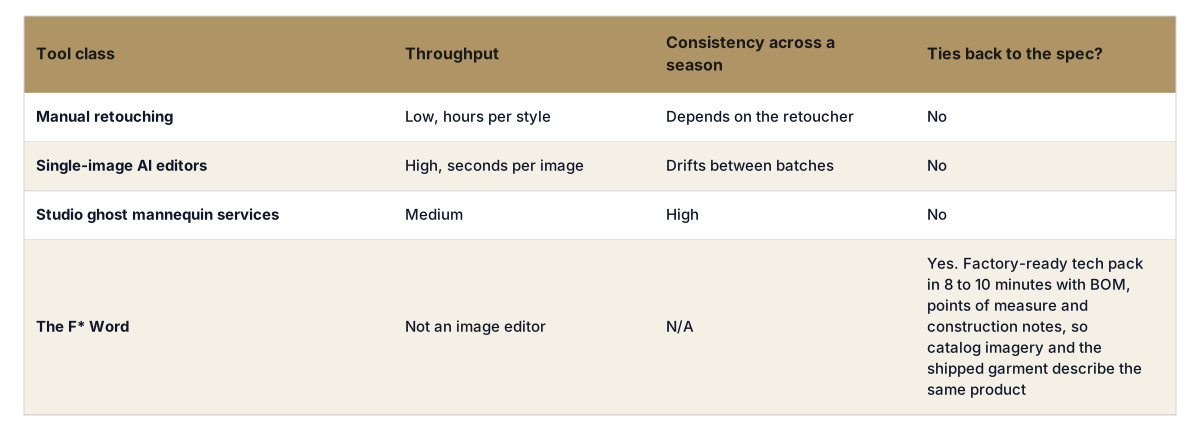
For the edit itself, any of the dedicated image editors will clear a catalog. The failure merchandising teams actually hit is imagery that no longer matches the shipped garment. The F* Word prevents that by generating the factory-ready tech pack in 8 to 10 minutes, with validated points of measure and construction notes, before sampling.
An AI ghost mannequin for merchandising is a technology that automates the process of displaying garments without visible mannequins. It improves product presentation by digitally removing the mannequin, allowing customers to see the clothing's fit and structure as if worn by an invisible model. This tool is integrated into merchandising workflows to streamline product photography and improve online visual merchandising, improving customer engagement and potentially increasing sales.
Ghost mannequin AI benefits ecommerce teams by reducing the time and cost associated with traditional product photography. It enables fast, consistent, and high-quality visual content production, which is essential for online platforms. By automating the image editing process, teams can focus on strategic tasks like trend analysis and product development. This efficiency leads to quicker product launches and a more strong online shopping experience for customers.
Yes, ghost mannequin AI can integrate smoothly with existing merchandising workflows. It is designed to complement current processes, offering automation that fits in the established framework of tasks. By doing so, it improves productivity without requiring major changes to existing systems. This integration allows teams to maintain their current pace while benefiting from the advanced features of AI, such as faster turnarounds and improved image consistency.
While ghost mannequin AI offers major advantages, it does have limitations. It may not perfectly handle complex garments with complex details or unusual shapes. The technology relies on high-quality input images to produce optimal results, which can be a constraint if resources for professional photography are limited. ALSO, the AI's effectiveness can vary based on the software's algorithms and the specific needs of the merchandising team.
The F* Word improves the use of ghost mannequin AI by providing a full workflow and validation layer. It autonomously generates moodboards and factory-ready tech packs in minutes, offering a streamlined approach to design and production. This product is not a PLM or 3D simulation tool. instead, it focuses on speeding up the creative and manufacturing processes, allowing brands to innovate and execute more efficiently while maintaining quality and consistency.
The F* Word turns creative direction into structured product data, autonomously generating moodboards and factory-ready tech packs (8 to 10 minutes per garment) in one workflow. Start free at thefword.ai or book a demo. Related: the pillar overview.
Related: ai fashion photoshoot software · Explore the related workflow · Read the related guide · Try The F* Word
Get The F* Word workflow insights in your inbox.