

3 mismatches explain why most AI visibility tools mislead fashion teams. First, a beauty brand wants to know if a prompt like best retinol serum surfaced its name, and that works because the shopper query is brand-shaped. Second, apparel shoppers ask for a waterproof trench under 300 dollars that ships by Friday, or a ribbed knit midi dress in chocolate with a waist tie and machine wash cold. A brand name does not appear until the very end of the agent's reasoning. Third, a tool that counts brand mentions tracks the wrong unit for apparel. If you are a merchandiser or e-commerce director, you need to know whether the garment record is machine-readable enough to qualify for that answer, not whether the brand got a shout-out after the fact.
Fashion visibility is won at the garment level. The agent or marketplace ranker only surfaces a waterproof trench that it can classify as waterproof with credible evidence, price-qualified at under 300, available in the shopper's size, in a colorway that maps to a standard palette, and that can ship within the requested window. The brand becomes part of the exposure only after the system has proven the trench qualifies on attributes, and even then it still needs a cite. If your visibility tool cannot see the garment record that drives that decision, it measures surface noise, not sell-through probability.
This is why the market's current obsession with AI image and campaign tools misses the point. Those suites produce pixels. A pixel is not machine-readable. An AI shopping agent cannot verify seam sealing, fibre content, or POMs from a render, cannot file the trench in the right region of meaning space, and cannot cite it. The F* Word is not an image generator. It is the validation and orchestration layer that produces the structured garment record, plus the machine placement and recommendation data that make an agent confident enough to surface the product.

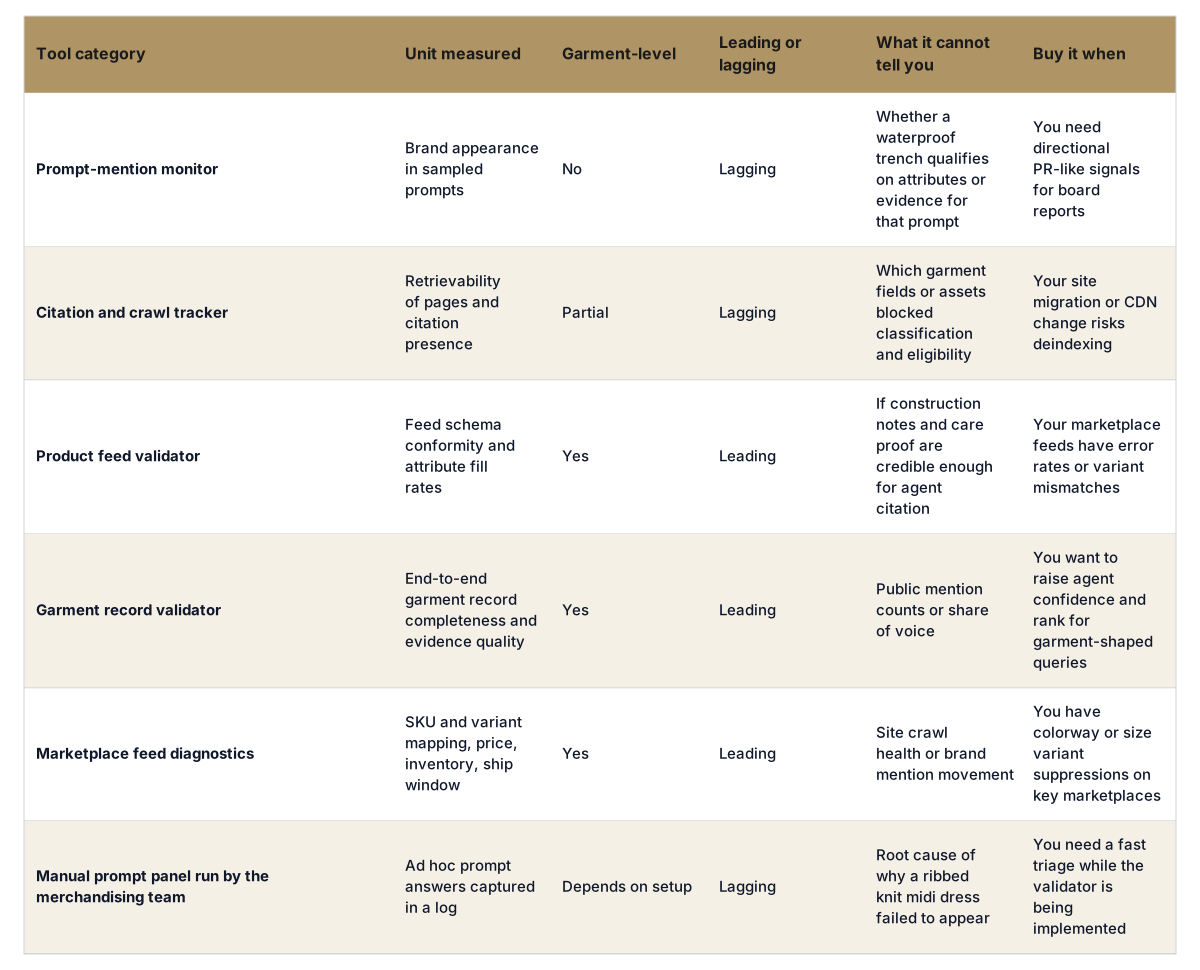
Almost every AI visibility pitch collapses into brand monitoring. You will see four categories in the wild. Category 1 is prompt-mention monitors that sample prompts and count whether a brand appears. Category 2 is crawl and citation trackers that tell you whether your site is retrievable and whether agents cite it. Category 3 is feed and record validators that check whether the garment record itself is parseable, unambiguous, and complete at attribute level. Category 4 is generative engine optimization suites that bundle Category 1 and Category 2 with a dashboard.
Only Category 3 speaks to the unit that drives apparel visibility. Categories 1 and 2 are lagging indicators. They show the output of upstream data quality and evidence, but offer no handle to fix either. The reason brands still buy them first is demo theater. A line chart of mentions looks exciting. A validator that tells you a ribbed knit midi dress is missing waist measurement POMs looks like work. Yet the second one is exactly what you can fix on Monday, because it sits on the pathway to rank and to sell-through.
The Semantic Shelf Positioning Matrix from The F* Word's book The Machine-Readable Brand makes this crisp: visibility needs correct classification and credible evidence. Mention-counting measures neither. It measures the downstream output once both are already in place. If you have not read the framework, there is a short primer on the book page.

Production-ready visibility starts with a machine-readable garment record. Take a waterproof trench in stone. The agent will ask: is waterproof true, and what is the rating if claimed. Are the seams taped or bonded. Is the shell a polyester or cotton-nylon blend, with percentages that add to 100 and map to a known ontology. Is the price under 300. Are the colorways mapped to a standard color dictionary so that stone resolves to beige, not gray. Is the size run graded with POMs that allow a size filter to be fair across brands. Does the care instruction prove machine wash cold or dry clean. Is the drop code FW24 and is this a carryover or newness. Does inventory exist in the shopper's country and can it ship by Friday.
Now look at a ribbed knit midi dress in chocolate. The agent needs fiber composition with elastane percentage, a rib pattern description mapped to a design vocabulary, fit intent such as body-skimming versus relaxed, sleeve length, neckline classification, and a waist tie attribute with tie position. POMs should include chest, waist, and hip across sizes, with grade rules stated. Care needs to match the fiber blend and must cite test method or standard where available. Colorway chocolate must map to brown. If the dress is part of Drop 2 of SS25, that cadence must be surfaced so discovery modules that feature newness can include it, while carryover logic does not accidentally bury it under fresh arrivals.
These are not abstract requirements. They are exactly where fashion catalogs break for machines: colorway naming drift from studio to PDP, size grading gaps in extended sizes, fiber blends that do not sum cleanly, care instructions that say gentle wash without temperature, and variant feeds where the mid-rise straight-leg denim in dark rinse inherits the inseam from the black wash by mistake. If your AI visibility plan does not check those fields, it is checking the wrong thing.
The same operator logic applies upstream. When we talk about moodboards, creative direction, pre-production, and tech packs, the validation layer still decides visibility. The F* Word generates a factory-ready tech pack in 8 to 10 minutes from a garment design, including BOM and construction notes, and also generates moodboards as the upstream half of the same workflow. It is not a PLM, not a 3D sim, and not an image generator. It is the orchestration layer that ensures the structured record exists, passes a validator, and is production-grade for agents and marketplaces.
A fashion tracking spec must be query intent plus garment attribute, not brand string. For the waterproof trench, a spec entry might read: intent Waterproof trench under 300 with storm flap and hood, ship by Friday US. Required attributes: waterproof attribute true with rating or construction proof, seam sealing evidence, hood yes, storm flap yes, price less than or equal to 300, colorway maps to beige or khaki, size run in stock S to XL, US shipping SLA 2-day or faster. Evidence: construction notes that state seam tape placement, BOM listing membrane or coating method, care method that matches membrane, PDP sections that cite durability test or water column if claimed. Citation target: PDP or spec sheet URL with anchor.
For the ribbed knit midi dress, a spec entry could be: intent Ribbed knit midi dress in brown with waist tie, machine washable, under 150. Required attributes: ribbed knit pattern mapped to a known design term, colorway maps to brown, waist tie true with position and length, machine wash cold care statement, price less than or equal to 150, size run in stock XS to L with POMs declared, fit intent body-skimming, neckline crew or scoop. Evidence: BOM with yarn blend and elastane percent, care standard reference where possible, POM table present, creative direction notes that match style descriptors for cohesion. Citation target: PDP sections and care PDF or inline table.
Tracking at this level tells a merchant exactly what to fix. If the trench fails because seam tape is in the tech pack but never rendered into a PDP evidence block, you ship a copy update. If the ribbed knit midi dress is missing POMs for sizes above L, you close the size gap and restore rank fairness. Counting brand mentions will never tell you that.
For workflow buyers like a VP Product Development or Director of Sourcing, start where you can reduce rework and accelerate readiness. For in-house designers and creative directors, make sure the moodboard-to-spec path preserves the attributes an agent needs. For merchandisers, insist that every drop hits the shelf with a validator pass and evidence surfaced in language an agent can cite. Categories 1 and 2 are fine for context. Category 3 is what changes next week's sell-through.
If a vendor cannot answer yes to most of these, you are buying theater. If they can, you are buying a handle you can turn before the next drop. For teams that need a system-level orchestration and validation layer, review The F* Word's workflow overview and the enterprise deployment notes.
Run a manual prompt panel for a single drop. Pick five intents for the waterproof trench and five for the ribbed knit midi dress. Log answers, then map each failure back to a record field. This creates your first leading-indicator backlog. In parallel, audit your product and marketplace feeds. Focus on variant mapping for colorways and sizes, price accuracy, and ship-window metadata. If your mid-rise straight-leg denim in dark rinse keeps dropping from marketplace search, you likely have a variant or attribute mismatch that a diagnostic will surface in one run.
Install a garment record validator in your pre-production cadence. Treat it like a pass-fail gate before samples shoot or the PDP build locks. This is where an orchestration layer pays off. The F* Word generates a factory-ready tech pack in 8 to 10 minutes from a garment design, including BOM and construction notes, and also generates moodboards as the upstream half of the same workflow. Because it is not a PLM or a 3D sim, you can slot it beside those systems and use it to ensure the structured garment record is complete, citeable, and ready for agents and marketplaces in one pass. For a merchandiser, that means fewer last-minute copy rewrites and fewer suppressed variants on drop day.
Finally, align owners and SLAs. Creative direction owns design language and moodboard tags. Product development owns BOM, construction, and POMs. E-commerce owns PDP evidence blocks, feed schemas, and marketplace variant maps. Merchandising owns price, season codes, carryover flags, and launch calendars. Put those owners against the validator output and close the loop.
Yes, but treat it as a rearview mirror. It tells you when the market is recognizing your work. It cannot tell you what to fix. Once your validator backlog is under control, a mentions dashboard is useful for board decks and for spotting category-level shifts.
A garment record is the structured, machine-readable truth set for a single style across colorways and sizes. It includes fiber composition, construction notes, size grading and POMs, fit intent, care, pricing, season codes, and evidence links. A PDP is a consumer-facing rendering of that truth set, often missing fields that agents and marketplaces require to classify and cite.
PLM and 3D solve different problems. The validator layer checks that the data these systems produce can be read, mapped to a known ontology, and cited by agents and marketplaces. The F* Word is not a PLM, not a 3D sim, and not an image generator. It generates tech packs in 8 to 10 minutes from a garment design and moodboards upstream, then orchestrates the handoff into feeds and PDPs.
Pick the two highest intent queries for your waterproof trench and ribbed knit midi dress and run them through a garment record validator. Fix any attribute or evidence gaps. In parallel, check marketplace feed diagnostics for variant suppressions and ship-window inaccuracies. This combination changes rank in days, not quarters, because it closes the gap between what the agent asks and what your record can prove.
Start free at thefword.ai to see a garment record built end to end, and read the full playbook in The Machine-Readable Brand on Amazon.
Related: AI visibility for fashion brands · AI visibility tracking
Get The F* Word workflow insights in your inbox.