

An apparel design agency should run each client through a separate, repeatable workflow: trend validation, moodboard and brief, approval, tech pack development, and factory handoff. Keep brand rules, versions, and decisions explicit. The F* Word supports moodboards, briefs, and editable, factory-ready tech packs in 8 to 10 minutes. Brands using it report 75% fewer physical samples.
For an agency or private-label studio, the operating challenge is not simply producing more designs. It is keeping each client's intent intact as work moves between account managers, creatives, technical designers, and factories. A shared production process should make those transitions clearer without making the brands look alike.
When brand knowledge lives mainly with an account lead, everyone else has to reconstruct it from old presentations and messages. Replace that dependency with an approved brand reference covering customer, assortment role, fit intent, materials, construction preferences, and visual boundaries. Treat it as an input to every project, not background reading.
A moodboard in a presentation, a revised brief in email, and a specification in a shared folder can represent different decisions. Define an authoritative location for each deliverable. Label its client, collection, style, revision, and status so the team can distinguish a proposal from an approved factory instruction.
Separate creative approval from technical review. A client choosing between silhouettes needs a different review than a technical designer checking measurements or construction notes. If both happen in the same conversation, preferences can become production instructions before anyone has assessed their implications.
Require feedback to name the affected deliverable and requested change. "Make it more premium" should trigger clarification about material, finish, proportion, or construction, rather than an unrecorded interpretation passed to the factory.
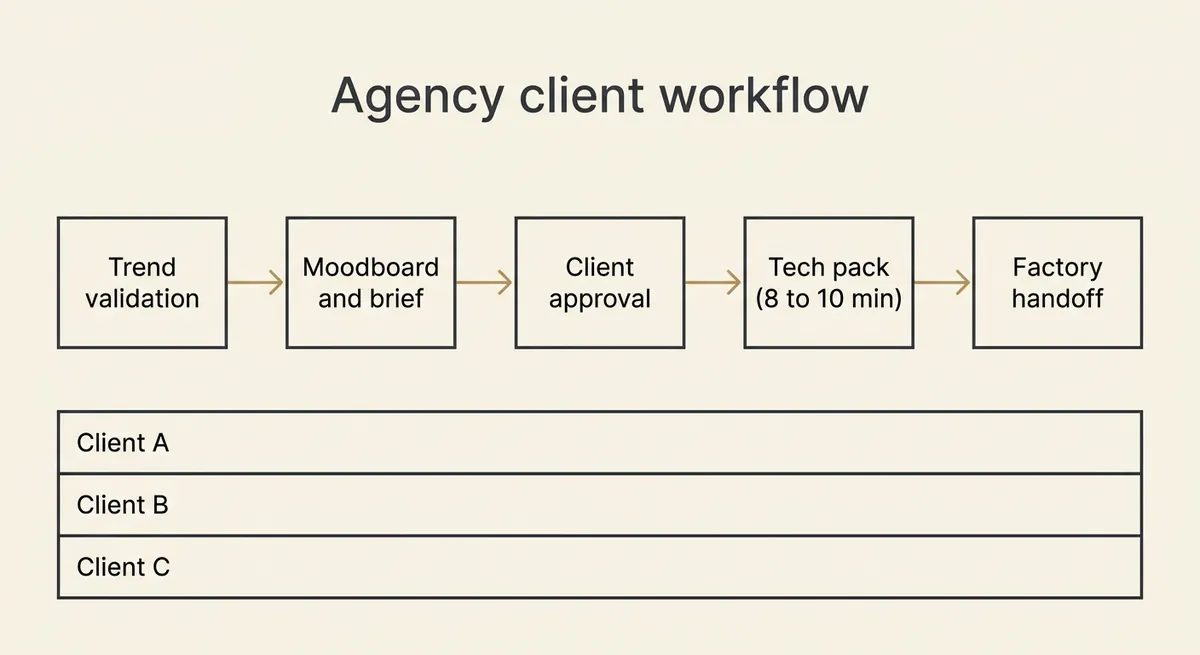
Use the same stage gates for all clients, but set inputs and acceptance criteria to suit each brand. You need a repeatable decision process rather than a repeated aesthetic. Assign an owner to each gate so someone takes charge. Each gate also needs a deliverable you can review and a clear condition for moving forward.
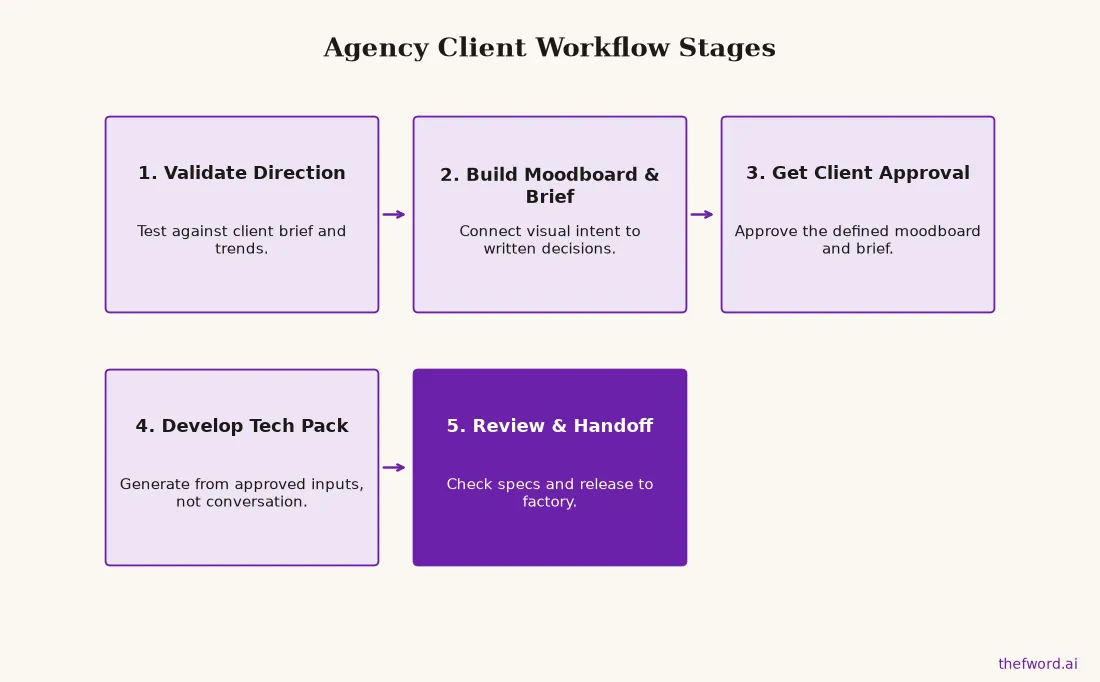
Start with the intended customer, category, collection purpose, commercial constraints, and delivery requirements. Use trend analysis and validation to test whether a direction belongs in that client's range. Distinguish an interesting reference from a direction the client has actually agreed to develop.
For private-label work, use private-label fashion trend intelligence as a starting point for organizing those questions. Record why a direction fits the brief and which assumptions still require client input.
The moodboard should communicate visual intent. The brief should translate that intent into decisions. Identify silhouette, palette, fabric direction, details, and exclusions. A reference image should have an explained purpose, so reviewers know whether it represents shape, texture, styling, or construction.
Use a consistent fashion design brief template to capture the written decisions. For tool selection, review AI moodboard tools for fashion designers against your team's need to explain and approve direction, rather than presentation appearance alone.
Ask the client to approve a defined moodboard and brief revision. Record outstanding questions separately. If fabric selection remains provisional, for example, do not present the entire style as fully resolved. Clarify which technical work can proceed and which decisions depend on that selection.
After approval, classify requests as corrections, clarifications, or scope changes. This gives account managers a basis for discussing schedule and fees without asking technical designers to negotiate commercial terms during production work.
Develop the tech pack from the approved inputs. Check points of measure, bill of materials, grading, tolerances, and construction notes against the brief. Assign a technical reviewer to resolve contradictions and confirm that the pack communicates the intended garment.
At handoff, identify the released revision, unresolved questions, and the person responsible for factory replies. Keep later changes attached to the relevant style and revision. A factory question should result in a documented answer, not a second, unofficial set of instructions.
Standardize the process while separating client content. An agency can reuse a checklist or document structure without reusing another client's design direction, fit assumptions, or confidential instructions. Make that distinction explicit during onboarding and internal reviews.
Do not assume that a familiar silhouette can inherit another brand's specifications. Require the team to confirm fit, materials, grading, and construction for the current client. Reuse the method of checking, not unverified product decisions.
Pro includes team collaboration and a private tenant. Fit those features into your agency's own client-separation rules, and confirm the access and confidentiality controls you need before you organize client work, since a private tenant alone does not prove any specific client-level permission setup.
Organize responsibilities around decisions rather than document ownership alone. The creative lead should own direction, the technical designer should own specification review, and the account lead should own client approvals and scope. In a smaller studio, one person may hold several roles, but the checkpoints should remain distinct.
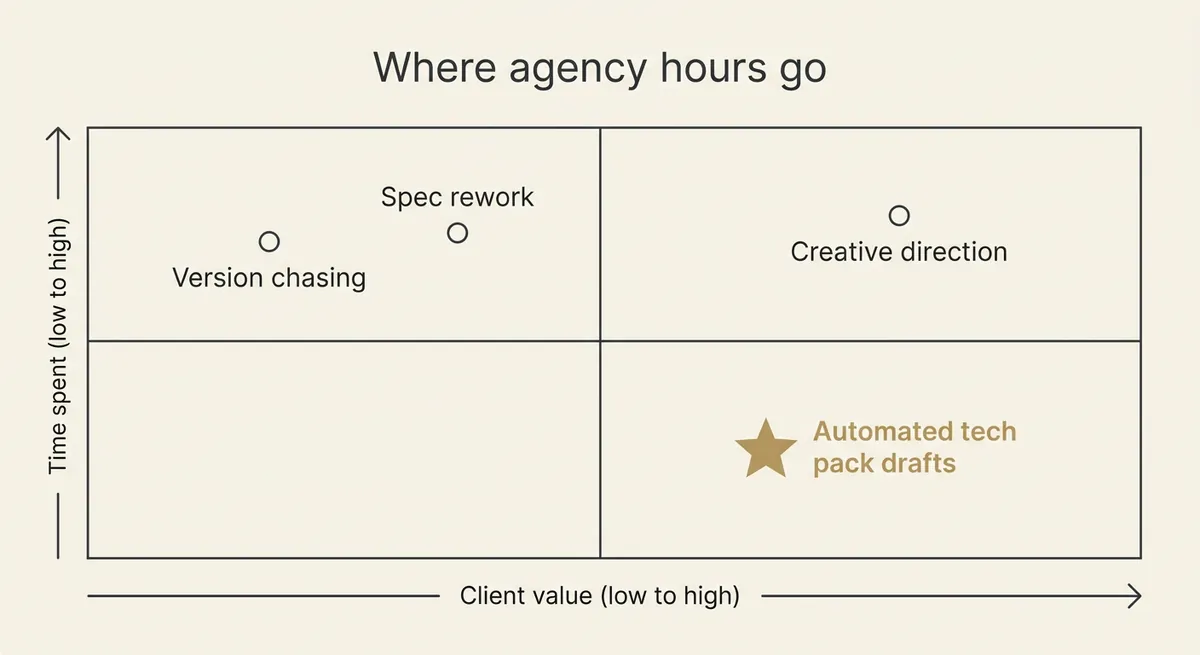
When routine preparation takes less effort, choose deliberately where the recovered capacity goes. It could support more styles, closer technical review, or better client communication. Do not automatically translate faster document generation into an equally shorter end-to-end delivery promise.
Describe what the engagement includes: direction development, approval gates, technical preparation, review, and factory clarification. Specify what happens when a client changes the approved silhouette or material direction. Depending on the agreement, additional work can be billed per style, through revision fees, or as a separate scope.
Track where staff effort actually goes. Distinguish time spent preparing deliverables from time spent waiting for approval, resolving contradictory feedback, or revisiting approved decisions. This creates a practical basis for staffing and pricing discussions without assuming that every revision has the same cost.
For agencies coordinating external technical designers, define who consolidates feedback. A single, agreed revision list is preferable to asking a freelancer to reconcile competing instructions from several stakeholders.
The F* Word is AI workflow software for fashion brands. It generates AI moodboards and creative briefs, supports trend analysis and validation, and produces editable, factory-ready tech packs from a sketch, photo, or brief in 8 to 10 minutes.
Those tech packs include points of measure, bill of materials, grading, tolerances, and construction notes. For an agency, the practical placement is after direction has been clarified and before the factory handoff review. Explore AI tech packs with that distinction in mind: generation creates the deliverable. Your workflow assigns approval responsibility.
Use the broader creative direction workflow for fashion brands to connect early direction to technical development. Avoid running moodboards and specifications as disconnected services when both are meant to express the same client decision.
The F* Word works before or alongside PLM. It is not a PLM or an image generator. Where a client already uses PLM, agree how approved information will enter that system rather than assuming an automated connection or a replacement for existing records.
Brands using The F* Word report 75% fewer physical samples. Treat that as a reported outcome, not a guaranteed reduction for every agency engagement. Retain the technical checks and physical validation appropriate to the garment and client.
Pro includes team collaboration, a private tenant, priority generation, and 3,600 credits per month. At the introductory $299/month price, about 31 Trend-to-Tech-Pack workflows put Pro at about $10 per factory-ready tech pack, making it worth evaluating for recurring client development. Compare plans
Use this comparison as a purchasing checklist. For service providers and existing systems, confirm deliverables and terms directly rather than assuming standard turnaround, revision allowances, or file formats.
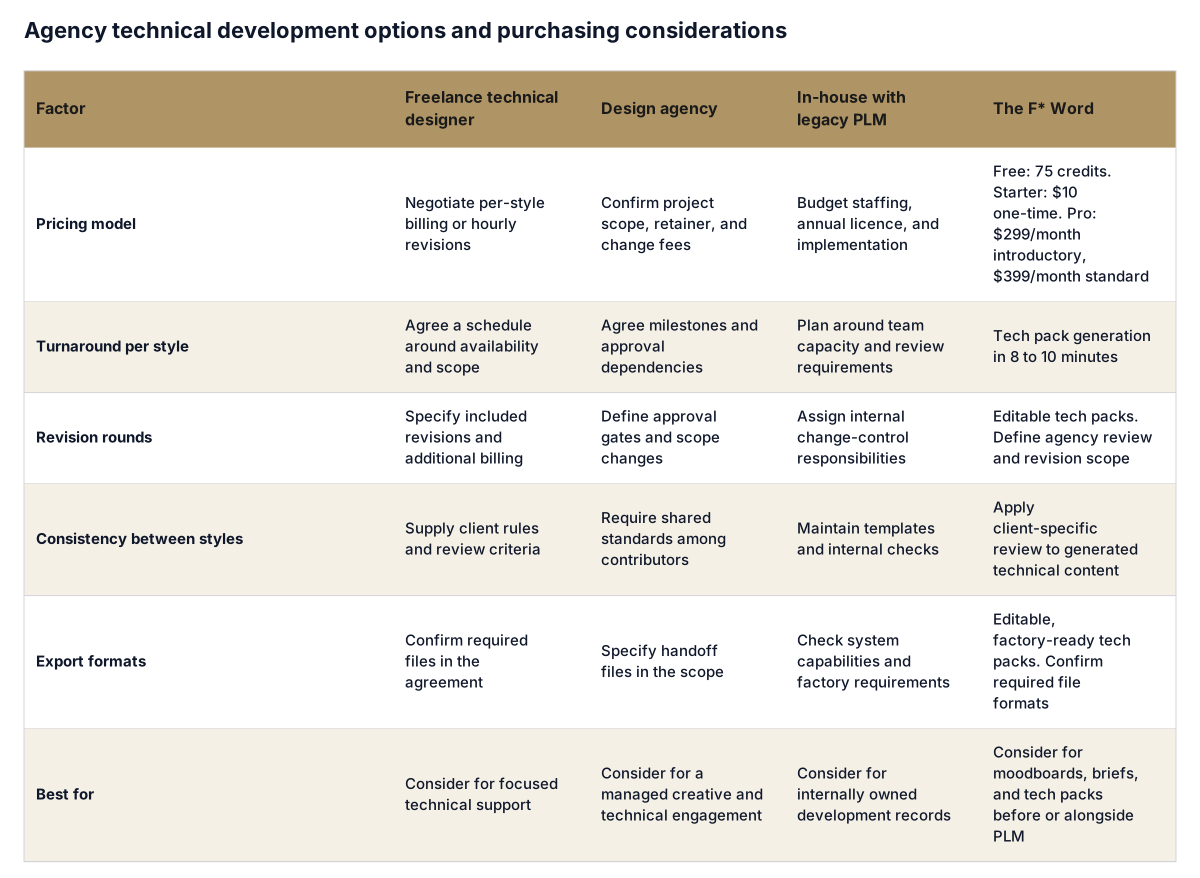
The F* Word helps you create moodboards and creative briefs, analyze and validate trends, and edit tech packs. Pro adds team collaboration and a private tenant. Use these tools in a process built for each client, and check access needs before you decide where confidential work belongs.
Approve the moodboard and brief first, with unresolved decisions clearly marked. Then generate and technically review the pack. If the client changes the approved direction, record the change and assess its effect on specifications, scope, and handoff timing.
Pro provides 3,600 credits per month. A Trend-to-Tech-Pack workflow uses 115 credits, giving about 31 workflows monthly. At the introductory $299/month price, that is roughly $10 per factory-ready tech pack. Budget staff review, client approvals, and other project work separately.
Related: AI fashion design consistency · AI roi in fashion design
Get The F* Word workflow insights in your inbox.