

48 hours is the window that decides whether a private label wins a trend or buys someone else's leftover demand. In that window the only deliverable that matters is a supplier-ready brief that turns a live market signal into yarn, fit, and lead time without rework. AI fashion trend intelligence exists to create that brief and to do it before national brands mobilize their lines.

Retail teams do not lack signals. Feeds, dashboards, and moodboards capture what is moving. What separates high-performing private label programs is the cadence from signal to supplier clarity. Execution intelligence compresses discovery, design, validation, and pre-production into one synchronized workflow where the output includes a purchase-order-ready spec with a clear ask for the factory.
For operators, this is not a romantic story about taste. It is a series of timestamps. Signal timestamp. Brief timestamp. Proto approval timestamp. If your timestamps beat the market by one to two weeks, unit economics look different. If they slip, your best creative call becomes an aged buy.
AI fashion trend intelligence is not just more listening. It links a demand spike to pre-qualified construction, trims, grade rules, and test requirements so a supplier can quote fast and cut waste. The result is fewer emails, fewer RFQs, and fewer samples you never ship. See the difference in practice in real-time fashion trend intelligence and why we call it execution intelligence, not a new wrapper on old trend forecasting.
Popular framing says speed comes from better trend detection. Teams then add another dashboard on top of Pinterest, TikTok, and sell-through data, but the production calendar does not budge. The bottleneck sits in the brief. It is the translation from "crochet bolero is spiking" to a supplier instruction that locks yarn count, gauge, tolerance tables, and a fallback trim set in case a component goes on back order.
Three personas feel the drag in different ways:
The fix is not another moodboard. The fix is a brief that suppliers can price today. That requires a live signal mapped to material availability, factory capability, fit block libraries, MOQ constraints, and a lead time bracket. When AI adds discipline to that mapping, the calendar shifts. For a deeper look at signal quality and speed, review hashtag-velocity as a fashion trend signal and how it connects to SKU decisions.
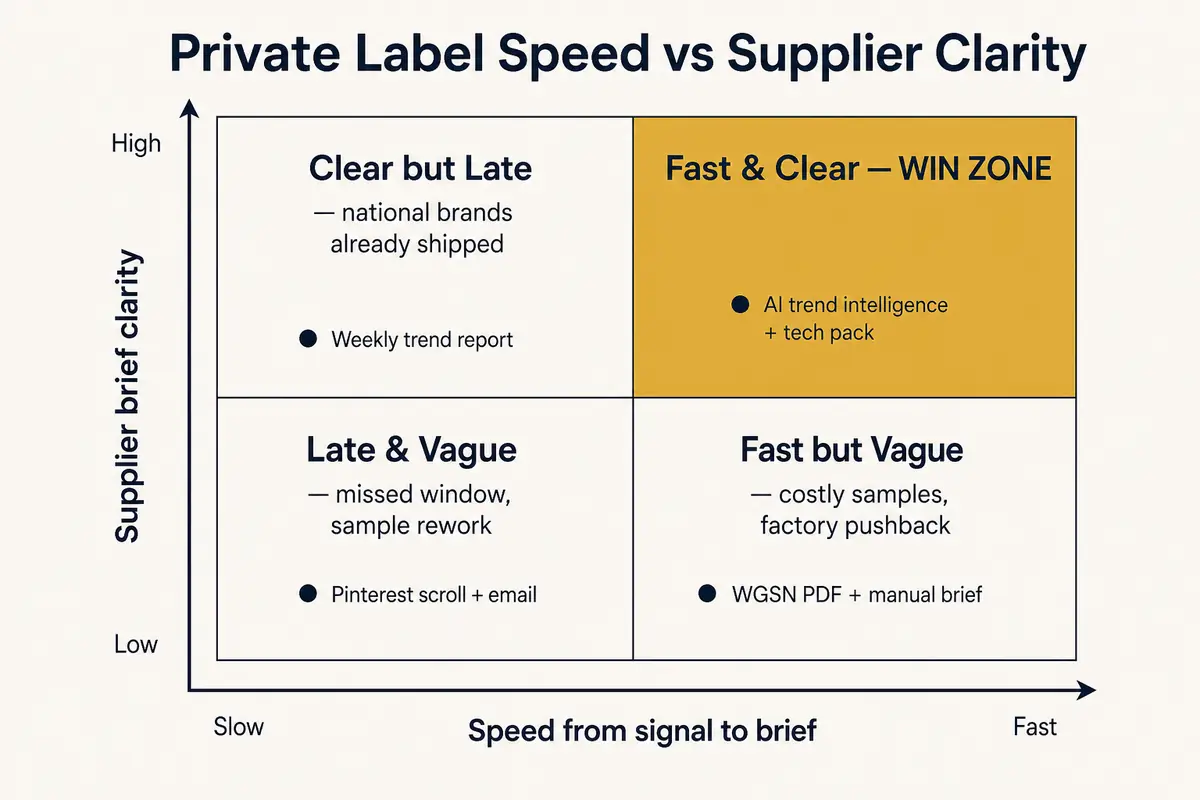
Private label win zone: fast signal-to-brief speed combined with high supplier-brief clarity.
Trend signal to supplier brief requirements.

A supplier-ready brief has five layers that remove guesswork:
This is where operators use AI for execution intelligence. The F* Word converts a garment design into a factory-ready tech pack in 8 to 10 minutes, including BOM and construction notes, then routes that spec into supplier briefs without retyping. Upstream, the same workflow generates moodboards tied to live signals, so creative direction and pre-production stay synced. The F* Word is not a PLM, not a 3D sim, and not an image generator. It is the validation and orchestration layer that connects AI fashion trend intelligence to your design room and your vendor matrix.
Merch teams get the buy math matched to the brief. Sourcing gets quoteable specs with fewer clarifying emails. Designers keep control of the hand and the fit while offloading repetitive spec work. This is the shape of production-ready in private label: decisions that travel intact from the trend to the cutting table.
Private label teams that win fast cycles use a common decision framework throughout categories. The inputs are simple: signal strength, lead time bracket, fabric availability, and margin floor. The outputs are three paths: kill, test, scale.
Two tools raise the hit rate. First, treat merch launch workflow as a partner to the brief. Slot the brief into a calendar that includes photography, PDP readiness, and store ops. Second, build your signal inputs into a pipeline with thresholds that trigger action. See how to build an AI fashion trend pipeline, including the use of hashtag-velocity to set go-or-no-go gates. For product category nuance, match with AI fashion trend analysis on core vs chase styles and the acceptable volatility per tier.
Finally, compare tool stacks with a clean lens. If a platform cannot output supplier-ready specs and route them to vendors, it is a research tool. Research matters, but it is not where time-to-market is won. Execution intelligence is.
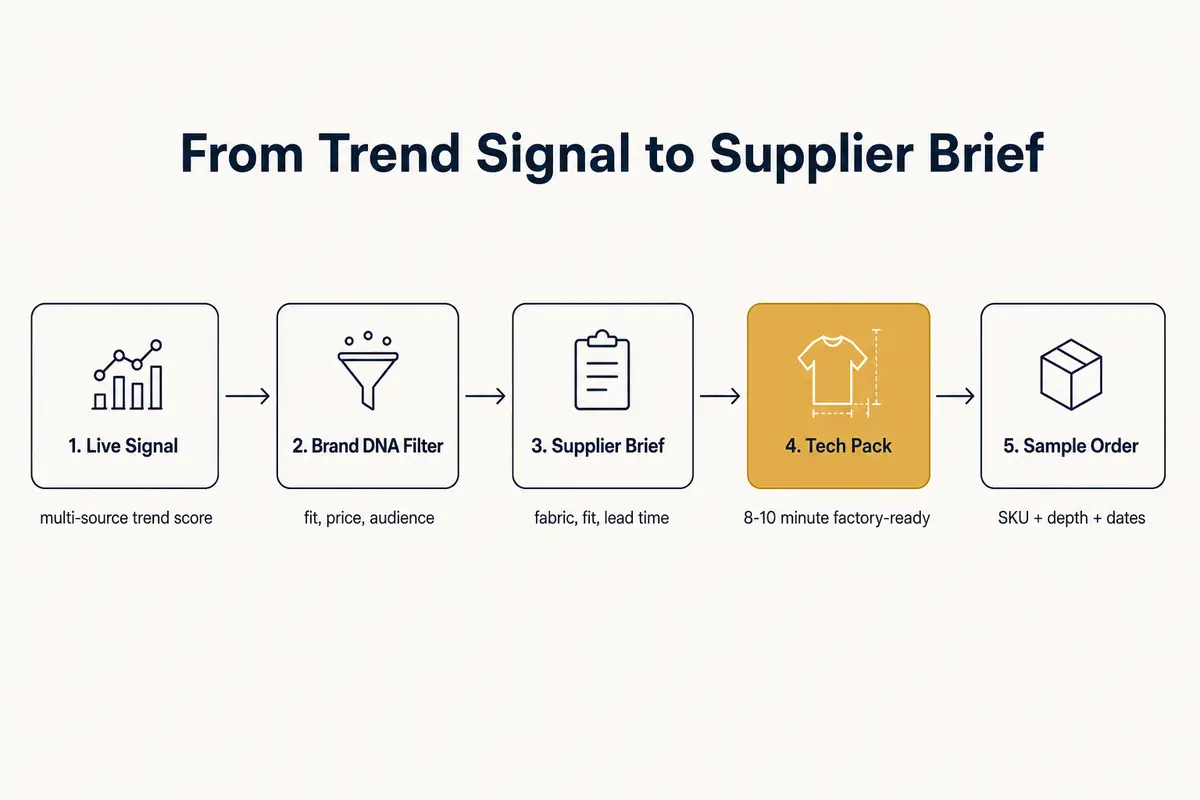
From live trend signal to sample order in five steps, with the 8 to 10 minute tech pack at the center.
Operators often stop at a clean tech pack and assume production-ready is checked. Inside the factory, production-ready also means the line supervisor, QA lead, and purchasing manager can each do their job without waiting on you. Translate that into the packet:
The F* Word's orchestration closes these gaps by including operation lists, tolerance tables, and label specs in the same packet that designers review. Because tech pack generation takes 8 to 10 minutes from a final design, teams can move from studio sign-off to supplier-ready faster than a standard internal meeting. Pair that with moodboards upstream to keep creative direction pinned to specific fabrics and trims you can actually buy.
Week 1. Map signals to vendors. Identify five repeatable signals you care about by category. For each, list vendors who can ship inside 45 days with in-stock materials. Build a one-page vendor capability matrix with contact names, MOQ, typical lead time, and available fabric libraries. Connect signal inputs from real-time fashion trend intelligence to a shared channel so sourcing and design see the same prompts.
Week 2. Lock blocks and grade rules. Pick two blocks per category you can trust. Write plain-language guardrails around silhouette and finish. Pre-approve a seam and stitch library per category so the factory is not waiting on micro decisions.
Week 3. Pilot two categories. For each, select one live signal and move it to a brief in 24 hours. Generate the moodboard for context, then convert to a tech pack. Use The F* Word to produce the factory-ready tech pack in 8 to 10 minutes from your design, including BOM and construction notes, then dispatch the supplier brief. Track two metrics: time from signal-to-brief and number of follow-up emails to clarify the spec.
Week 4. Calibrate with suppliers. Hold a 30-minute call with each pilot vendor. Ask where they padded lead time or price due to ambiguity. Update your templates. Add a red-yellow-green map of trims by availability and bake alternates into the brief. Fold the process into your merchandising launch workflow so photography and PDP content do not lag the buy.
KPIs worth tracking from day one:
You will feel the system start to click when vendors proactively confirm capacity the same day they get your brief and when merch can commit to launch windows with less buffer. At that point, scale the categories and increase your cadence to two briefs per week per category lead.
Turn live fashion trends into moodboards, briefs, designs, and factory-ready tech packs at thefword.ai.
Traditional forecasting packages themes and color direction months ahead. AI fashion trend intelligence ties live signals to production variables and outputs supplier-ready briefs. Think execution intelligence: from signal to materials, operations, and a lead time bracket that a factory can quote without guesswork. You can see a side-by-side overview in AI trend tracker vs traditional forecasting.
Yes. The F* Word is not a PLM, not a 3D sim, and not an image generator. It is the validation and orchestration layer that turns design intent into supplier-ready packets. Export specs, BOMs, and construction notes for upload to your PLM, and keep using your 3D tools for visualization while The F* Word handles briefs and vendor routing.
You need fit blocks, grade rules, fabric libraries, approved trims or alternates, test requirements by category, and a current vendor capability matrix. If a field is missing, The F* Word proposes defaults based on category standards and flags risk zones for your approval. The goal is a brief that answers factory questions before they ask them.
Teams that adopt execution intelligence convert a hot signal into a supplier brief in under an hour and receive quotes inside 48 hours for in-stock materials. The F* Word generates a factory-ready tech pack in 8 to 10 minutes from a garment design, including BOM and construction notes, so sampling can start the same day. PO placement still depends on approvals and compliance, but the critical path shortens by days to weeks.
Related: fashion trend intelligence dashboard · Explore the related workflow · Read the related guide · Try The F* Word · fashion trend intelligence software buyer guide
Get The F* Word workflow insights in your inbox.