

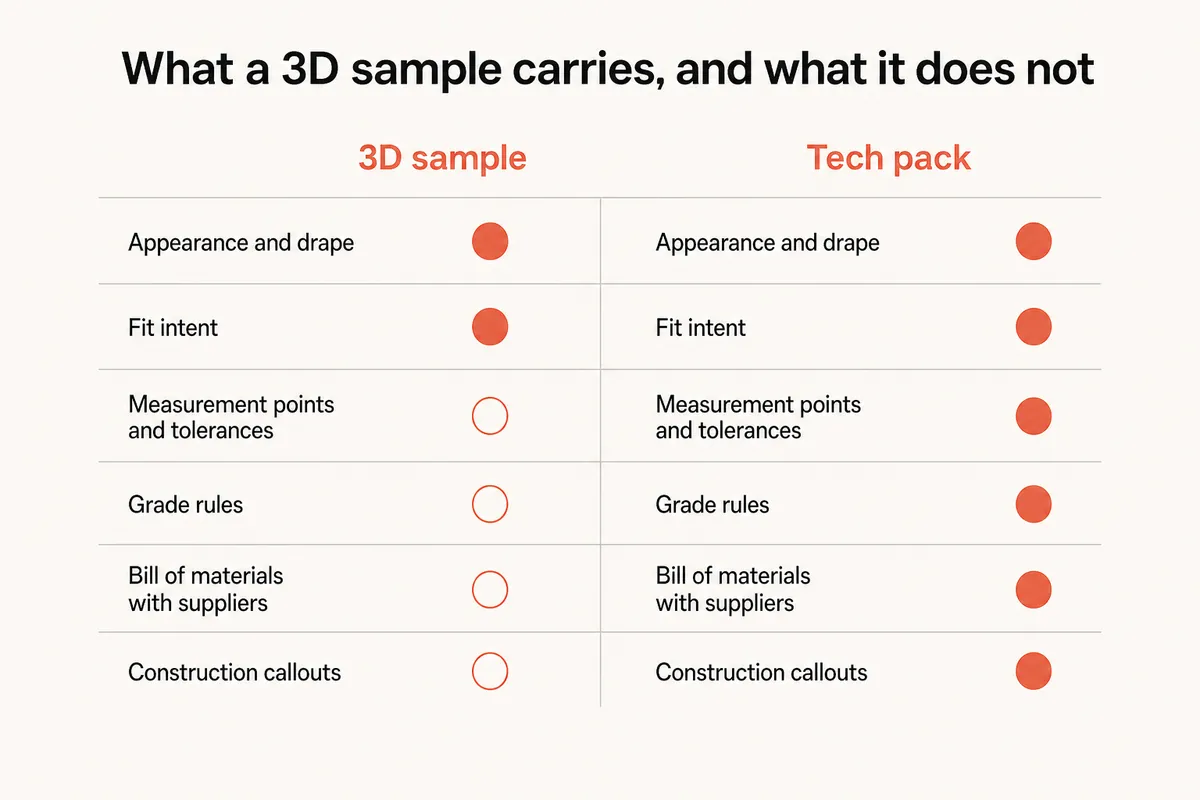
Short answer: No, a 3D sample does not replace a tech pack, because a 3D file communicates appearance, drape and fit intent while a tech pack is the instruction set a factory quotes, cuts and sews from. A 3D sample is an input to approval, not a substitute for the spec a vendor needs to cost, grade, cut, stitch and inspect production.
Be fair to 3D first. A good 3D workflow cuts physical sampling rounds for fit and color decisions, lets merchandising align assortments early, and for line reviews it often beats a photo sample. The structural gap remains: factories decide from measurements, tolerances, grade rules, BOM with resolved trims and suppliers, stitch and seam callouts, labeling and packaging, and the quality criteria used at inspection. The competitive field has split into two camps. One camp generates something, a pattern, a DXF, a render, a draft tech pack, and calls that the finish line. The other camp stores the record in PLM and PIM and assumes what arrives is correct. Neither camp validates. The F* Word operates in the gap between produced spec and factory acceptance. It is the validation and orchestration layer. It generates a factory-ready tech pack in 8 to 10 minutes from a garment design, including BOM and construction notes, and also generates moodboards as the upstream half of the same workflow. It is not a PLM, not a 3D simulator, and not an image generator.
For creative directors and in-house designers, 3D answers the visual question fast. Clo3D, Browzwear and Optitex can show silhouette, proportion and drape well enough to get to an approved look, often before fabric orders are placed. For merchandisers, 3D gets colorways, graphics placements and line architecture onto a page without waiting for photography. For workflow buyers, that can remove one or two fit and photo rounds and bring sell-in tools up earlier.
3D is also strong at internal alignment. A rendered fit session on your base avatar with modelled ease can clarify intent for pattern teams and brand partners. For line review, a consistent 3D viewport often communicates better than mixed-quality proto photos under varied lighting.
There is a trap. A 3D simulation is only as accurate as its fabric physics parameters. If the file used default bending and shear values or an uncalibrated material swatch, the approved 3D sample can still fail when the real fabric stretches, shrinks or puckers differently. That is not a knock on 3D. It is a reminder that visual approval is one input, not the full instruction set a factory needs to make repeatable units.
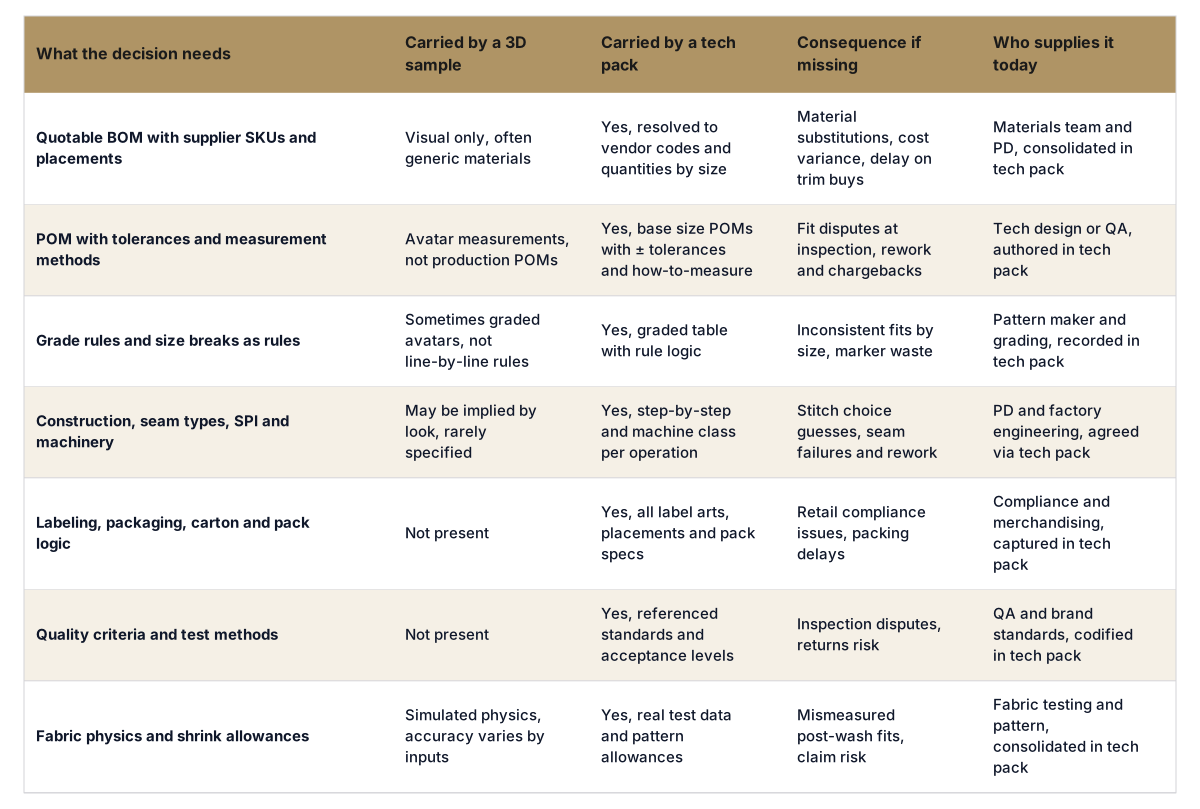
Factories plan labor, markers and quality from structured, measurable data. Most 3D files do not include that data in a vendor-usable way, and even when metadata exists it is rarely the single source of truth used on the cutting table. Here is the non-visual core a tech pack must carry for quoting, cutting and inspection:
Without those items, a vendor can only guess. A DXF is not a factory handoff by itself. See the breakdown in DXF files are not factory handoff. Pattern intelligence is not a tech pack either. It must be validated against BOM and POM to be producible. See why pattern intelligence is not a tech pack and the BOM and grading details in AI Tech Pack BOM, POM, Grading. This is the manufacturing question the 3D camp does not answer.
The F* Word closes this gap with validation. It generates a factory-ready tech pack in 8 to 10 minutes from a garment design, including BOM and construction notes, then runs pre-flight checks before handoff. Examples include POM coherence, grade continuity, trim counts by size, and label and packaging completeness. See the validation list in 7 AI validation checks before factory handoff.
The validated path starts with 3D approval, but it does not end there. The brand confirms silhouette, ease and colorways in 3D. The F* Word then turns the approved design into a factory-ready tech pack in 8 to 10 minutes, including BOM, POM, grading and construction notes, and runs objective checks before the file leaves the building. Those checks close the gap between a pretty render and a producible spec that a vendor can accept without a revision round. That is the distinction between generating and storing versus validating and orchestrating. The first camp generates assets like renders, patterns or draft packs. The second camp stores them in PLM. The F* Word is neither. It is the validation and orchestration layer that sits in between.
If you already run Clo3D or Browzwear and keep records in Centric or FlexPLM, you do not have to rip and replace. Use the 3D sample for internal decisions, then push the design through factory-ready tech pack generation and validation inside The F* Word. You can standardize pre-production using pre-production workflow orchestration and centralize AI checks across categories using AI fashion workflow software. For pattern-first teams, see also AI tech packs and the impact of reducing factory comment rounds in tech pack revisions after factory comments.
Operator note: if 3D is your visual source of truth, keep using it. Just pair it with a validated spec before vendor handoff. See the validation step run end to end at thefword.ai.
Only in a rough, non-binding way. A vendor needs a resolved BOM with supplier SKUs and trim counts by size, plus construction notes that determine labor. Without those, quotes are placeholders that change after the first proto. Send the 3D file alongside a validated tech pack if you want a price that holds.
It can be realistic for internal sign-off and early buy readiness, but it is risky as the only approval before production. The limiting factor is the accuracy of fabric physics and the absence of test data, shrink allowances and stitch performance in a 3D file. Most brands still run at least one physical proto or SMS in the real fabric to confirm quality criteria.
Send a factory-ready tech pack with POM and tolerances, grade rules, a resolved BOM, construction and seam callouts, labeling and packaging specs, and your quality acceptance criteria. Include any 3D assets only as visual intent to speed interpretation on first proto. The F* Word generates this tech pack in 8 to 10 minutes, including BOM and construction notes, and runs validations so you can hand off with confidence.
The F* Word is not a PLM, not a 3D simulator and not an image generator. It sits between creation and storage as the validation and orchestration layer that produces and checks the vendor-ready spec. It also generates moodboards as the upstream half of the same workflow, which lets creative direction roll forward into structured specs without manual rekeying.
Get The F* Word workflow insights in your inbox.