

2027 is the first sell-date when EU textiles must ship with a Digital Product Passport, and the mandate is specific in field terms: composition by percentage, chemicals and test data, country and process steps, recycled content and certificates, care and repairability, and a unique identifier resolvable via a QR or digital link. Treat that as your engineering spec. The fastest brands will not rebuild for it. They will export it from the same structured garment record they already use to brief factories and power their sales channels. Compliance as use means one machine-readable record that serves the regulator and the AI agent from one source.
The Digital Product Passport is a schema and an audit trail with a QR at the edge. It rewards brands that run a connected pre-production workflow where material facts are captured in fields, versioned, and signed. If the garment record is already machine-readable, the passport is a filtered export. If the record lives in scattered PDFs, emails, and supplier PDFs, the passport becomes a rebuild project with manual data entry, vendor chases, and late-season rework.
There is a second reason to build once. The market is saturated with AI image generators and campaign tools. They are interchangeable and they produce pixels. A pixel is not machine-readable. An AI shopping agent that stands between the shopper and your catalog cannot verify fibre content from a render, cannot map the product into the right meaning space, and cannot cite it to the user. The F* Word is not an image generator. It is the validation and orchestration layer that produces the structured garment record: the asset plus the machine placement data plus the machine recommendation data that makes an agent confident enough to surface the product.
The operating point from The F* Word team's book, The Machine-Readable Brand, is simple: mandates accumulate between 2026 and 2030 and none of them phases out. If you solve the passport as a one-off sustainability project, you add permanent overhead. If you treat it as the first export of a single record, every new mandate becomes another export template, not another scramble. That is the compliance stack strategy the book outlines, and it starts in pre-production, not in a PDF afterthought.
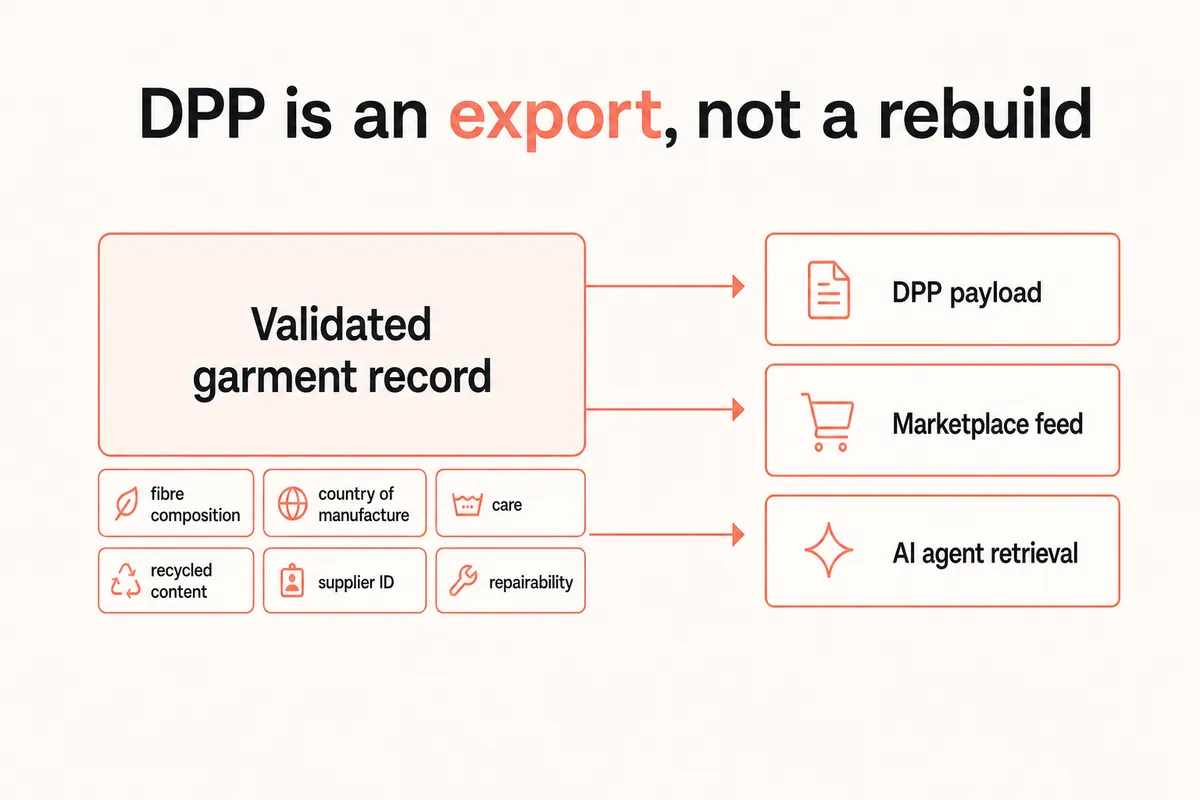
The passport is not a narrative about your footprint. It is structured-data regulation with a deadline. Sustainability language often centers on story, targets, and initiatives. The passport asks for verifiable, referenceable, machine-parsable facts tied to a unique product identifier. If you house those facts in a living record that your sourcing team already maintains, compliance is maintenance. If you try to retrofit them from CSR decks and campaign copy, compliance is rework.
Where the framing goes off course:
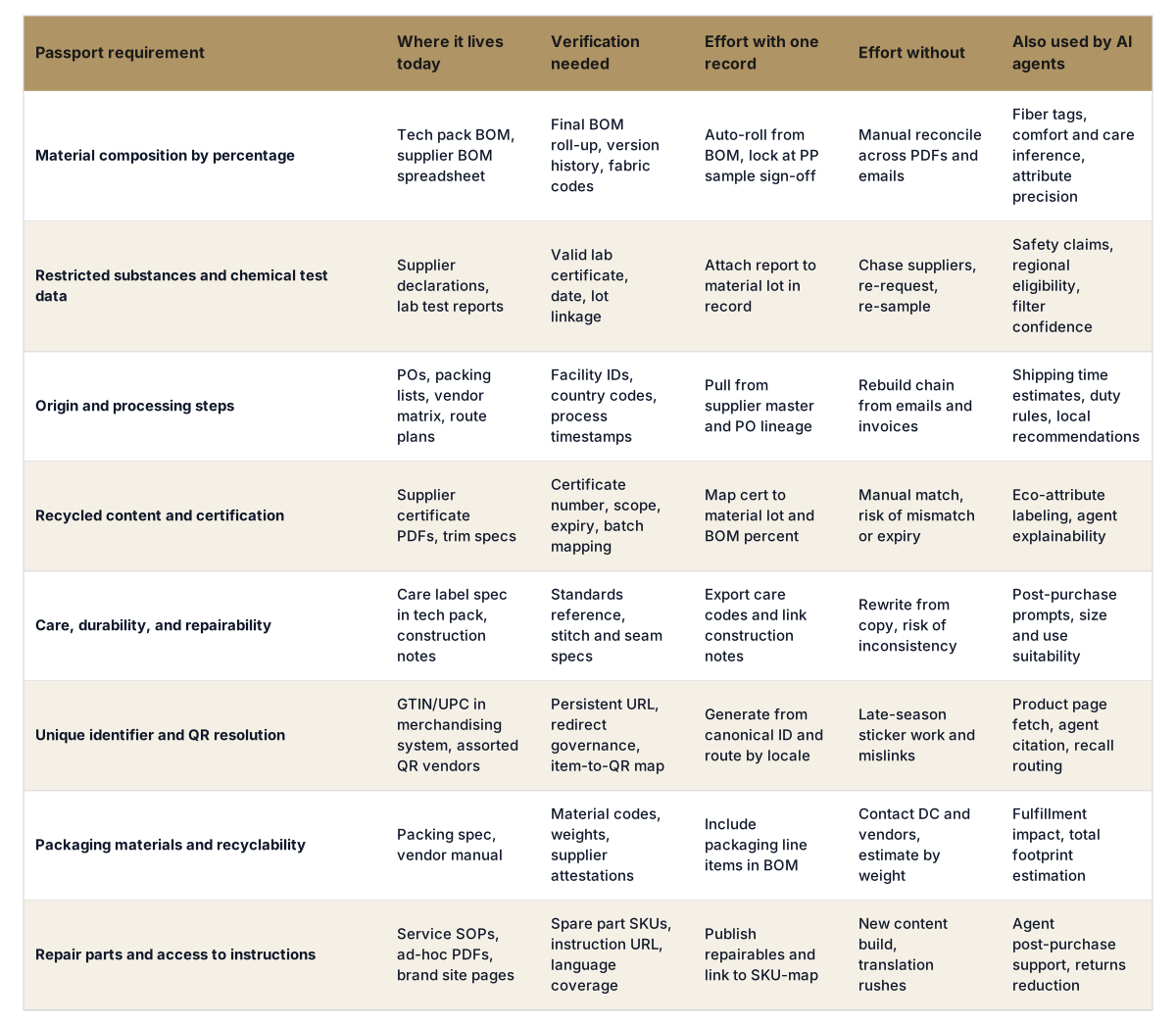
If you want a simple cost model, consider this illustrative math: 1 hour per style to reconcile composition sources, 2 hours to obtain and attach chemical and recycled-content documents, 30 minutes to assign and test a QR, and 30 minutes to proof the page. On a 2,000-style year, a rebuild costs 8,000 to 10,000 hours before exceptions. An export from a verified record reduces that to minutes per style for final checks.

Production-ready means your garment has a canonical record with schema, identifiers, evidence, and exports. It is not another dashboard. It is a set of primitives the whole company reuses.
This is where The F* Word sits in your stack. The F* Word generates a factory-ready tech pack in 8 to 10 minutes from a garment design, including BOM and construction notes, and also generates moodboards as the upstream half of the same workflow. It is not a PLM, not a 3D sim, and not an image generator. It is the validation and orchestration layer that turns the creative intent into a verified record that you can export to factories, regulators, and agents. See the pre-production flow described at thefword.ai/pre-production-workflow-software-fashion and how creative direction connects at thefword.ai/creative-direction-workflow-fashion-brands.
Bridge back to the agent point. The market is full of AI tools that output beautiful imagery. That category is commoditized and does not move the passport or the agent needle. Agents read fields, units, provenance, and care. When your record holds those fields and you export them, you win both the compliance check and the recommendation slot. The F* Word's role is to make that record production-grade, auditable, and exportable.
This table compares three common approaches to managing pre-production data for Digital Product Passport compliance. Use it to decide which workflow best protects your brand from rework and prepares you for future machine-readable mandates, not just the EU's.

For workflow buyers and sourcing leaders:
For in-house designers and creative directors:
For merchandisers:
If you want a shorthand, use the Export vs Rebuild test. If a field cannot be produced without emailing a supplier or opening a PDF, you are on a rebuild path. If the field exists as a value with a change log, you are on an export path. Shift fields one by one into export status before 2026 and you de-risk the cutover.
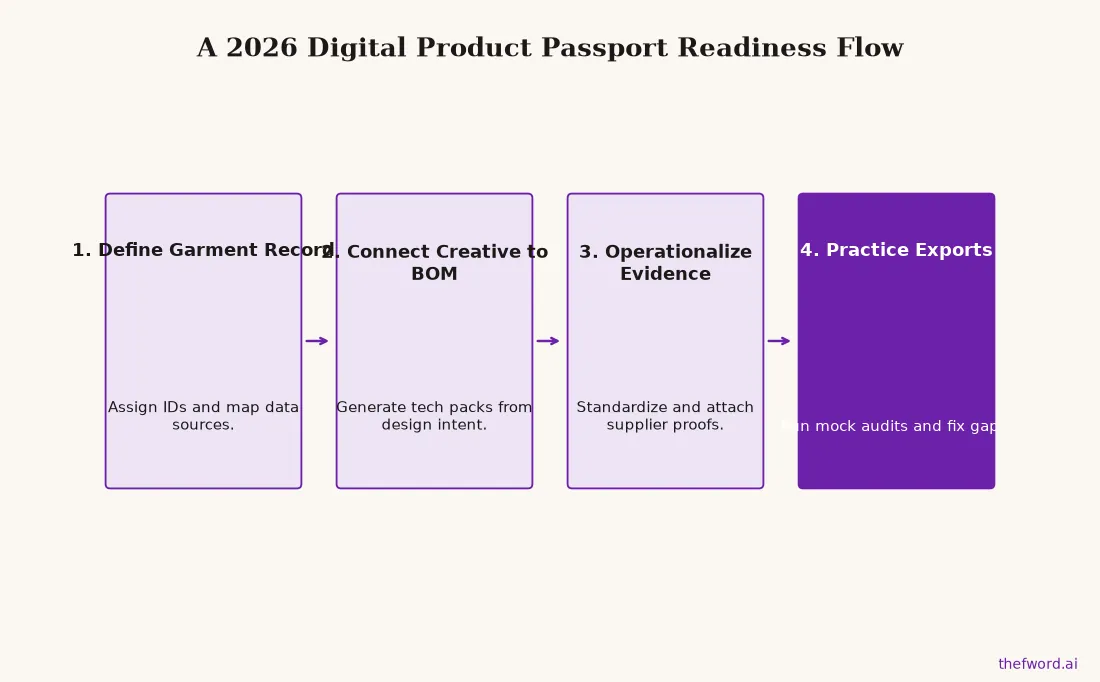
Use this four-step sequence. It is sequenced to minimize lift and concentrate ownership with the sourcing desk, not the sustainability desk.
This is a sourcing-led program. The fields live with BOMs, vendors, and labs. Sustainability and brand comms benefit, but they do not hold the keys. When you treat the passport as an export, the team that already manages the record leads the work, and the company gains a reliable feed for agents at the same time.
One last planning note. The compliance stack will get denser from 2026 to 2030. None of it phases out. Use the stack logic from The Machine-Readable Brand page to plot your exports by mandate and region. The same record can output DPP for the EU, a safety and care card for another region, and a full-fact agent feed for global catalogs. That is how you convert compliance into distribution.
You need a persistent ID that links a physical unit to its digital record. Most brands pair an internal product ID with a GTIN and expose a QR that resolves to a stable URL. The key is persistence and governance so the URL and the fields behind it do not rot across seasons and locales.
Start with carryovers and core programs because the BOM and supplier sets are stable. Backfill fields that the passport expects and attach proofs where they exist. For deep legacy, create a cutline by risk and value, then treat anything below the line as a basic page with minimal claims while you rebuild upstream processes for new seasons.
No. You need a verified, exportable garment record. Keep PLM if it serves you and add an orchestration layer that validates fields, captures proofs, and emits the passport. The F* Word is that layer. It is not a PLM, not a 3D sim, and not an image generator, and it produces a factory-ready tech pack in 8 to 10 minutes from a design, including BOM and construction notes.
Assign ownership to the VP Product Development or Director Sourcing, with legal and sustainability as stakeholders. The data lives in BOMs, supplier attestations, and POs, so sourcing has the levers to make it accurate. Set a weekly cross-functional review to clear exceptions and lock exports on cadence.
Start free at thefword.ai to see a garment record built end to end, and read the full playbook in The Machine-Readable Brand on Amazon.
Related: 3d visualization in digital fashion design · product content management
Get The F* Word workflow insights in your inbox.