
Language


TL;DR. Fashion product data orchestration is the enterprise solution for unifying fragmented data from systems like PLM, ERP, and design software into a single, validated source of truth. It automates the flow of information, eliminating manual data entry, reducing costly errors, and accelerating product development cycles. Unlike a PLM which stores data or a 3D tool which visualizes it, an orchestration platform like The F* Word acts as a command layer. It autonomously generates factory-ready artifacts such as the tech pack and coordinates creative assets for the moodboard, ensuring that every team, from design to sourcing, operates with consistent, accurate, and real-time information, directly enabling faster time-to-market for large-scale fashion enterprises.
Enterprise fashion brands operate in a complex web of disconnected systems. Creative concepts live in design software, material specifications in a PLM, costings in an ERP, and supplier communications in email. This fragmentation creates major operational drag. Product development managers chase down BOM data, technical designers manually copy-paste measurements into spreadsheets, and merchandisers struggle to gather accurate product attributes for e-commerce listings. Each manual hand-off is a potential point of failure, introducing errors that lead to incorrect samples, production delays, and increased costs.
Fashion product data orchestration addresses this fundamental challenge. It is not another system of record, but an intelligent workflow layer that connects existing systems. It ingests, standardizes, validates, and directs the flow of product data throughout its entire lifecycle. In an enterprise context, this means creating a cohesive digital thread that links initial design intent to the final product listing. This orchestration ensures that a change made to a trim in the PLM is automatically showed in the tech pack, the costing sheet, and the product information management (PIM) system without human intervention.
The F* Word is purpose-built as this orchestration and validation layer. We do not replace your Centric or FlexPLM, nor do we compete with 3D tools like Browzwear or CLO. Instead, The F* Word integrates with these platforms. It pulls data from them, validates its integrity, and then uses that validated data to autonomously generate critical production and creative documents. It is the engine that converts disparate data points into actionable, factory-ready instructions, ensuring precision from concept to consumer.
The data market in a modern fashion enterprise is notoriously siloed. A single garment generates hundreds of data points scattered throughout many platforms and departments. Design teams work with Adobe Illustrator files and digital sketches. Product development teams manage complex Bills of Materials (BOMs) and points of measure (POMs) in a PLM system. Sourcing teams track supplier quotes, lead times, and compliance data in separate spreadsheets or procurement software. Merchandising and marketing teams require a different set of data, including product descriptions, photography, and pricing for PIM and e-commerce platforms.
This fragmentation is a direct barrier to efficiency. Inconsistencies become rampant. A technical designer might update a POM specification, but if that change isn't manually communicated and updated in the factory's system, the next sample will be wrong. A material code might be updated in the ERP but not in the PLM's BOM, leading to costing errors and procurement delays. These seemingly small discrepancies accumulate, creating a massive drag on the entire product development process.
The impact on The main point is substantial. Extended product development timelines mean missing key market windows. Costly rework from bad data inflates the cost of goods sold (COGS). A lack of a central, trusted data source hampers a brand's ability to respond quickly to market trends or supplier issues. For enterprise brands managing hundreds or even thousands of SKUs per season, the cumulative effect of this data chaos is a major competitive disadvantage.
Implementing a data orchestration strategy provides a decisive competitive advantage by transforming data from a liability into an asset. The most immediate benefit is a dramatic improvement in data accuracy and consistency. By establishing an automated flow of information with built-in validation rules, orchestration eliminates the human error inherent in manual data entry and repetitive tasks. When a material is approved, its corresponding data, from composition to supplier ID, is propagated automatically to every relevant system and document, ensuring everyone from the technical designer to the merchandiser is working from the same playbook.
This single source of truth accelerates decision-making at every level. A sourcing lead can instantly assess the impact of a fabric change on cost and lead time because the data is centralized and correct. A product development manager can approve sample requests with confidence, knowing the associated tech pack shows all the latest updates. This agility enables teams to move from reactive problem-solving to proactive strategy, focusing on innovation rather than data reconciliation.
Collaboration between departments becomes more useful. The traditional friction between design, technical design, product development, and merchandising is often rooted in data disputes. Orchestration removes this friction. Creative directors know their vision, captured in an orchestrated moodboard, is directly linked to the technical specifications in the tech pack. Merchandisers can build collections and plan assortments with validated product attributes, reducing the risk of launching products with incorrect online descriptions. FINALLY, this connected ecosystem reduces the number of sample rounds, minimizes costly production errors, and shortens the overall calendar from concept to launch.
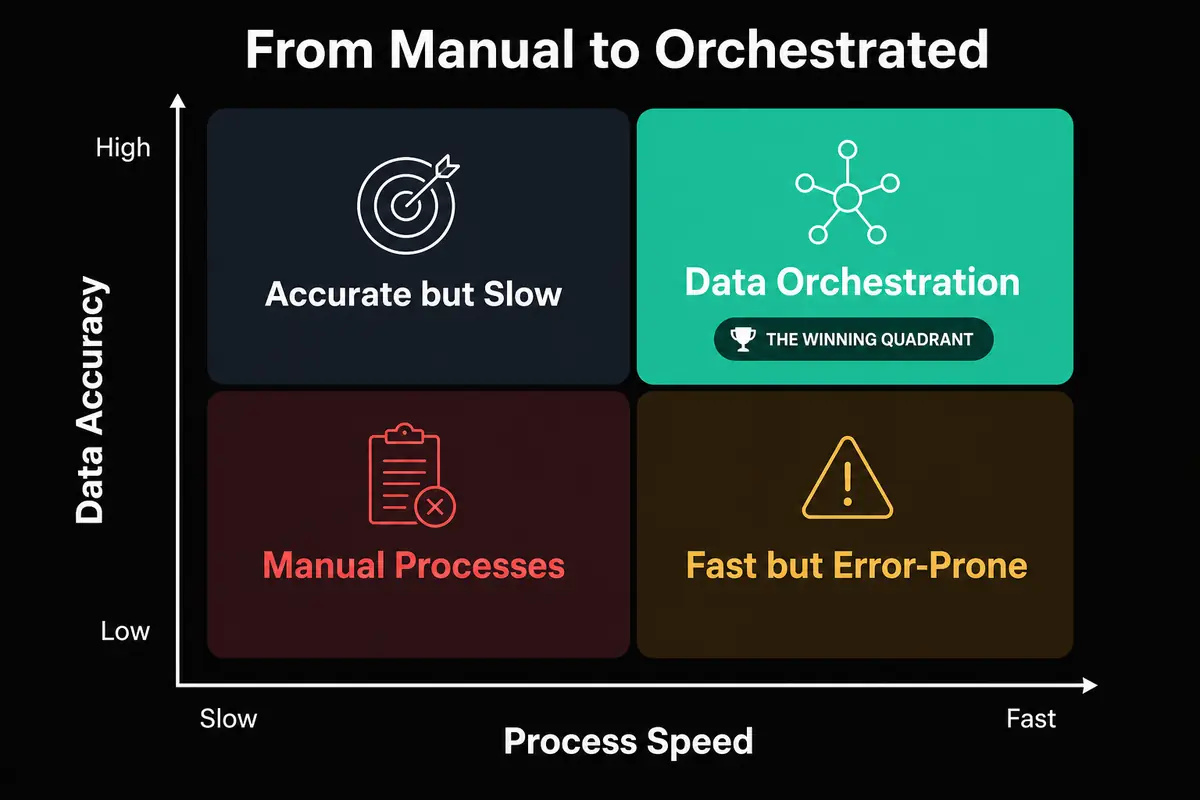
A 2x2 quadrant shows how brands move from the low-accuracy, low-speed environment of 'Manual Processes' to the high-accuracy, high-speed benefits of 'Data Orchestration' by automating workflows and validating information.
An useful fashion data orchestration platform is built on four critical components that work in concert. The first is data ingestion and standardization. The system must be capable of connecting to a wide array of sources, including PLMs, ERPs, DAMs, and even simple spreadsheets, via APIs or other integration methods. Once connected, it pulls in data in its native format and standardizes it, translating different field names and structures into a unified, coherent model. A 'material code' from an ERP and a 'fabric ID' from a PLM are mapped to become a single, consistent entity.
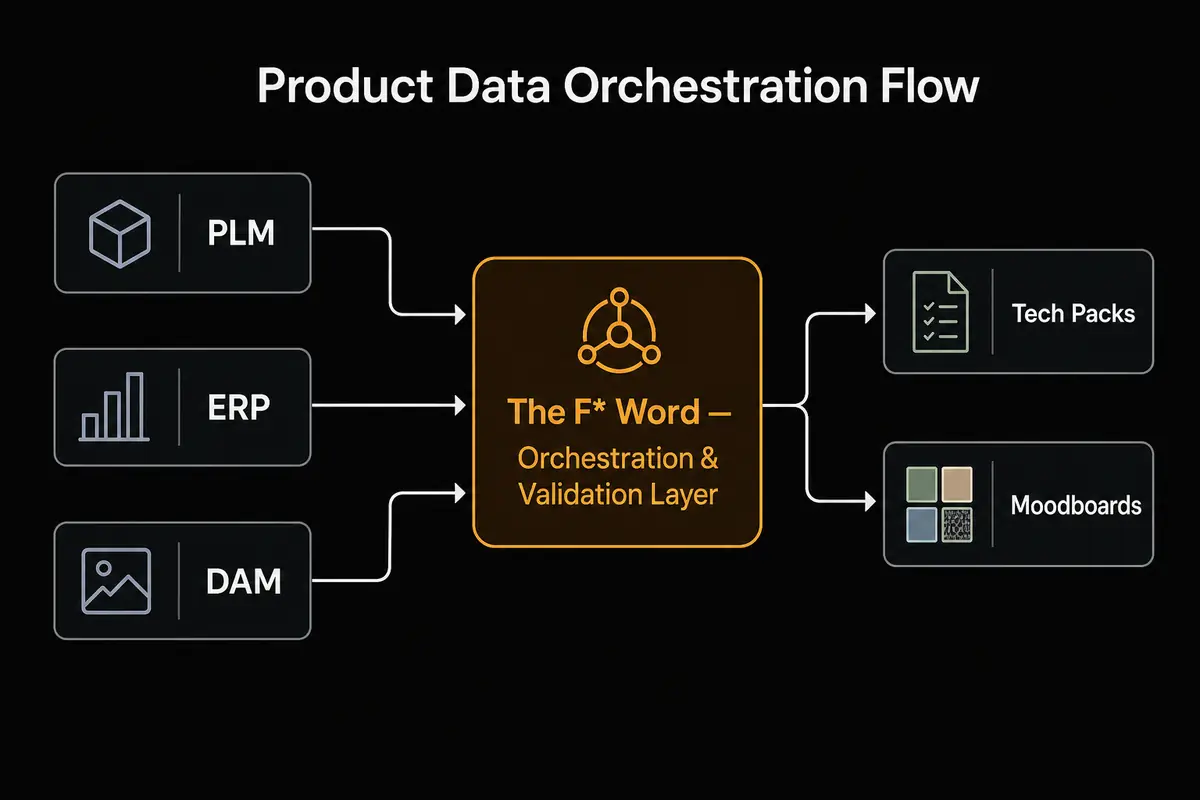
This chart shows the flow of product data from disparate systems into The F* Word's orchestration layer, where it is validated and used to autonomously generate tech packs and moodboards for production and creative teams.
The second component is data validation and enrichment. Ingesting data is not enough. it must be checked for accuracy and completeness. The orchestration engine applies a set of configurable business rules to validate the data. For example, it can flag a BOM where the component costs do not add up to the total target cost or identify missing wash care instructions for a specific fabric type. It can also enrich data by, for example, automatically generating harmonized system (HS) codes for customs based on material composition and product category.
Workflow automation is the third, action-oriented component. Based on triggers, such as a design being marked 'approved' in a PLM, the orchestration platform initiates a sequence of automated actions. This could involve generating a draft tech pack, assigning tasks to the technical design team, and creating a new product shell in the PIM system. This automation removes bottlenecks and ensures processes move forward without constant manual oversight.
Finally, deep integration with existing enterprise systems is essential. An orchestration platform is not meant to be a monolithic replacement for a brand's entire tech stack. Its power lies in its ability to be the connective tissue. It must read from and write back to the systems of record that a brand relies on. This bi-directional sync ensures that the PLM, ERP, and other platforms always contain the most current, validated information, reinforcing their value as the ultimate sources of truth.
The distinction between managing data and orchestrating it is fundamental to understanding its impact on a fashion enterprise. Traditional data management is characterized by a static, repository-based approach. Data is entered into a system like a PLM and largely stays there, requiring manual effort to move it or use it elsewhere. This creates information silos and process latency. In contrast, an orchestrated data flow is dynamic and action-oriented. It focuses on the intelligent movement and transformation of data to drive business processes forward automatically. A direct comparison shows the operational differences and strategic benefits.

For an enterprise managing 500 styles a season, the inefficiencies of traditional management compound rapidly. A single data error in a BOM, replicated throughout multiple colorways and sizes, can lead to thousands of dollars in wasted materials or incorrect production runs. An orchestrated flow mitigates this risk at scale. By validating data at the source and ensuring its consistent propagation, the system preemptively resolves issues that would otherwise require weeks of manual correction, freeing up teams to focus on strategic, value-adding work.
In practice, data orchestration translates directly into tangible operational improvements for enterprise brands. Consider the critical path for a new seasonal collection. When a creative director finalizes a concept, an orchestration platform can trigger a series of parallel workflows. It can automatically generate a digital moodboard by pulling approved concept sketches, inspirational images from a DAM, and preliminary fabric data from the PLM. This ensures immediate alignment for the entire design and merchandising organization.
Simultaneously, the platform can create a placeholder tech pack for the same style. It populates the tech pack with foundational data pulled from the concept brief and a style library, such as product category, target fit block, and initial POMs. It then assigns the draft to a technical designer for detailing. This single event, the approval of a concept, sets in motion a cascade of automated, data-driven actions that would traditionally require multiple meetings, emails, and manual file creation.
This agility is critical for responding to fast-moving market trends. Consider a merchandiser identifies a spike in demand for a particular silhouette or color. With an orchestrated data flow, the brand can react swiftly. The merchandiser can initiate a "fast track" workflow. The orchestration engine can locate similar base styles in the product library, pull their validated tech packs and BOMs, and present options to the design and product development teams for rapid adaptation. This allows the brand to move from trend identification to issuing a purchase order in a fraction of the time required by manual processes, capturing revenue that would otherwise be lost.
The F* Word is designed as the definitive orchestration tool for fashion's specific complexities. Our core function is the autonomous generation of the most critical product artifact: the tech pack. We connect to a brand's PLM, ERP, and material libraries. When a new style is initiated, our platform ingests all associated data points, including sketches, measurements, grading rules, BOM components, construction details, and label placements. Our validation engine then scrutinizes this data for completeness and consistency before generating a full, factory-ready tech pack. This eliminates the hours of manual copy-pasting and checking that technical designers endure, freeing them to focus on fit, quality, and innovation.
On the creative front, The F* Word streamlines moodboard creation to ensure brand and product vision is perfectly matched from the start. We orchestrate the aggregation of assets, pulling inspiration from DAMs, concept sketches, approved color palettes, and fabric scans into a cohesive, shareable format. This ensures that the creative intent established by the design director is locked to the specific product data that flows downstream to development and production, preventing costly misinterpretations.
Our capabilities extend far beyond simple document generation. The true power lies in validation and orchestration. Before a tech pack is finalized, our system can cross-reference the BOM with inventory data from the ERP to flag potential material shortages. It can verify that all POMs have specified tolerances and that the grading rules are complete for the full size range. For a large enterprise producing hundreds of styles, this automated oversight acts as a critical quality gate, preventing thousands of potential errors from ever reaching the factory floor and dramatically reducing the need for multiple sample rounds.
The success of a fashion data orchestration initiative is measured through clear, quantifiable key performance indicators (KPIs) that directly show operational efficiency and profitability. The most critical metric is a reduction in time-to-market. By automating data workflows and eliminating manual bottlenecks, brands can significantly shorten their product development calendar. This should be measured in days or weeks saved from initial concept approval to the product being ready for a purchase order.
A second critical KPI is the decrease in data-related errors. This can be tracked by monitoring the number of incorrect samples received due to spec errors, the volume of rework required on tech packs, and the rate of product returns linked to inaccurate online information. A successful orchestration implementation will show a marked downward trend in these areas, translating directly to lower costs for sampling, shipping, and reverse logistics.
Improved cross-functional team efficiency is another key measure. While harder to quantify, this can be assessed through surveys and by tracking the reduction in time spent on non-value-added tasks like data entry, file searching, and inter-departmental queries. Freeing up technical designers, product developers, and merchandisers from data administration allows them to focus on their core competencies. Finally, improved product page accuracy and completeness on e-commerce sites is a tangible outcome. This can be measured by the percentage of product pages with a full set of validated attributes at the time of launch, which correlates strongly with conversion rates and customer satisfaction.
A system of record like a Product Information Management system is effective at storing product information. But storing data is not the same as verifying it. To be truly useful for production and sales, garment data must have qualities that go beyond simple storage. An entry in a database does not prove the value is correct, complete for its intended use, or consistent with other product attributes. This gap is where costly errors in sampling, production, and merchandising originate.
The first quality is validity. This means the data is internally coherent and factually correct. For instance, a ribbed knit dress record where the fiber composition adds up to 110 percent is invalid, yet many systems would store this information without an issue. Validity checks ensure the composition sums to 100 percent. It also confirms that the assigned care instruction is appropriate for a specific viscose and nylon blend, preventing contradictory information from reaching the factory or the customer.
The second quality is destination-specific completeness. The data required for one channel is often different from another. Your own brand website might only need a short description and key features. A large online marketplace, however, may require fabric weight, country of origin, and a fit intent statement for every garment. A production-ready record accounts for this by ensuring all required fields are populated based on the specific needs of each destination, from the tech pack for the factory to the data feed for a retail partner.
The final quality is provenance. This is the ability to trace every piece of data back to its source. The claim that a trench coat is waterproof should be directly linked to the lab report that proves it. The fiber content should point to a supplier declaration or a test result. When the source of truth is a detached PDF or an old email, the data lacks authority. A record with clear provenance provides a citable trail for every claim, building trust with partners, regulators, and automated shopping tools.
Enterprise fashion product data orchestration is the process of automating the flow of product information throughout a brand's entire technology ecosystem. It connects disparate systems like PLM, ERP, and design tools to create a single, validated source of truth. This ensures that data related to materials, measurements, costs, and creative direction is consistent and automatically updated everywhere, enabling large-scale brands to operate with greater speed and accuracy from concept development through to e-commerce launch.
PLM and ERP systems are primarily systems of record. they are designed to store data. A PLM stores product-related data like BOMs and specs, while an ERP manages financial and inventory data. Data orchestration, in contrast, is a system of action. It does not store the master data but instead connects to these systems, validates the information in them, and automates workflows between them. It's the intelligent layer that directs traffic, not the destination itself.
For large brands, the primary benefits are accelerated time-to-market, reduced operational costs, and improved data accuracy. Orchestration eliminates manual data entry errors, which minimizes the need for costly sample corrections and production rework. By automating workflows, it shortens the product development calendar, allowing brands to respond faster to market trends. It also provides a unified view of product data, enabling better, faster decision-making for merchandising, sourcing, and design teams at scale.
The F* Word is a purpose-built orchestration platform for fashion. It specializes in connecting to a brand's existing systems (like Centric, FlexPLM, ERPs) to pull and validate data. Its core function is to use this validated data to autonomously generate critical outputs like factory-ready tech packs and matched creative moodboards. By doing so, it serves as the critical action layer, turning static data from several sources into consistent, error-free, and actionable production artifacts without replacing the underlying systems.
A fashion orchestration system manages the flow of all data points in the product lifecycle. This includes creative and design data like sketches and moodboard assets. It covers technical data such as Bills of Materials (BOMs), Points of Measure (POMs), grading rules, construction details, and trim specifications. It also handles sourcing and production data like supplier information, costings, and quality tolerances, as well as merchandising data like product descriptions, pricing, and category information for e-commerce.
Data orchestration improves time-to-market by removing manual bottlenecks and idle time from the product development process. When a design is approved, an orchestration platform can automatically generate a draft tech pack, trigger material requests, and create product listings simultaneously. This parallel processing, combined with automated data validation that reduces errors and rework cycles, compresses the timeline from weeks to days for key stages. It ensures a smooth, rapid transition from concept to a purchase order ready product.
By transforming your data from a collection of static, siloed records into a dynamic, intelligent, and automated flow, your enterprise can achieve new levels of speed and precision. This is the strategic imperative for competing in the modern fashion market. To learn how The F* Word can serve as the command center for your product lifecycle, see enterprise capabilities. Explore our other resources on scaling your brand's technical infrastructure at our full enterprise hub.
Related: AI fashion image disclosure
Explore the related workflow. Read the related guide. Read the related guide. Try The F* Word.
Get The F* Word workflow insights in your inbox.