Language
Assortment planning decides how much of each style a brand buys and where it goes: breadth (how many options), depth (units per option), sizes, and which stores, clusters or channels carry each one, inside the open-to-buy budget. It comes after the range plan. The F* Word helps by validating trends and generating tech packs in 8 to 10 minutes per style.
A range plan or line plan says what the season will contain. The assortment plan turns that list into quantities and destinations. Retail Plan, a merchandise planning guide, puts the split in one line: the line plan is what we will make, and the assortment plan is where it goes and how much. This guide covers the breadth and depth trade-off, store clusters, size curves and the budget link, with worked numbers. For the wider launch process, see our merchandising and launch workflow guide.
Oracle describes assortment planning as the way fashion retailers plan their seasonal styles and allot them to each store and sales channel, so the right styles reach the right channels in the right sizes and colors. The Merchandise Planning Institute glossary adds the mechanics: an assortment plan sets the number of options, the price points, the depth of each option, and which stores get what, by category and store cluster. It links the money plan to the line-by-line buys.
For a brand, assortment planning runs after the range is agreed and before purchase orders go out. Our guide to the range plan covers the step before it. RetailNorthstar, a planning resource for apparel brands, notes that buy decisions are often made four to six months before product reaches the floor, which is why the assortment has to be right on paper long before any sales data exists for the new styles.
Open-to-buy is the budget: how much money is left to spend on stock for a period after sales, markdowns and stock on hand are accounted for. The assortment plan decides how that budget is spent. If open-to-buy for a dress category is $120,000 at cost and the average cost per unit is $24, the category can buy 5,000 units. Every decision after that is a way of dividing those 5,000 units.
Plan the money first, then the product. A team that picks styles first and adds up the cost afterward usually ends up over budget, then cuts depth on every style to fit, which leaves the whole range thin. Starting from the unit total forces the trade-offs into the open while they are still cheap to change.
Breadth is the number of options in a category, where an option is one style in one color. Depth is the number of units bought for each option. On a fixed budget they trade off directly. Apparel Search, a long-running apparel industry directory, describes it as breadth and depth fighting over the same money.
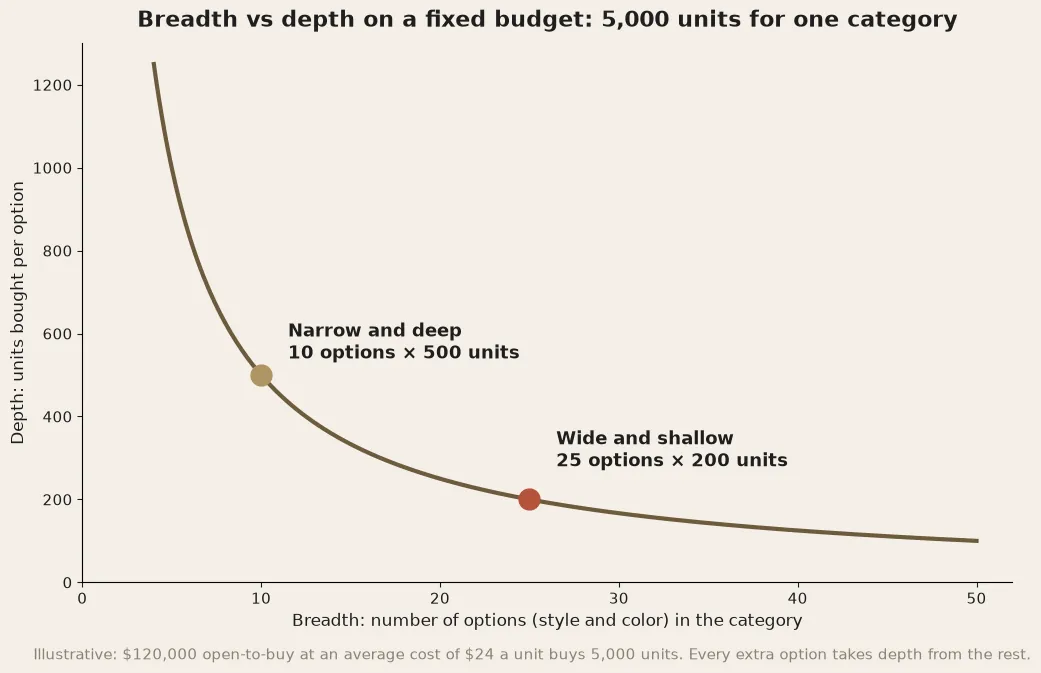
With 5,000 units, the dress category could carry 10 options at 500 units each or 25 options at 200 units each. The wide plan gives customers more choice and freshness, but each option is one sold-out size away from a stalled sale, and a 200-unit buy spread over five sizes leaves 40 units per size on average. The narrow plan gives excellent availability where the bet is right and heavy markdowns where it is wrong. Fashion-led categories usually justify more breadth bought shallow. Core and replenishment categories, such as a white shirt or a classic jean, usually justify depth.
Most brands mix several approaches inside one season. The table compares the common ones by when they fit and what they risk.

A chain of 30 stores rarely needs 30 separate plans. Store clustering groups stores with similar sales volume, customer and climate, and the plan is set once per cluster. A flagship cluster might carry the full range, a mid-size cluster most of it, and small stores only the core. Online often carries everything, plus web-only options that would not earn space on a shelf.
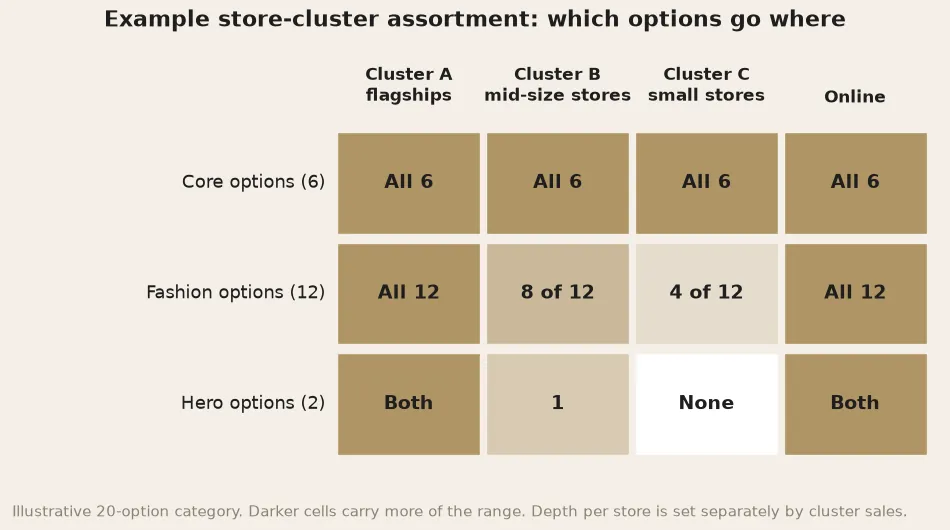
The example grid shows a 20-option category: 6 core options, 12 fashion options and 2 hero options. Every cluster carries the core. Fashion options thin out toward smaller stores, and hero pieces go only where they can be shown properly. Depth per store comes next, from each cluster's past sales, so a flagship might take three times the units of a small store on the same option.
Each option's units then divide by size, and a style bought in several colors also needs a color ratio before the sizes are set. The size curve is the ratio of units per size, for example 1 XS, 2 S, 3 M, 3 L and 1 XL for a 10-unit pack. It should come from past sell-through by size, because a curve that over-buys XS leaves the same broken run every season.
Check size-level results after each season and adjust the ratio by category. Knit tops, tailored trousers and outerwear rarely share a curve, and online customers often buy a different size mix from store customers. The Merchandise Planning Institute calls the result of getting this wrong assortment imbalance: total stock looks healthy while the sizes customers want are short.
Each of these mistakes shows up later as low sell-through, broken size runs or markdowns. Teams that review the plan against what sold, style by style and size by size, catch most of them before the next buy. Our piece on AI line review tools covers how merchandisers bring that evidence into the line review.
The F* Word does not replace a planning or allocation system. It works on the inputs that make an assortment plan reliable. Trend analysis and validation tests whether a signal is real before a team decides how much breadth to give a new idea, so a fashion option gets its place in the plan on evidence. Once styles are chosen, The F* Word generates a factory-ready tech pack for each one in 8 to 10 minutes, with a bill of materials, points of measure, grading and construction notes.
Fast specs matter most for test and chase. A brand that can cost and spec a new option in minutes can keep the first buy small and reorder the winners, instead of committing deep on every style months ahead. The F* Word works before or alongside a PLM and does not replace one. Our guide to the fashion line sheet covers how the final assortment is presented to wholesale buyers.
Related: what is a range plan · fashion line sheet · SKU rationalization · sell-through rate
Assortment planning decides how many options a brand carries in each category, how many units of each it buys, how those units split by size, and which stores and channels get them, inside the open-to-buy budget.
The range plan, or line plan, sets which styles the season will contain. The assortment plan sets the depth of each style and where it goes by store, cluster and channel.
Breadth is the number of options in a category, one style in one color each. Depth is the number of units bought per option. On a fixed budget, adding breadth takes depth away from every other option.
Open-to-buy sets how much money is available for stock in a period. The assortment plan decides how that money becomes options, units, sizes and store allocations.
AI can validate trend signals before a team commits breadth to them, and speed up specs for test and chase buys. The F* Word does both, with tech packs generated in 8 to 10 minutes per style.
Get The F* Word workflow insights in your inbox.