

Short answer: A tech pack with AI takes roughly 8 to 10 minutes from a garment design to a validated draft, while a manual build usually takes 6 to 20 hours. This clock starts at a design input such as a sketch, photo, pattern file, or annotated render, and stops at a factory-ready draft that has passed internal checks. End to end, including human review and the factory comment round, typically runs 1 to 2 business days with validation, compared with 1 to 3 weeks without.
Speed claims in this category are slippery because vendors do not state what the clock covers. The useful number starts when a design is provided and stops at a defined handoff point. The competitive field has settled into two camps: one camp generates something, such as a pattern file, a.DXF, a render, or a draft tech pack, and calls that the finish line; the other camp stores the record in PLM or PIM and assumes what arrives is correct. Neither camp validates. The gap between "a spec was produced" and "a factory accepted the spec without a revision round" is where cost, delay, and rework live. The F* Word is the validation and orchestration layer in that gap.
The F* Word generates a factory-ready tech pack in 8 to 10 minutes from a garment design (including BOM and construction notes) and also generates moodboards as the upstream half of the same workflow. The F* Word is NOT a PLM, 3D sim, or image generator, it is the validation and orchestration layer. Read the overview at AI Tech Packs and how POM, BOM, and grading are handled at BOM, POM, Grading.
Start point: a design input that contains intent. That can be a flat sketch, a photographed sample, a pattern file, or a 3D render plus annotations. If you need to hunt for references or decide trims, that is pre-work, not the clock. If your org treats trend and palette as part of the same ticket, include moodboarding as upstream time. The F* Word can generate moodboards as part of the same workflow so creative direction and technical spec stay aligned.
Stop point options, which produce different "minutes" and are not comparable:
What expands or shrinks the window:
For planning purposes across a typical assortment, a realistic model is 8 to 10 minutes to a validated draft per style, 30 to 60 minutes same-day human review across a drop, then a 1 to 2 day factory round. Without validation, expect 2 to 3 rounds and up to 1 to 3 weeks elapsed. See how the validation checks map to real failure points at 7 AI validation checks and why pattern intelligence or DXF alone is not the handoff at Pattern intelligence vs tech pack and DXF is not factory handoff.
The ranges below are illustrative for planning except the 8 to 10 minute validated draft, which is measured. Validation adds minutes and removes rounds.
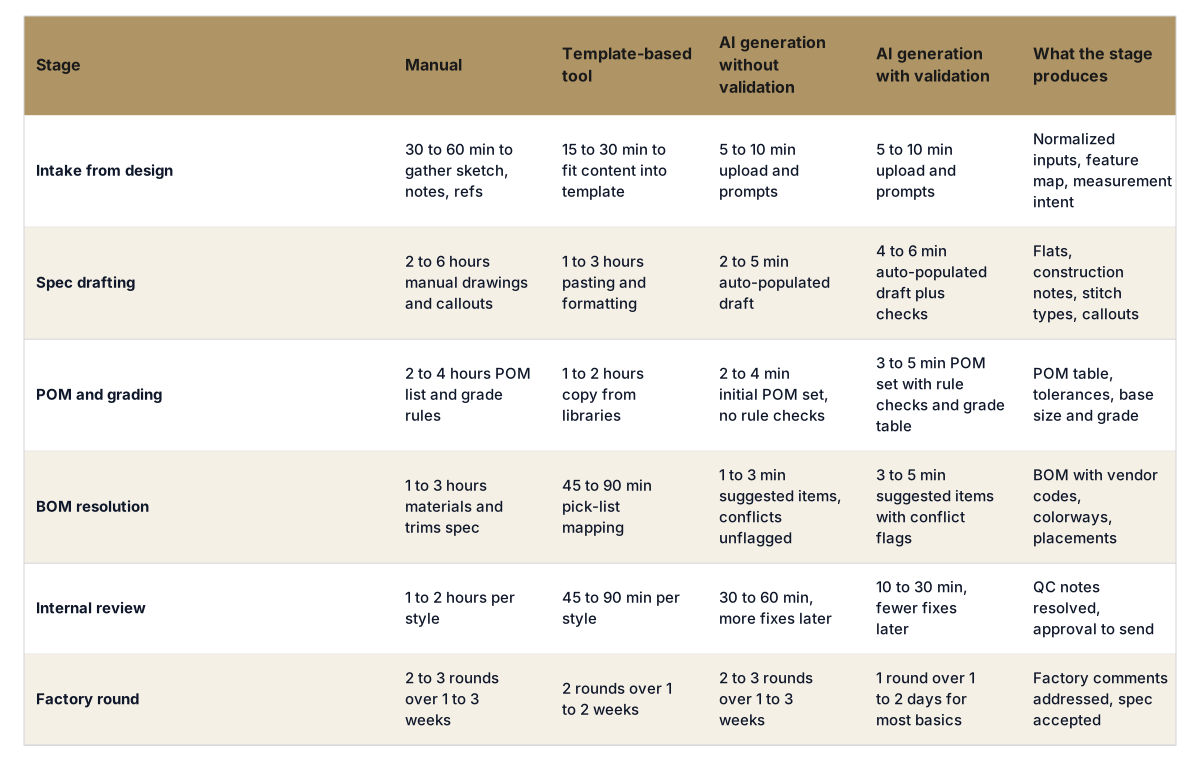
Template-based tools are strong at formatting speed but do not check logic. PLMs such as Centric or FlexPLM store the record and manage change control well. 3D tools such as CLO or Browzwear generate renders that help intent, not the handoff spec. Pattern suites or.DXF exports carry geometry, not the production instructions factories request. Validation is the step that prevents avoidable rounds.
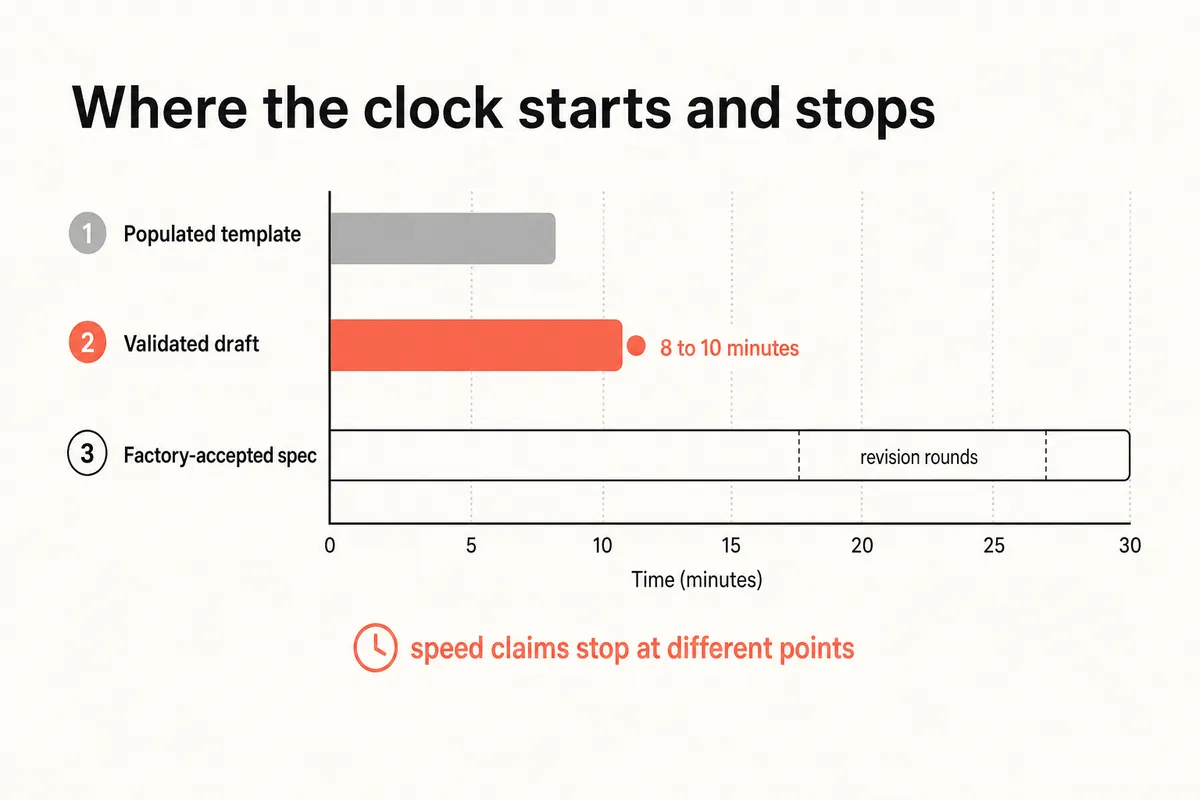
Most vendors sit in one of two camps. Generation-first tools create a draft and stop. System-of-record tools store and route the draft and assume the data is right. Neither camp validates that POMs are internally consistent, that BOM items exist and match placements, or that construction notes align with the silhouette. That is why "three minutes" and "ten minutes" usually stop at different points and cannot be compared.
The F* Word fills the gap. It is the validation and orchestration layer between creative intent and factory handoff. It generates a factory-ready tech pack in 8 to 10 minutes from a garment design, including BOM and construction notes, then runs checks before anything leaves the building. It also generates moodboards upstream so fabric direction, trims, and silhouettes are connected to the spec, not disconnected slides. See the full workflow map at AI fashion workflow and how pre-production orchestration works at Pre-production workflow. If your team needs enterprise controls and SLAs, review Enterprise and the pilot plan.
Ready to see it operate on your line plan with your BOM catalog and QA gates. See the validation step run end to end at thefword.ai.
A flat sketch, a photo of a prototype, a pattern file, or a 3D render with basic annotations is enough to start. You will get a validated draft that includes construction notes, POM with grades, and a proposed BOM. If you have a materials catalog with vendor codes, the BOM resolves faster and cleaner. If you do not, the system still drafts and flags conflicts for a human to finalize.
No. AI eliminates drafting and hunt-and-peck formatting while surfacing conflicts, so specialists can focus on decisions that matter. Tech designers still set tolerances, resolve edge cases, and approve construction. Pattern makers still own fit and balance, and their work feeds the spec rather than being replaced by it.
With validation, most basics and standard wovens see acceptance in one round. Complex outerwear and tailored garments may still require an additional pass, driven by vendor practices and seasonal workload. Validation does not eliminate factory calendars, but it removes avoidable errors that trigger extra cycles.
The window is measured from design file upload to a validated draft generated and logged, on a per-style basis. Knits and straightforward woven tops cluster at the low end, while multi-panel jackets land near the high end due to BOM and construction checks. The total elapsed time for a style, including human review and one factory round, typically fits within 1 to 2 business days when teams action comments promptly.
Get The F* Word workflow insights in your inbox.