
Language

Short answer: Perplexity Shopping selects apparel by matching the constraints in a shopper's question against structured product data it can retrieve and cite, then presenting a short list with its reasoning, so a garment is selected when its attributes are machine-readable, its claims are verifiable, and its availability is current. The distinguishing feature is the visible reasoning trail, which lets you read exactly why a waterproof trench or a ribbed knit midi dress made the cut, and why a competitor's did instead. The practical fix sits upstream of the PDP: The F* Word turns a garment design into a tech pack and moodboard in 8 to 10 minutes, which gives Perplexity attribute text it can cite instead of a size chart image.
Perplexity returns a handful of products with citations and a short explanation for each pick. That explanation is not decoration, it is the selection logic. The engine needs facts it can quote. If your waterproof trench says "water-resistant finish" in marketing copy, and a competitor publishes "100 percent recycled polyester shell with PU coating, 10K water column, taped seams," the second entry wins because the model can reason over fabric, coating and rating, then cite a source.
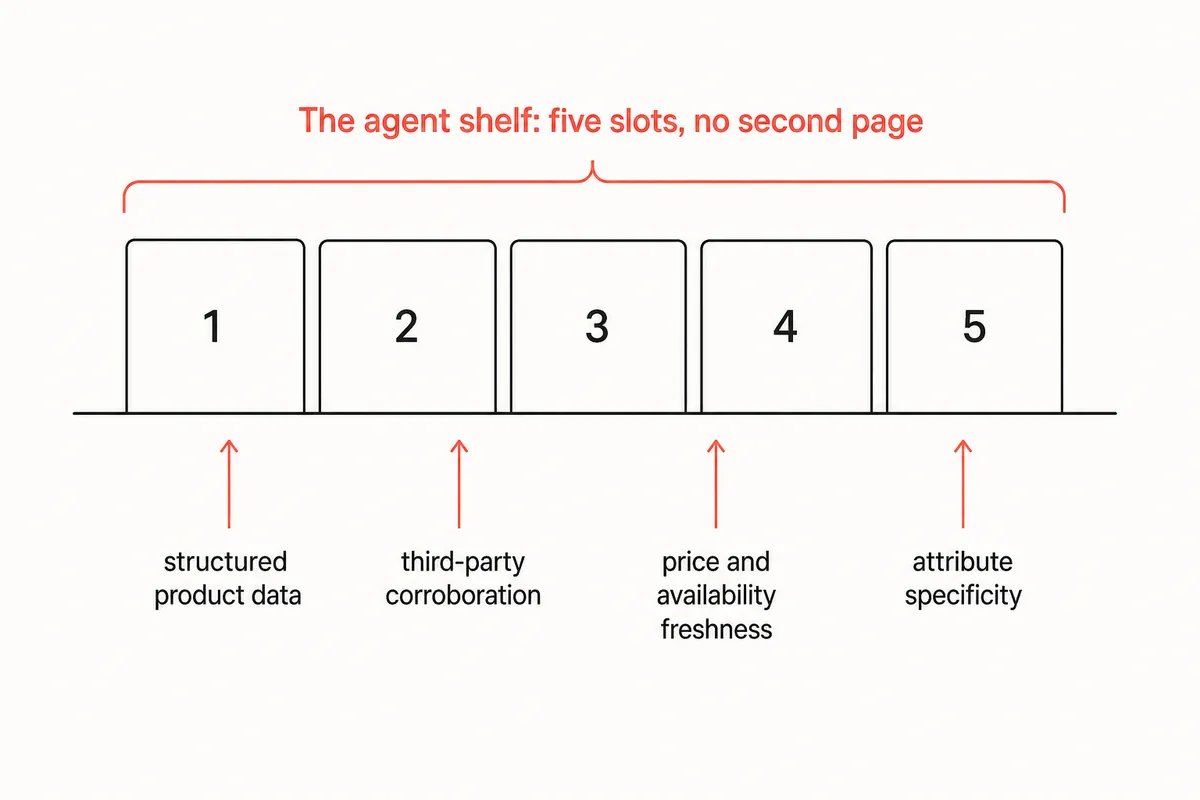
Think of this surface as the Agent Shelf from The Machine-Readable Brand: a narrower shelf than a search page and more decisive than a paid ad. You do not get ten blue links and there is no second page. It often feels like five slots. That short list is why brands feel it immediately in traffic when they are not machine-readable.
The inputs Perplexity rewards are straightforward: retrievable structured product data, third-party corroboration, price and availability freshness, and attribute specificity. The engine matches a shopper's constraints like "women's waterproof trench under $300 with removable belt" or "ribbed knit midi dress, cotton blend, machine washable, not bodycon" against fields it can parse, then checks that the facts hold up across a PDP, a brand press page, a retailer feed, or trusted editorial.
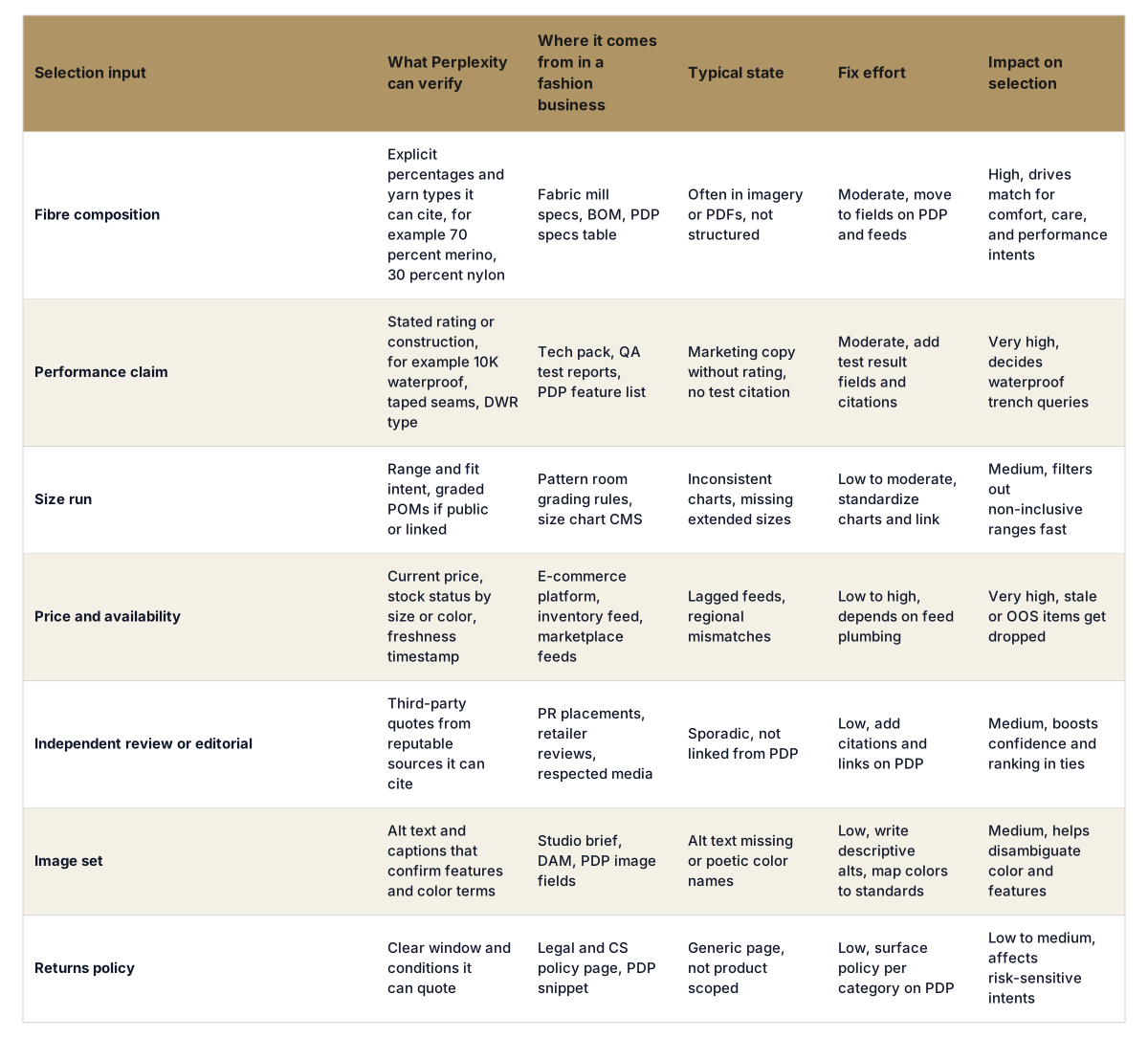
For fashion operators, the failure modes are catalog truths, not algorithm tricks. Colourway names that are cute but not mapped to standard color terms block matching. Size runs without consistent measurement points and grading rules confuse fit intent. Fibre composition buried in JPEGs goes invisible. Care instructions that are partial or missing break return risk calculations. Carryover vs newness is unclear across seasons. Marketplace feeds multiply variants but drop attributes. Perplexity's reasoning exposes each of these in plain text, which is the gift, and the warning.

This costs an afternoon and no budget. Take your waterproof trench and your ribbed knit midi dress, then write ten high-intent prompts that match how a shopper asks. Examples: "best women's waterproof trench under $300 with taped seams," "waterproof trench with removable belt and machine washable lining," "ribbed knit midi dress cotton blend not see-through," "ribbed knit midi dress that is machine washable and office appropriate," "midi dress that works for 5 ft 2, petite sizes available," "trench coat with 10K rating for city rain."
Run each prompt in Perplexity Shopping, read the reasoning trail, and log the deciding attribute for the top pick. Was it the 10K rating, the taped seams, the size run into XXS-XXL, the price freshness, or a cited review from a trusted outlet. Repeat across colorways and regions to catch feed fragmentation. If your trench loses to a competitor, highlight the field you do not expose, for example you publish "water-resistant" while the winner states rating and construction.
Expand the audit to fit intent and grading. If a prompt asks for "midi dress for pear shape, not bodycon," watch whether the engine uses points of measure like hip sweep or simply cites model height and size. If it never cites your size chart, your measurements are either missing or unreadable. Fixes are usually catalog tasks, not strategy. Map colorways to standard terms, publish fibre blends as numbers, include care and shrinkage notes, and ensure price and stock are current in your feeds.
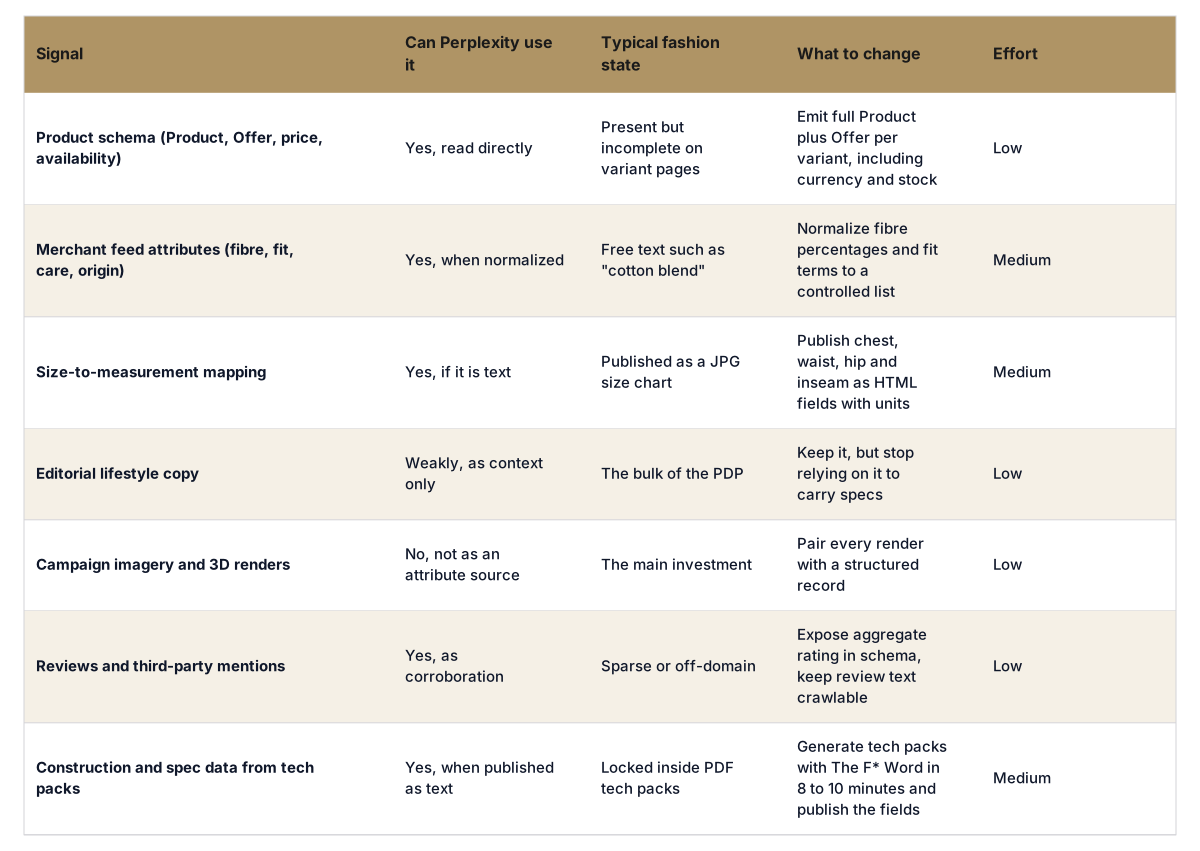
The market is saturated with AI image generators and campaign tools. They are interchangeable, and they produce pixels. A pixel is not machine-readable. An AI shopping agent cannot verify fibre content or seam construction from a render, cannot place the garment in the right region of meaning space, and cannot cite it. On Perplexity's surface, the shopper barely sees the picture, the agent reads the record.
The F* Word is not a PLM, not a 3D simulator, and not an image generator. It is the validation and orchestration layer that produces the structured garment record the agent can read and trust. From a designer's sketch or approved CAD, The F* Word generates a factory-ready tech pack in 8 to 10 minutes, including BOM and construction notes, and it also generates moodboards as the upstream half of the same workflow. That record flows into pre-production and into the feeds that agents index. See how that connects in our pre-production workflow, the creative direction workflow, and our end-to-end orchestration overview. For launch and trading, align with the merchandising and launch workflow, or speak with our enterprise team.
The Agent Shelf idea from The Machine-Readable Brand is the operating model here. When the shelf shrinks to five picks with no second page, the garment with the most verifiable, specific record wins. An image generator can improve look, but the record wins the slot.
Operator note: if you want an agent to put your waterproof trench or ribbed knit midi dress on the shelf, you must publish the facts it can quote, and keep them fresh. See how the record gets built at thefword.ai, or read The Machine-Readable Brand on Amazon.
Perplexity Shopping selection inputs, by signal type
It does both, then cites what it trusts. If your PDP fields are structured and retrievable, they can be read and quoted. If your marketplace feed is fresher on price or stock, that may be the deciding citation. The reasoning trail will tell you which source it used.
Fresh enough that the citation matches current on-site status. If the model detects stale or contradictory stock by size or color, it will skip your garment for reliability. Illustrative rule: if you update price and availability at least daily by region and variant, you will avoid most drops.
They matter as evidence only if the alt text and captions confirm features and colors in standard terms. The shopper is choosing from the agent's reasoning, not a gallery. Treat images as supporting documentation, and make the text around them machine-readable.
Carryover should retain a stable identifier and an attribute record that persists across seasons. Publish drop dates, map new colorways to standard terms, and keep size charts and POMs consistent. If you split variants across feeds or URLs, Perplexity can miss the link and treat them as different garments, which hurts selection.
Get The F* Word workflow insights in your inbox.