


TL;DR. Tech pack automation platforms dramatically accelerate merchandising workflows by instantly generating complete, factory-ready tech packs from creative inputs. Instead of waiting weeks for technical designers, merchandisers can validate range plans, run cost scenarios, and confirm product viability in minutes. This speed is achieved by using AI to translate a design concept, such as a moodboard or sketch, into a detailed tech pack containing the bill of materials (BOM), points of measure (POM), construction details, and grading. By eliminating manual data entry and cross-departmental delays, automation lets merchandising teams make faster, data-driven decisions, reduce time-to-market, and match the product assortment more closely with financial targets.
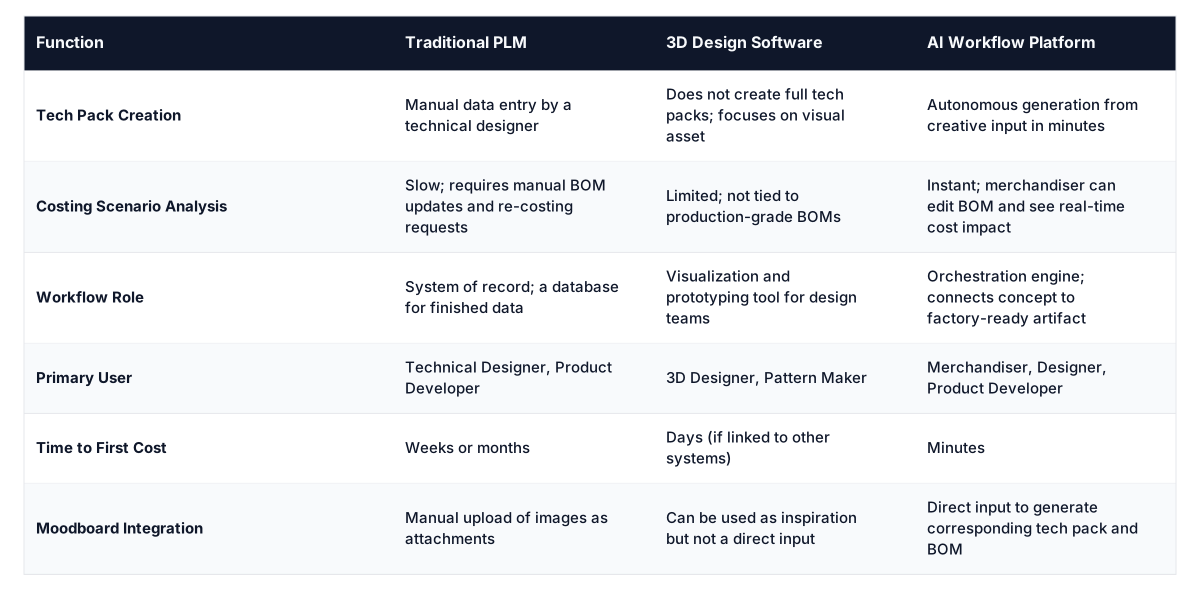
Tech pack automation is a new category of software that uses AI to autonomously generate the complete set of technical documents required for apparel production. Unlike traditional Product Lifecycle Management (PLM) systems which act as databases, or 3D design tools which focus on visualization, an automation platform functions as a workflow engine. It ingests high-level creative or product inputs, like a reference image, a text prompt, or a moodboard, and outputs a fully detailed, factory-ready tech pack. This is not a template filler. it is generative AI applied to the specific, structured needs of product development.
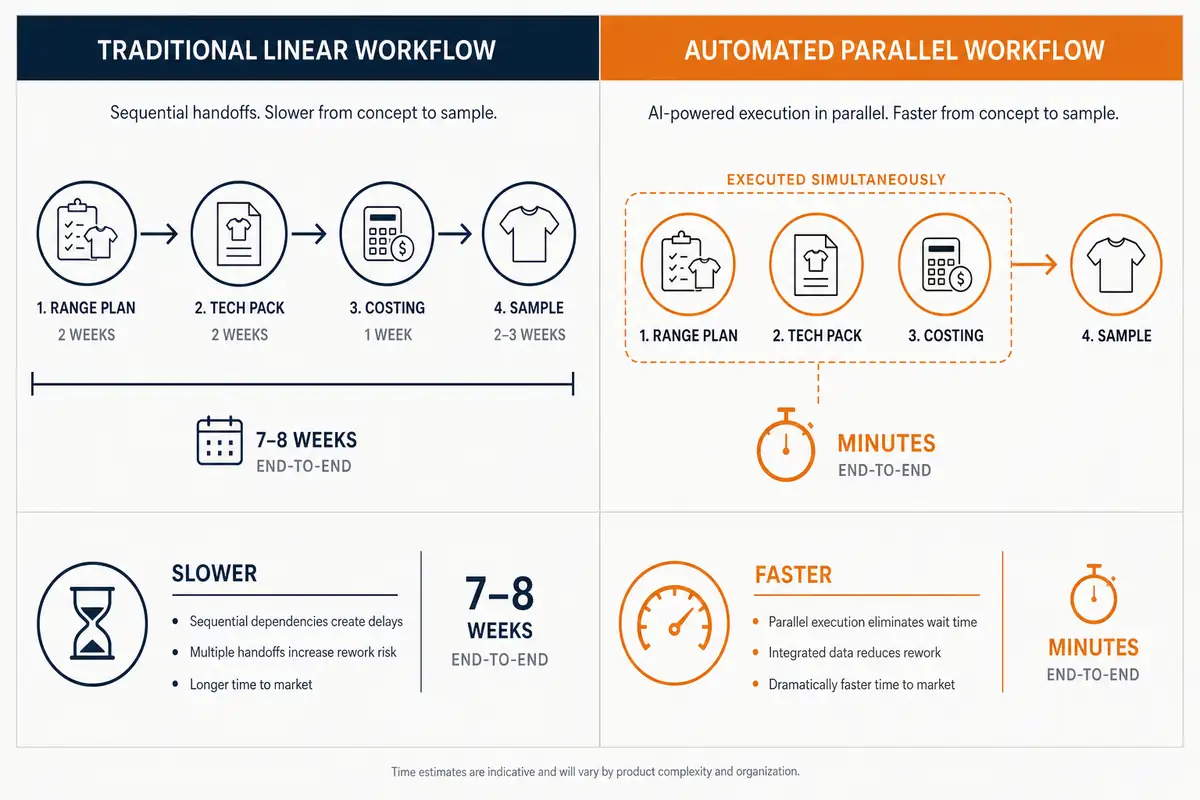
The core function is to translate a product idea into a precise manufacturing blueprint without manual intervention from a technical designer. The AI analyzes the input, identifies garment type, and then populates all necessary sections: a detailed bill of materials (BOM) with suggested trims and fabrics, precise points of measure (POM) with initial specs, construction callouts, label placement instructions, and preliminary grading rules. This process collapses a multi-week, multi-departmental effort into a matter of minutes.
For a merchandising team, this represents a fundamental shift in capability. It means a merchandiser can ideate a new SKU for their range plan and immediately have a production-ready document to begin costing analysis. The system acts as an expert co-pilot, handling the tedious, technical documentation so the human operator can focus on strategic decisions like pricing, assortment mix, and matching the product line with market trends and financial goals.
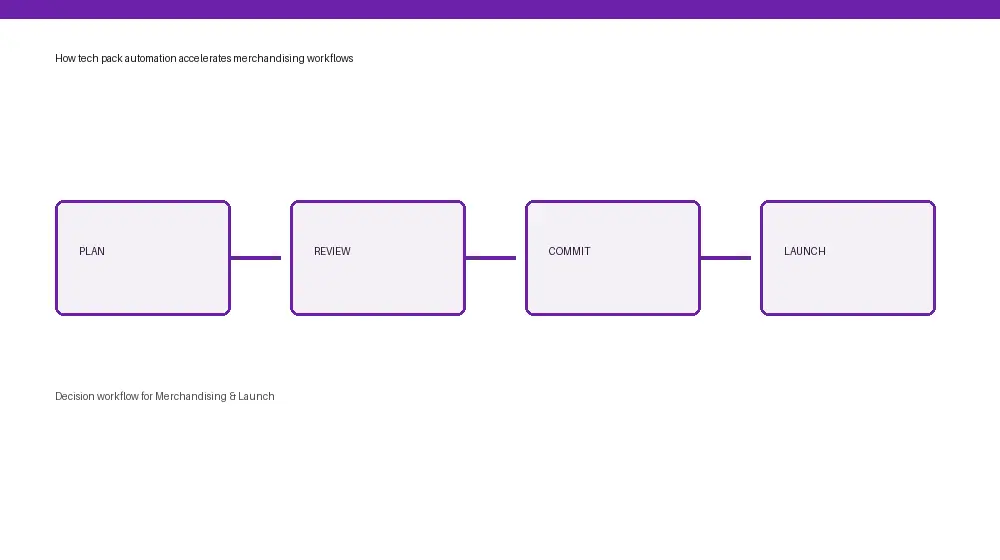
Plan your merch and launch with AI
Assortment, pricing, and launch calendar in one view. See what to ship, when, and at what margin before the sample lands.
In most fashion brands, the traditional workflow is linear, siloed, and slow. A merchandiser builds a seasonal line plan in a spreadsheet, often based on historical data and trend forecasts. Once the plan gains initial approval, the creative team develops concepts, which are then handed to technical designers. This is where the primary bottleneck occurs. The technical design team becomes a service department, manually creating tech packs for every single SKU in the collection. This is a painstaking process of data entry into a PLM system, drafting spec sheets, and coordinating with sourcing on materials.
This manual bottleneck has severe downstream consequences for merchandising. A merchandiser cannot get an accurate product cost until the tech pack, especially the BOM, is complete. This means costing and margin analysis happens weeks, or even months, after the initial range plan is conceived. If a product is projected to miss its margin target, the merchandiser must either request costly revisions, which creates more work for the technical design team, or kill the style late in the process. This cycle of delays and revisions puts immense pressure on the launch calendar and inflates development costs.
Version control becomes another major challenge. With tech packs being edited in PLM systems, BOMs living in spreadsheets, and design feedback arriving via email or chat, there is no single source of truth. A merchandiser trying to confirm the final cost for a garment may be looking at an outdated BOM, leading to inaccurate margin calculations and poor strategic decisions. The entire system relies on manual checks and balances that are prone to human error.
Range planning is the core responsibility of a merchandiser, defining the structure and financial viability of a collection. Tech pack automation transforms this from a speculative exercise into a data-driven one. When a merchandiser can generate an entire tech pack in minutes, they are no longer dependent on the technical design queue. They can create a "what-if" SKU, instantly get its production specifications, and add it to a draft assortment for immediate evaluation.
This capability allows merchandisers to build and iterate on range plans with new speed and accuracy. For example, if a merchandiser identifies a gap in the assortment for an opening price point knit top, they can use an AI workflow platform to generate three different versions: one with a standard rib, one with a pointelle knit, and one with a specialty yarn. The system would generate three distinct tech packs, each with a corresponding preliminary BOM. The merchandiser can then immediately engage sourcing for initial costing, making a decision in hours, not weeks.
This speed allows the range to be more responsive to market trends. If a key trend emerges late in the planning cycle, a merchandiser can quickly test its viability. They can generate the necessary tech pack, get an initial cost, and slot it into the line plan with confidence that it meets margin targets and production timelines. It moves merchandising from a reactive role, constrained by development timelines, to a proactive, strategic function driving the business forward.
For a merchandiser, managing margins is the core job. Traditionally, this is a reactive process. The tech pack is finalized, the sourcing team gets factory quotes, and only then does the merchandiser see if the product hits its target margin. Tech pack automation flips this model on its head by enabling dynamic, real-time costing from the earliest stages of development.
Because the AI generates a complete BOM as part of the tech pack, a merchandiser can immediately begin "what-if" cost analysis. They can duplicate a generated tech pack and edit key cost drivers directly. For instance, they can swap a specified RiRi zipper for a YKK equivalent, change the fabric composition, or alter the garment wash. The system updates the BOM, and by integrating with internal cost libraries or supplier data, it can provide an updated cost estimate on the spot. This lets the merchandiser engineer the product to a target cost, rather than discovering the cost after the fact.
This workflow enables a much more strategic approach to margin optimization throughout the entire assortment. Merchandisers can quickly identify which products are driving margin and which are dragging it down. They can make small adjustments to multiple SKUs, for example, by standardizing a common trim throughout five styles, and see the aggregate impact on the collection's overall profitability. This level of granular, real-time control was previously impossible without a massive coordination effort between merchandising, technical design, and sourcing.
A frequent point of failure in product development is the gap between the creative director's vision and the final manufactured product. A moodboard filled with aspirational images and textures can be misinterpreted by the time it becomes a technical specification document. Tech pack automation bridges this divide by creating a direct, unbroken thread from creative intent to production reality.
Workflow automation platforms like The F* Word are designed to interpret visual and text-based creative inputs. A merchandiser or designer can upload a moodboard, a sketch, or even a detailed text description of a garment. The AI analyzes these inputs to understand the intended silhouette, fabrication, texture, and construction details. It then generates a tech pack that directly shows that intent, selecting appropriate BOM components and defining POMs that match the desired aesthetic.
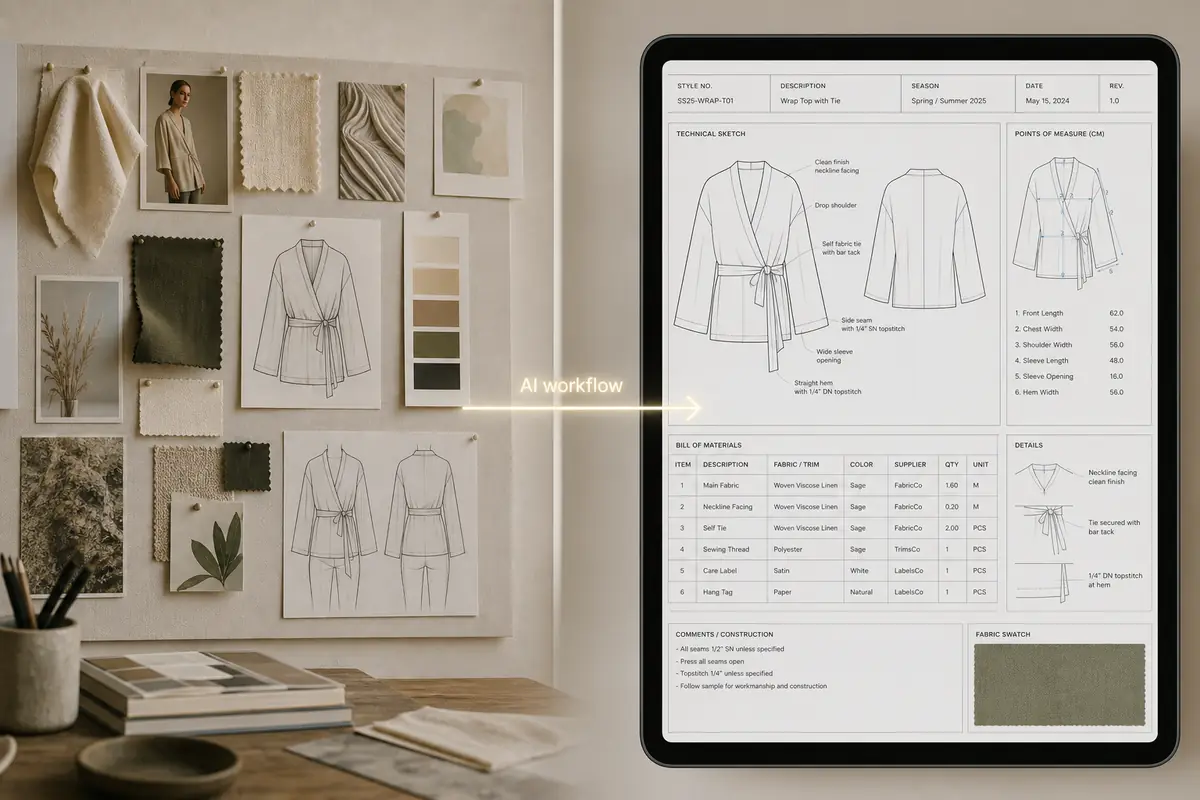
This creates a powerful validation loop. The creative director can review the AI-generated tech pack and BOM to confirm that their vision has been accurately captured before any major time or resources are invested. For merchandisers, this de-risks product development. It ensures that the product they are planning and costing is the same product the creative team envisioned, preventing late-stage surprises and costly rework that can derail a launch calendar.
The number of sample rounds is a critical KPI for any fashion brand. Each round adds weeks to the calendar and major cost in materials, shipping, and factory time. The primary driver of multiple sample rounds is inaccurate or incomplete tech packs. When a factory receives a tech pack with vague instructions, incorrect measurements, or a missing trim specification, they are forced to make their best guess. The resulting sample is often wrong, triggering a cycle of corrections and new requests.
Tech pack automation directly attacks this problem by improving the quality and completeness of the initial tech pack. Because the AI is trained on hundreds of thousands of successful production documents, it produces highly detailed and logically consistent specifications. It doesn't forget to include fusible placement, specify thread type, or define tolerances. This clarity and precision minimize ambiguity for the factory, dramatically increasing the likelihood that the first sample is correct.
For a merchandiser, reducing sample rounds from three or four down to one or two has a massive impact. It can shave four to six weeks off the product development calendar. This acceleration means products hit the market faster, allowing brands to better capitalize on trends. It also directly reduces Cost of Goods Sold (COGS) by eliminating the expense of unnecessary samples. FINALLY, it allows the merchandising team to operate a more agile and profitable business model.
While automation handles the generation of documents, its impact on team collaboration is major. By removing the low-value, administrative task of manual tech pack creation, it frees up highly skilled team members to focus on more strategic work. Technical designers are no longer buried in data entry. they can transition to a role of quality assurance, exception handling, and innovating on complex construction challenges.
Automation platforms serve as a single source of truth that is accessible to all stakeholders. When a merchandiser runs a cost scenario by swapping a fabric, the sourcing lead can be automatically notified to begin vendor negotiation. When a designer attaches a new reference image, the product development manager can see the context immediately. This eliminates the endless back-and-forth emails and the risk of teams working from outdated information locked in spreadsheets.
This collaborative environment is faster and less prone to error. It allows merchandising teams to lead the product creation process with more authority and data. Discussions about product viability are no longer theoretical. they are grounded in a tangible, complete tech pack that is available from day one. This supports a more matched and efficient organization, where every department from creative to sourcing is working in concert to achieve the merchandiser's range plan and financial targets.
Yes, it is exceptionally well-suited for fast-fashion cadences. The ability to generate a factory-ready tech pack in minutes allows teams to go from trend identification to production-ready design in a single day. This speed is critical for weekly or bi-weekly drop models, enabling brands to react instantly to market signals and competitor movements without the traditional weeks-long development bottleneck.
Late-stage edits are significantly easier. Instead of initiating a complex, manual revision process throughout multiple departments, a merchandiser can simply clone the existing product in the AI platform and apply the change. For example, changing a colorway or modifying a sleeve length can generate an updated tech pack and BOM instantly. This agility reduces the friction and cost associated with last-minute adjustments to the line plan.
Absolutely. This is a primary benefit. A merchandiser can independently generate a tech pack and then create multiple versions to test cost implications. By editing BOM components like fabric, trim, or even stitch type in the platform, they can model different cost scenarios in real-time. This lets merchandisers proactively engineer products to meet margin targets without needing to wait for technical design resources.
The learning curve is minimal because the interface is designed for the merchandiser's workflow. Instead of navigating complex PLM fields, the user interacts through intuitive inputs like text prompts or image uploads. Running "what-if" scenarios feels more like using a modern web application than a legacy enterprise system. Most teams can become proficient in a few hours of training, focusing on strategic outcomes rather than software operation.
No, tech pack automation platforms are designed to be workflow layers that integrate with, rather than replace, existing systems like your PLM. The AI platform generates the tech pack, which can then be automatically pushed into your PLM system to serve as the official system of record. This allows you to gain the speed and efficiency of automation without disrupting your company's existing data infrastructure.
It improves accuracy by eliminating manual data entry, which is a major source of human error. The AI generates a complete and internally consistent tech pack, ensuring that details like fabric codes in the BOM match callouts on the construction page. For merchandisers, this means the data used for costing and planning is reliable from the start, reducing the risk of basing strategic decisions on incorrect information.
Yes, the AI can handle major complexity. It is trained on vast datasets of garments, including outerwear, tailored pieces, and items with complex construction. While highly novel or avant-garde designs may require a final review by a technical designer to handle unique exceptions, the platform provides a production-ready baseline that is 90% or more complete, even for complex products. This allows expert staff to focus their time on true innovation.
Automating the tedious aspects of product creation allows your merchandising teams to focus on strategy, profitability, and speed to market. By instantly translating creative concepts into cost-aware, factory-ready tech packs, The F* Word gives your brand a decisive advantage. See the launch workflow in action and discover how to accelerate your entire merchandising process. You can explore a complete overview of our solutions in the AI for Merchandising and Launch hub.
Related: AI tech pack generator
Explore the related workflow. Read the related guide. Read the related guide. Try The F* Word.
Get The F* Word workflow insights in your inbox.