
Language
Direct answer. Learning how to become a technical designer requires mastering garment construction, patternmaking, and modern digital workflows. You must combine traditional fitting expertise with applied artificial intelligence skills to succeed in 2026. Employers expect candidates to build accurate tech packs, evaluate fit corrections, and use AI tools for automated sizing and trend extraction. Securing a role involves creating a specialized technical portfolio, obtaining relevant AI certifications, and directly pitching your qualifications to brands actively hiring for digital-first design positions.
Technical designers focus on how clothing actually fits on a human body. You must understand grading rules, ease allowances, and advanced patternmaking techniques to excel in this role. Your daily tasks will involve taking a concept sketch and translating it into a factory-ready specification sheet.
Precision is a non-negotiable trait for technical design professionals. You will conduct fit sessions on live models, measure garments against approved specs, and write detailed comments for overseas manufacturers. Clear communication ensures factories understand exactly how to correct a gaping neckline or an uneven hem.
Companies value candidates with a strong foundational knowledge of fabrics and materials. Different textiles require specific sewing techniques and tension adjustments during production. Mastery of these physical elements remains essential even as the industry adopts digital workflows globally.
Artificial intelligence provides significant advantages for technical designers compiling factory data. You can now process physical samples and reference garments instantly using digital tools. The F* Word provides a free AI scanner that reads images and extracts fabric, color, trend, and size data in seconds.
This automated extraction replaces hours of manual measuring and data entry. You can upload reference photos of a successful fit block, and the AI scanner will map out the precise dimensional data needed for your tech pack. Efficiency at this stage allows you to focus on complex fit corrections rather than basic data transcription.
Technical designers who master AI extraction reduce sampling errors significantly. Accurate initial data means the factory produces a better first prototype. Brands actively seek designers who use these tools to shorten the overall product development calendar.
A standard sketch portfolio will not help you secure a technical design position. Hiring managers need to see comprehensive tech packs, graded specs, and detailed construction callouts. You must present this information clearly to demonstrate your readiness for an associate or senior role.
The F* Word offers an AI fashion designer tool for hands-on garment design work alongside an AI portfolio builder that compiles your technical projects into a public, shareable portfolio. You receive a free Portfolio Score out of 100 as a baseline diagnostic to identify blind spots in your presentation.
Organizing your work digitally allows employers to review your technical capabilities instantly. Your portfolio should highlight how you integrate traditional fit knowledge with modern software tools to solve real-world production challenges.
Education requirements for technical design have shifted toward applied software skills. University degrees provide a foundation, but specialized certifications prove you understand current technology. Employers prioritize candidates who can demonstrate immediate proficiency with modern drafting tools.
Using the AI scanner, the AI fashion designer, and the AI portfolio builder on The F* Word earns you the industry's first and only free, hands-on AI Fashion Design Certification. This credential comes with absolutely no paywall and validates your ability to operate modern design software confidently.

Adding a verifiable certification to your resume immediately sets you apart from applicants using outdated workflows. Technical design roles demand high accuracy, and this certification proves you have tested your skills in a practical environment.
The transition from traditional methods to modern practices requires specific skill upgrades. Understanding the exact differences helps you focus your training on areas that employers actually care about in 2026.
The table below outlines how specific technical design responsibilities have shifted. You can use this matrix to identify gaps in your current training and adjust your career strategy accordingly.
| Responsibility | Traditional Method | 2026 AI-Assisted Workflow |
|---|---|---|
| Spec Measurement | Manual tape measuring | Automated AI image and size data extraction |
| Fabric Analysis | Physical hand-feel testing | AI scanner material and composition mapping |
| Portfolio Presentation | Printed binders or static PDFs | Diagnostic-scored public portfolios |
| Job Application | Cold emailing HR departments | Direct pitches via tailored job fit scores |
The final step in learning how to become a technical designer involves strategic job hunting. Mass applying to generic job boards rarely yields positive results for specialized technical roles. You need a system that matches your specific grading and tech pack skills with brands actively looking for those exact qualifications.
The F* Word provides a live job feed called Briefs. This feature surfaces open fashion industry roles ranked by a fit score based on your profile. You can attach your certified portfolio and pitch directly to the hiring brand.
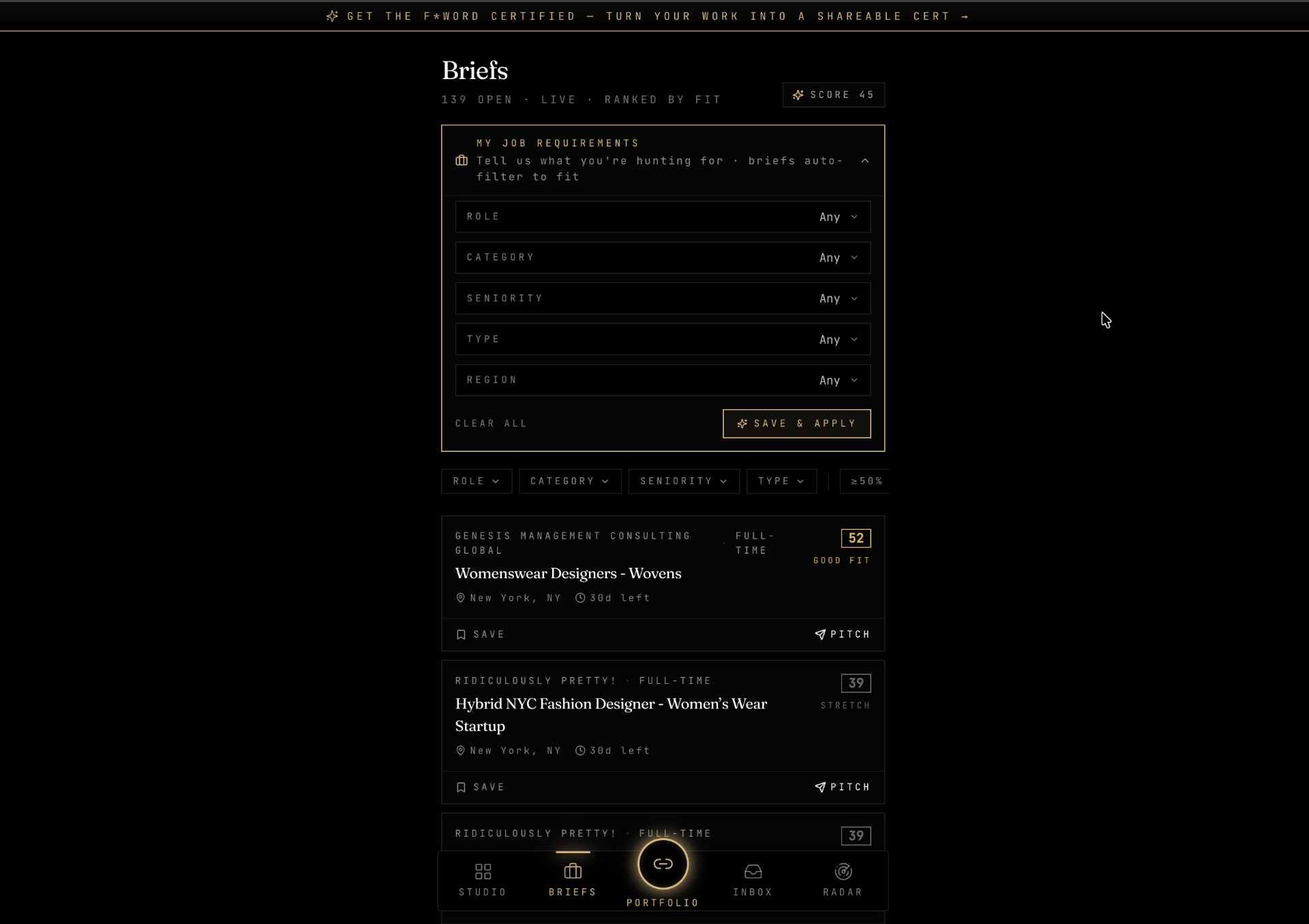
This targeted approach ensures your technical projects reach the production managers making the hiring decisions. High fit scores give you the confidence to apply for roles where your specific mix of traditional construction knowledge and AI tool proficiency is highly valued.
While many professionals hold degrees in fashion design or garment technology, specialized certifications often carry more weight in 2026. Real-world experience with tech packs, grading, and a validated portfolio can supplement or replace formal education.
Technical designers rely on vector illustration tools, PLM (Product Lifecycle Management) systems, and AI applications. Mastering data extraction tools and digital patternmaking software is mandatory for modern production workflows.
Mastering the basics of grading and fit usually takes two to four years of study and practice. You can shorten your job search timeline through targeted AI tool training and building a diagnostic-scored public profile.
Ready to upgrade your production skills and secure your next technical role? Access the AI scanner, build your verified portfolio, and earn your free certification entirely within the AI Fashion Studio.
Get The F* Word workflow insights in your inbox.