Language
To make a digital fashion design portfolio, show both concept and factory readiness: moodboards, on-body visuals, flats, specs, and a tech pack. The F* Word covers the production side by drafting a factory‑ready tech pack in 8 to 10 minutes from a sketch, photo or design and by running validation checks on specs, tolerances and BOM before samples are cut.
Build your book like a mini collection. Start with a tight story, prove material and fit decisions, then end with a clean handoff. Students win interviews with clarity and proof of process. Brand teams use the same skill to cut sample rounds and speed approvals, which saves time and budget in the season calendar.
A good portfolio makes it easy to see your taste, your build quality, and how you hand work to production. A short set that hits mood, silhouette, finish and spec often beats a long reel of loose ideas. Aim for one page per garment and a fast scroll. Recruiters scan first; they read later.
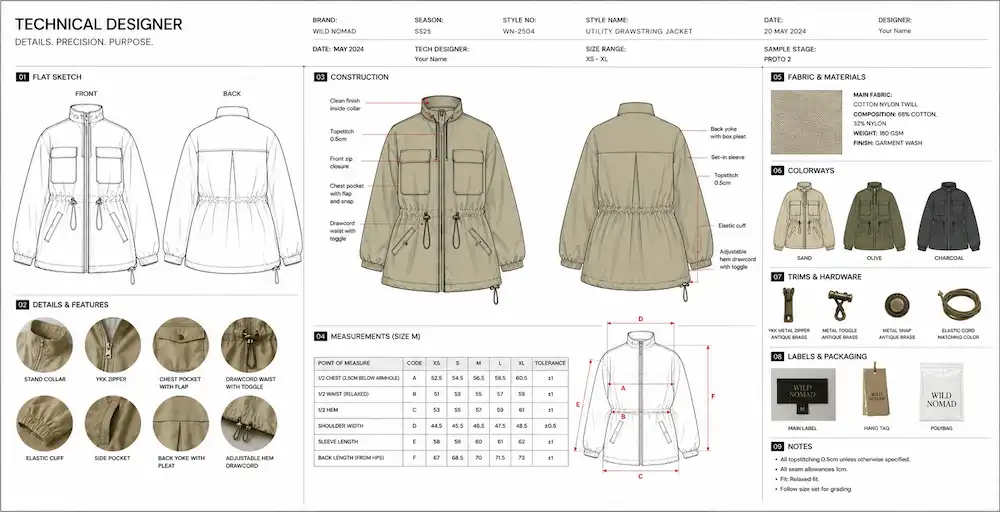
Include five proof points per style: 1) a concise moodboard, 2) one on-model or styled render, 3) front and back flats, 4) key specs with points of measure and tolerances, and 5) a tech pack snapshot with BOM and construction notes. The F* Word State of AI Fashion 2026 reports that 75% of practitioners spend more than an hour per tech pack by hand and 45% spend more than four hours, so clear specs signal you can do hard work on time.
If you target internships or junior roles, two to three finished styles with this depth is enough. For in-house paths, show one style taken through to a factory-ready tech pack to prove handoff. For brand teams, add a page on how you reduce sampling risk. The same report notes that adopters move from four sample rounds to two and that 60% of teams still run four or more rounds, so proof of spec quality helps hiring managers see cost impact.
Here is how common tool categories map to a portfolio that must convince design leads and production to say yes.
| What it is | Good for | Factory readiness and validation | |
|---|---|---|---|
| The F* Word | AI that drafts a factory-ready tech pack from a sketch, photo or design | Moodboards, on-model visuals, and a tech pack with BOM, points of measure, grading and construction notes | Runs validation checks on specs, tolerances and BOM before samples are cut; built for handoff |
| AI image generators (Midjourney, Resleeve) | AI image or concept generation for fashion designs | Fast concept art, variations, and look ideas for the top of the funnel | Category focuses on images, not spec validation or factory-ready tech packs on public pages |
| 3D garment simulation (Style3D, CLO 3D) | 3D garment simulation and digital sampling | Fit visuals, fabric drape studies, and virtual samples to refine design intent | Use with PLM or tech pack tools for handoff; validation checks are not the category's focus |
| PLM systems (Centric, Lectra) | Systems of record for product data | Version control, approvals, and cross-team tracking once specs exist | Handoff depends on what you attach or link; spec validation is process-driven |
| Tech pack templates (Techpacker) | Tech pack templates and collaboration for brands and factories | Organized pages and exports for factories once content is authored | Content quality and checks depend on your team; focus is templates and sharing |
Keep the file size lean and the section order stable. Use consistent type, callout boxes, and a short caption on every page so a design lead can scan in under two minutes. Put the spec and tech pack at the end of each style so the story flows from concept to handoff without a detour.
The F* Word is not a PLM, not a 3D simulator and not a general image generator. It sits where most junior books go thin: the production handoff. It drafts a factory-ready tech pack in 8 to 10 minutes from a sketch, photo or design and attaches BOM, points of measure, grading and construction notes. It then runs validation checks on specs, tolerances and BOM before samples are cut, which protects your book from preventable misses.
Why this matters to a hiring team: The F* Word State of AI Fashion 2026 reports that full reviewed and released tech packs take 45 to 90 minutes with AI in the loop against a 4 to 16 hour manual baseline. Faster, cleaner handoffs reduce the coordination tax of moving work between nine tools per collection on average. The Machine-Readable Brand notes that "the tech pack is a living record: versioned, approved, linked to its BOM and size chart. The PDF export freezes it and severs every link" and that "artifact liquidity is the degree to which such an object can move between people, systems, and partners without getting scrambled, outdated, stripped of context, or separated from its approvals." Use that lens to judge your portfolio pages.
For students and early-career designers, showing a validated spec is the strongest proof you understand how brands spend. The State report models that approvals move from four sample rounds to two with AI adoption, and sample rounds cost about 200 to 1,500 dollars per round per style on teams surveyed. Your book should read as time saved and risk removed, not only a mood.
Lead designers scan for signal that your designs can move to factory without loss. In your book, use links or embedded pages that preserve BOM, size tables, and approvals when reviewers click through.
If you need a refresher on where image tools stop, read our guide to AI image generators and where they stop in apparel at thefword.ai/ai-fashion-image-generators-where-they-stop. For a full map of tool categories and how they fit together, see our AI fashion design software comparison at thefword.ai/ai-fashion-design-software-comparison. If you are new to spec work, this primer on becoming a technical designer explains the path and why AI skills matter now at thefword.ai/how-to-become-a-technical-designer-and-why-ai-skills-now-matter.
If you design inside a brand, apply the same portfolio moves to your internal line reviews. The Machine-Readable Brand frames success as artifact liquidity. Keep living tech packs linked to source data for style changes and buy meetings. If you freelance, send a stable link and a trimmed PDF so a client who forwards your work does not strip the context that proves fit, BOM, and tolerances.
Ready to turn your sketches into factory-ready work and a portfolio that reads fast to hiring teams? Try The F* Word's free AI fashion design tools at aifashion.thefword.ai.
Turn one concept into a finished page with flats and a spec to signal you can land work. Add points of measure and tolerances for the main size. Then use The F* Word to generate a factory-ready tech pack draft that fills the BOM and construction notes so your story ends on a handoff.
Recruiters skim for clarity, then dig into one style that proves you can ship. Show one clean process strip for a hero garment and end with the spec and tech pack snapshot. The F* Word State of AI Fashion 2026 links faster reviewed tech packs to shorter approval cycles, so the production page matters.
Use both. A PDF is quick to open in email, then include a link to your living spec or tech pack page so buyers and technical leads can see the full record. Every export and forward loses context, so a link helps you keep BOM, size charts, and approvals connected for anyone who forwards your work.
The F* Word cuts the time to a first tech pack draft to 8 to 10 minutes and runs validation checks on specs, tolerances and BOM before samples are cut. The State report found teams still juggle nine tools per collection on average, so a faster, cleaner handoff reduces errors, trims sample rounds, and keeps the line on calendar.
Get The F* Word workflow insights in your inbox.