Product Feed Optimization for Fashion: One Record, Every Destination
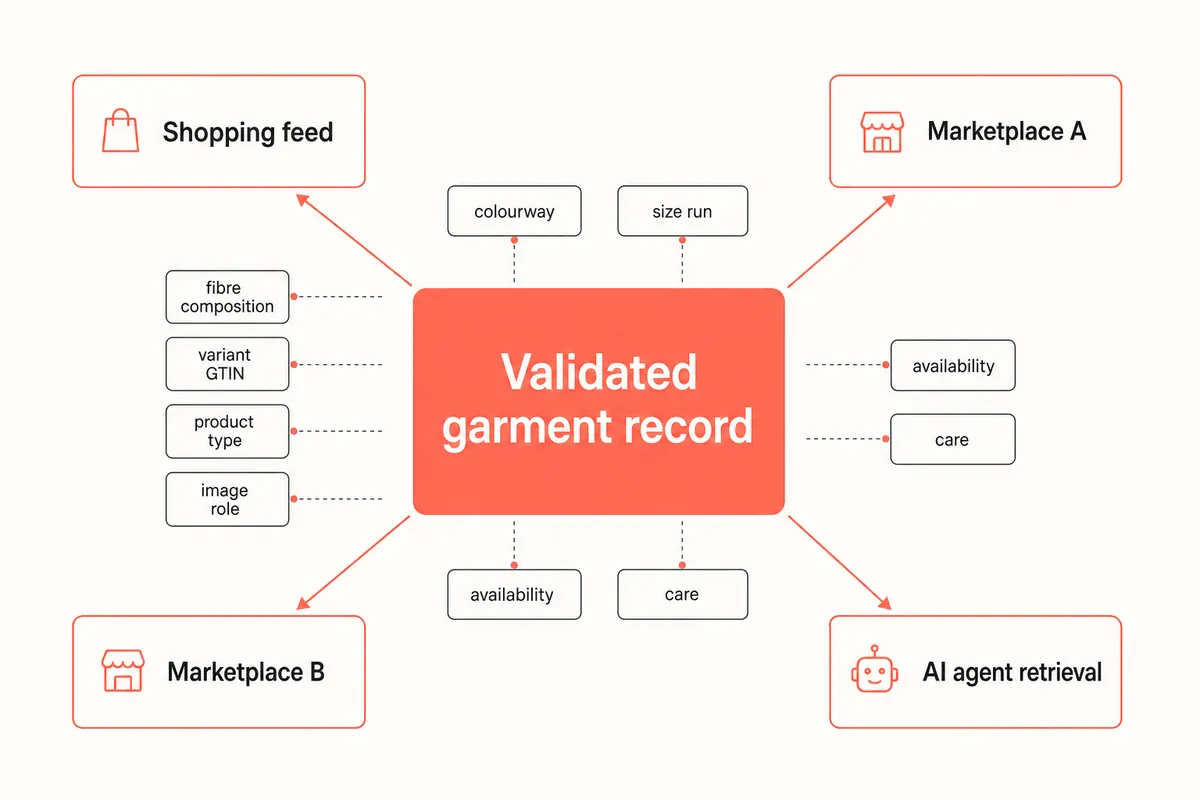
2,400 records is what a 600 SKU brand ends up maintaining when it ships to a shopping feed, two marketplaces, and a retail partner. Every time a merchandiser corrects a colourway from Sunset Glow to Orange, the same fix is keyed into four different templates. That is time you never get back, and it is the wrong place to fix it. The fix belongs upstream, at the garment record. Optimize the record, generate the feeds.
Opening insight: one record, every destination
Work the way machines read. The modern catalog has two readers: the destination feed validator and the AI agent that sits between the shopper and your catalog. Both want the same thing. They want a structured record for each variant of a specific garment. Not a campaign image, not a mood, not a collage. A ribbed knit midi dress in three colourways and five sizes is 15 variants. A waterproof trench in two lengths, four colours, and eight sizes is 64 variants. Each variant has its own identity, its own availability, and its own evidence.
Most teams still frame this as a channel problem. They split into a shopping feed spreadsheet, a marketplace template, a second marketplace template, and a retailer EDI or PIM upload. Then they repeat the same corrections four times. That approach bakes inconsistency into the calendar. The right framing is single source of truth. Build the garment record once with machine placement data and machine recommendation data. Generate every destination feed from that record. Use diff automation to keep parity as ranges shift season to season.
Pixels do not solve this. The market is saturated with AI image generators and campaign imagery tools. They produce pixels. A pixel is not machine-readable. An AI shopping agent cannot verify fibre content from a render, cannot file the trench in the right waterproofing cluster, and cannot cite it. The F* Word is not an image generator. It is the validation and orchestration layer that produces the structured garment record so feeds pass and agents read with confidence. See how this plugs into drops and launch in the Merchandising and Launch workflow.
The problem with the popular framing
The popular framing treats feed readiness as a last-mile formatting task. You hear phrases like mapping, export, and syndication. That mindset misses where errors are born. The errors live inside the record fields that are uniquely dangerous in apparel: colourway naming versus standard colour references, size run and grading across regions, fibre and blend composition with percentages, care and wash, GTIN per variant, fit intent, product type taxonomy mapping, image role tagging, availability and lead time, and seasonal drop and carryover flags.
Fixing those at the feed level is a losing game because destinations treat many missteps as silent downgrades. A marketplace will not reject a vague colour; it will just rank lower in colour filter use cases. An AI agent will not throw an error on an unparseable composition string; it will skip the garment because it cannot explain or cite it. The cost is invisible until you realise ads are burning budget on out-of-stock variants and agents are skipping your ribbed knit midi dress when a shopper asks for a machine washable body-skimming knit under 200 USD.
In The Machine-Readable Brand by Nitin Kumar, Rosmon Sidhik and Akanksha Lokam (The Machine-Readable Brand, The F* Word Press, 2026), the single number to manage is called Read Yield. It is the percentage of variants that a destination or agent can read, verify, and rank without manual override. Feed quality and agent readability are the same project with two reporting lines. You raise Read Yield by fixing the record first.
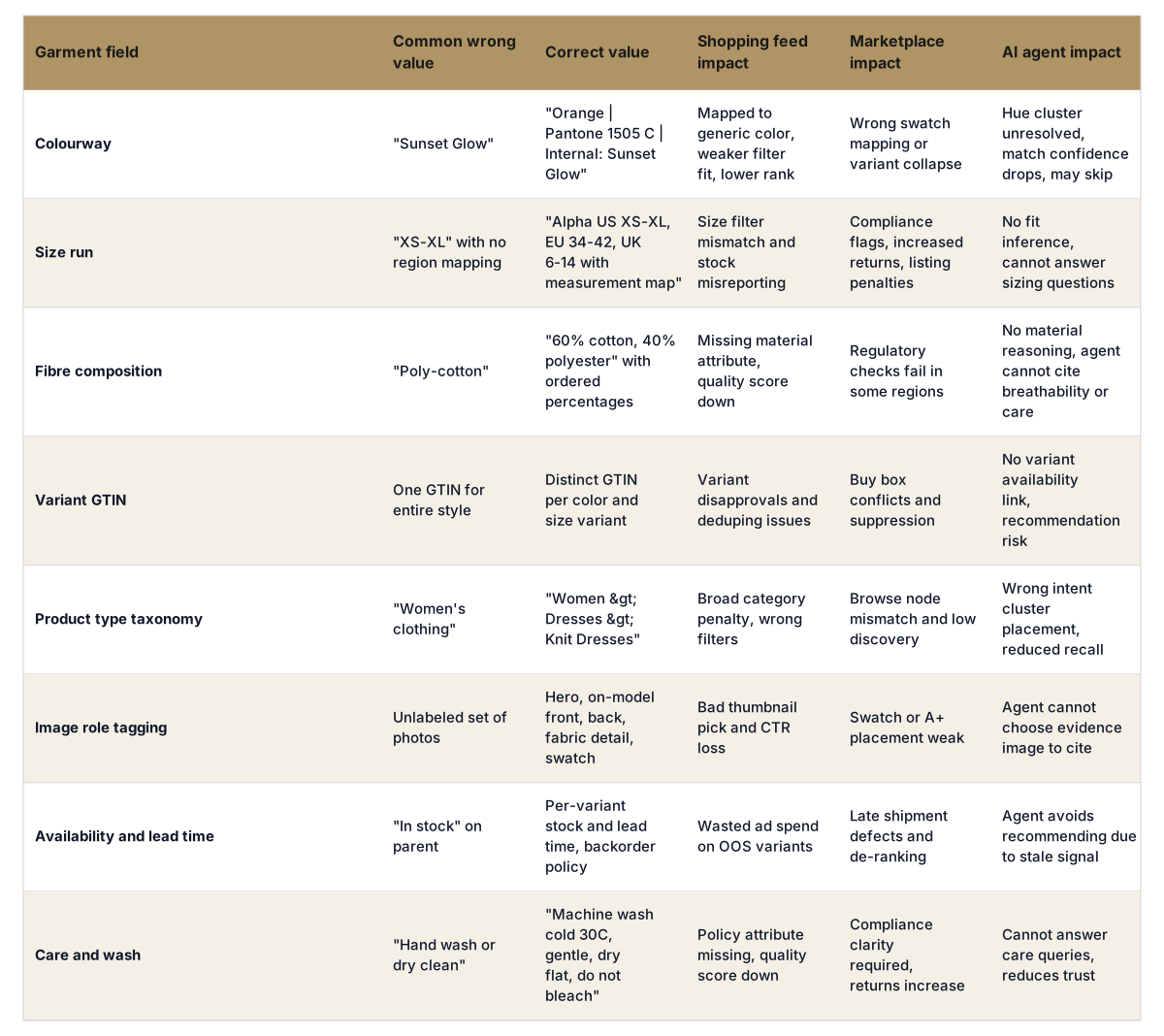
Side-by-side: what breaks feeds and agents
Apparel fields that commonly fail, the correct value, and their impact when wrong
What a feed-ready garment record requires
Production-ready means that a ribbed knit midi dress and a waterproof trench can be read the same way by three independent readers: a shopping feed validator, a marketplace ingestion process, and an AI agent responding to a shopper query. Here is the field-by-field standard that achieves that. The examples below are illustrative.
Colourway naming and standard references. Wrong: Sunset Glow on its own. Correct: Orange | Pantone 1505 C | Internal: Sunset Glow. The standard color lets feeds map to filters and swatches. The internal name keeps your palette language intact for the lookbook. Many marketplaces will not reject your poetic name, they will just bury it in color-filter journeys. AI agents tie the Pantone or standard color to the shopper intent and to proof in the image set.
Size run and grading across regions. Wrong: XS-XL with no region mapping for the trench. Correct: Alpha US XS-XL, UK 6-14, EU 34-42, and a measurement map for chest, waist, hip, sleeve, and body length. Include both alpha to numeric equivalence and the grading delta by point of measure. Shopping feeds need size filters that match regional storefronts. Marketplaces track returns by fit claims. Agents use the grading delta to reason about fit intent such as body-skimming versus relaxed.
Fibre and blend composition with percentages. Wrong: poly-cotton for the knit dress. Correct: 72% viscose, 28% nylon for the ribbed knit midi dress shell; for the waterproof trench, 100% recycled polyester shell with PU membrane, lining 100% recycled polyester. Order by descending percentage. Include membrane or coating where used. Some regions have strict fiber labeling requirements. Agents use composition to infer attributes like breathable, stretch, and water resistance, and to answer care questions with citations.
Care and wash. Wrong: hand wash or dry clean for everything. Correct: Machine wash cold 30C, gentle cycle, dry flat, do not bleach for the knit; Wipe clean, do not dry clean, close all fastenings before washing for the trench, plus heat and iron limits. Feeds factor care into quality scoring. Marketplaces want clear policy text. Agents cannot responsibly recommend a merino crew to a shopper who asked for machine washable if the care is missing or vague.
GTIN and variant identity. Wrong: one GTIN for the entire style code of the trench. Correct: a distinct GTIN for each color and size variant, for example BLACK-SHORT-US-M. Apparel is different from most categories because each variant is a product that can be in or out of stock, can ship on a different lead time, and can carry a different price. Many marketplaces silently collapse variants that share identifiers. An AI agent will not recommend a variant if it cannot tie availability and price to the exact request such as Stone, long length, US 10.
Fit intent. Wrong: none, or using marketing adjectives only. Correct: Body-skimming for the ribbed knit midi dress with key measurements at size M, and Relaxed with room for a sweater for the trench, with a stated ease model. This is not a CMS blurb. It is a structured field backed by measurements. Feeds do not ingest fit intent today as a standard, but marketplaces and agents use it to answer return-prone queries and to pick the right image to evidence the claim.
Product type taxonomy mapping. Wrong: Women's clothing for the knit dress. Correct: Women > Dresses > Knit Dresses for Google Product Taxonomy, and the equivalent browse node for each marketplace. Destination taxonomies are not the same. Your record needs a normalized internal type and a mapping layer out to each destination code. A mis-mapping is rarely rejected outright. It is silently downgraded through wrong filters and weak browse placement.
Image role tagging. Wrong: 8 images dropped into a gallery. Correct: tag the hero on white, on-model front, on-model back, three-quarter, detail of rib texture, fabric swatch, and context shot for the trench showing hood and storm flap. Shopping feeds use role to pick the thumbnail. Marketplaces use role to drive A+ placements and swatches. Agents use role to cite proof of a claim such as taped seams for waterproofing.
Availability and lead time. Wrong: In stock at parent level. Correct: Per-variant on-hand and a stated lead time for backorder. The trench may be in stock in Black US 8 and on a 12-day lead in Moss US 12. Feeds and marketplaces penalize late shipments and stale availability. Agents avoid recommending variants if the availability freshness cannot be verified.
Seasonal drop and carryover flags. Wrong: bury season in a free-text title like FW26 Drop 2. Correct: structured fields Season: FW26, Drop: 2, and Carryover: true on the merino crew that repeats every year. Shopping feeds use these as custom labels to steer bidding. Marketplaces use them in merchandising events. Agents use them to understand newness, to de-prioritize end-of-season outliers, and to keep continuity for successful carryovers.
Once these fields are present and correct, your record is production-ready. You should expect materially higher Read Yield. That means more of your ribbed knit midi dress variants make it through validation, get indexed into the right filters, and answer the shopper's query with confidence. It also sets up the next step: generate the feeds with mappings and constraints per destination. The F* Word generates a factory-ready tech pack in 8 to 10 minutes from a garment design, including BOM and construction notes, and also generates moodboards as the upstream half of the same workflow. The F* Word is NOT a PLM, 3D sim, or image generator. It is the validation and orchestration layer that turns designer intent into a machine-readable garment record. Read more on upstream work in pre-production workflow and in creative direction.
What production-ready means for the ribbed knit midi dress and the trench
Let's run the two garments end to end so you can see real fields.
Ribbed knit midi dress. Colourway: Orange | Pantone 1505 C | Internal: Sunset Glow. Sizes: US XS-XL with mapping to UK 6-14 and EU 34-42, grading delta set at 2 cm hip across sizes. Composition: 72% viscose, 28% nylon. Fit intent: body-skimming, waist ease 2 cm at size M. Care: machine wash cold 30C, gentle, dry flat. Product type: Women > Dresses > Knit Dresses. Images: hero on white, on-model front, on-model back, close-up rib detail, fabric swatch. Variant GTINs: one per color-size. Availability: per variant, with lead time for two replenishing sizes. Season: SS26, Drop 1, Carryover: false.
Waterproof trench. Colourways: Black, Stone, Moss with CIELAB or Pantone references. Sizes: numeric and alpha mapping across regions, long and short lengths tagged as attributes, with length differential of 7 cm. Composition: 100% recycled polyester shell with PU membrane, lining 100% recycled polyester, taped seams. Fit intent: relaxed with 8 cm chest ease over body. Care: wipe clean, machine wash cold only when needed, do not dry clean, iron low without steam. Product type: Women > Coats & Jackets > Trench Coats. Images: hero, on-model front and back, hood up, storm flap close-up, seam tape detail, swatch. Variant GTINs: each size-length-color combination unique. Availability: per variant, long Moss on 12-day lead. Season: FW26, Drop 2, Carryover: true for Black core.
Two things happen when you work like this. First, a shopping feed maps colour, size, type, and care correctly. Your quality score goes up and your spend efficiency improves. Second, an agent can read, reason, and cite. When a shopper asks for a machine washable knit midi dress in orange, under 200 USD, an agent can filter by care string and color reference, check the right variants in stock, and answer with linked evidence. That is Read Yield moving in your favor.
Decision framework: where each team leads
Workflow buyers, in-house designers and creative directors, and merchandisers all own parts of the record. Here is a simple framework.
Define the canonical garment record. Product development leads own fields that flow from specs: composition with percentages, grading and points of measure, construction notes that prove claims like taped seams. Designers and creative direct the palette and fit intent, but must attach standard references to expressive names. Merchandisers own product type mapping per destination and seasonal flags.
Decide what is validated at creation time versus at launch. Enforce composition syntax and care rules upstream. Fit intent must be backed by measurements at confirmation. Seasonal flags and availability are updated per drop, but they are still part of the record, not the feed file.
Set success criteria as Read Yield. If 95 percent of the trench variants get read, indexed, and recommended with citations in one pass, you are healthy. If 70 percent pass feed validation but only 30 percent surface in agent tests, your structured fields are missing detail. Use this as a cross-functional KPI. The book's framework is on a single page at thefword.ai/machine-readable-brand.
Choose your orchestration layer. You do not need another PLM. You need a validator that sits between design, development, and launch. The F* Word connects creative intent to factory-ready output and to channel distribution. It generates a tech pack in 8 to 10 minutes from the garment design with BOM and construction notes, generates moodboards upstream, then tests the record against feed and agent checks before you export. See how it scales at AI workflow software and Enterprise.
Getting started: build order and interim steps
The build order is simple and unforgiving. Fix the record. Generate the feeds. Automate the diff.
Fix the record. Start with the eight failure-prone fields in the table. Write a data dictionary that defines syntax and validation for colour references, size mapping per region, composition with descending percentages, care with temperature and method, variant GTIN assignment, product type mapping, image role tagging, and availability. Apply it to one range, for example SS26 knit dresses. Measure Read Yield on a test export.
Generate the feeds. Map your record to each destination. That means taxonomy codes, attribute names, and accepted value lists per channel. Keep mappings in the orchestration layer rather than in copies of your record. Build exports for your shopping feed, each marketplace, and the retail partner. Validate each export without hand-editing values.
Automate the diff. Weekly, compare what is live on each destination against the source record. Identify drift such as missing images, suppressed variants, and lagging availability. Send the diff back to merchandisers and product ops as a worklist. This is where you catch silent downgrades before they cost a drop.
What if the record does not exist yet? Do not stall the calendar. Stand up a thin record. For the ribbed knit midi dress, capture composition with percentages, size mapping across regions, care string with temperature, product type code, and assign GTINs per variant. Tag a minimum image set with roles. That thin record is enough to generate feeds while design and development finish the rest. Use a standing 30-minute Read Yield check in the week before each drop window. Then, once your range is reset, backfill fit intent, grading details, and rich images. For a deeper runbook, see the merchandising and launch hub.
Frequently Asked Questions
How is this different from a PLM or PIM?
A PLM manages workflows and approvals. A PIM centralizes attributes for e-commerce. The garment record we describe is validated against how feeds and agents read, then outputs production-ready assets including a factory tech pack. The F* Word is not a PLM, 3D simulation, or image generator. It is the validation and orchestration layer that connects creative intent to machine-readable outputs.
Do 3D visuals or campaign images help feed performance?
Visuals help conversion, but they do not fix ingestion or ranking. A pixel cannot express 72 percent viscose and 28 percent nylon or a 30C machine wash instruction in a way a machine can cite. If your structured fields are wrong, high-polish imagery will still be silently downgraded in filters and agent responses. Use role-tagged images to evidence claims that are already in text fields.
How should we handle carryover versus newness across drops?
Create a structured season field, a drop number, and a carryover flag in the record. Keep GTINs stable for carryover variants unless there is a materially different spec or compliance rule that requires a new identifier. Use custom labels in shopping feeds and event flags in marketplaces to manage bidding and placements by drop. Agents read these fields to prioritize continuity while still surfacing newness when intent calls for it.
What single metric should we hold the team to?
Track Read Yield, as defined in The Machine-Readable Brand. It is the share of variants that pass validation, enter the right category and filters, and can be recommended by agents with citations. Raise it by fixing apparel-specific fields at the record, not the channel. Use channel-level ROAS and conversion as lagging checks, not as your only signal.