

10 million in online revenue at a 25 percent return rate hides a second P&L. On an illustrative $80 AOV and 125,000 orders, about 31,250 units come back. If outbound and inbound freight total $12, processing is $3, and 20 percent of returns need a markdown to resell, you burn close to $600,000 to $900,000 in cash plus lost contribution from units that miss the season. This is before the hit to repeat rate and customer patience. The return was decided before the parcel shipped, usually by a field that was missing from the product record.
This is the Fitting Room Deficit from The Machine-Readable Brand. Stores built fitting rooms into the unit economics. E-commerce removed the fitting room and put nothing structural in its place, so the customer runs it at home at the brand's expense. If your goal is to reduce apparel returns AI will only help when the product record is complete and machine-readable. A photo or render cannot substitute for a fit intent, a fabric hand, or a color reference.

Returns look like a customer service problem on the surface. They are a product data problem in the ledger. If the size chart maps to a house block rather than a target body, you bought a return. If the fit intent is missing, you invited the wrong expectation. If the colorway has no reference, the buyer's monitor becomes your color pipeline. If the fabric hand and weight are not stated, the shopper guesses. If the construction details are absent, quality is a promise you cannot verify.
The market is crowded with AI image generators and campaign imagery tools. They are interchangeable. They produce pixels. A pixel is not machine-readable, so an AI shopping agent cannot verify fibre content from a render, cannot place the garment in the right region of meaning space, and cannot cite the source field. The F* Word is not an image generator. It is the validation and orchestration layer that produces the structured garment record: the asset plus the machine placement data plus the machine recommendation data that makes an agent confident enough to surface the product.
For workflow buyers, designers, and merchandisers, the fastest path to return reduction is to make the garment record speak to the body that will wear it. Every addressable cause of return maps cleanly to a fix in the record. You do not need a new reverse logistics partner before you fill those fields.
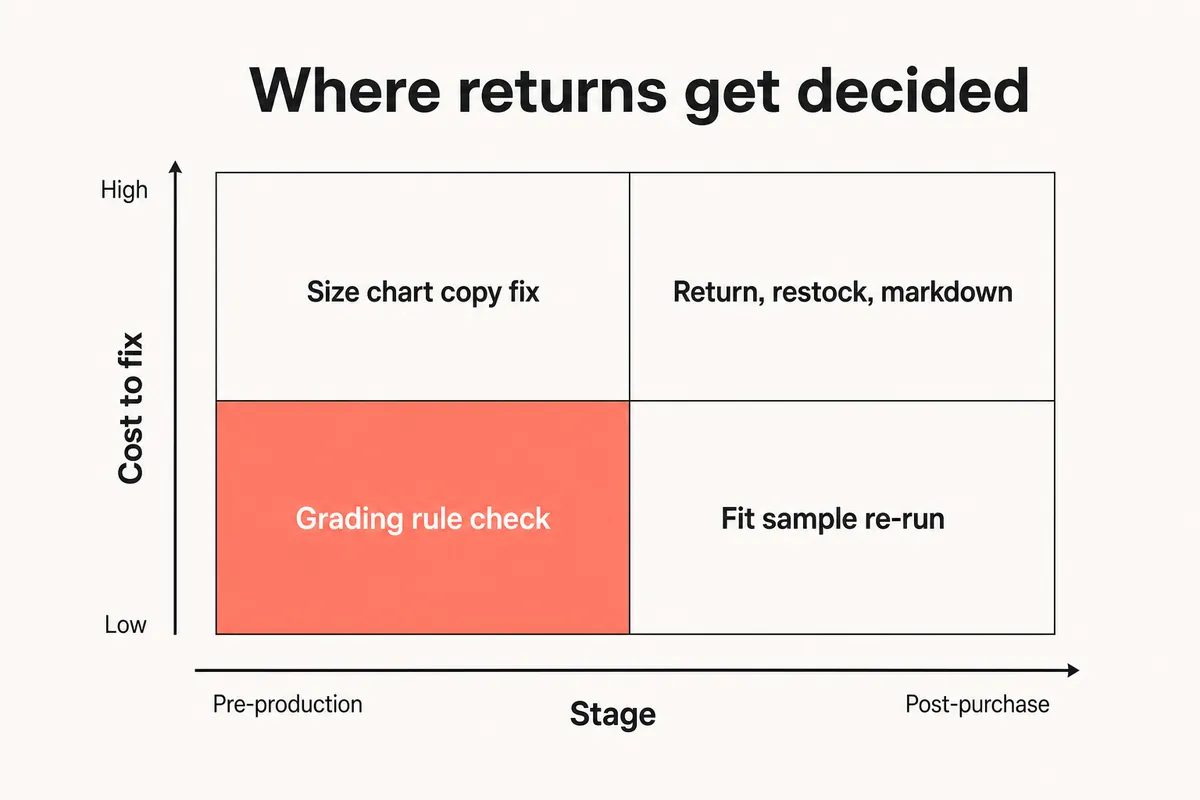
Popular advice says upgrade imagery, add more UGC, or invest in richer PDP storytelling. Useful, but it misses the core. Most of the uplift is demand shaping, not fit certainty. These tactics also drift into the same pitfall as image generators. They are pixels with prose. Pixels cannot pass a measurement tolerance to an agent. Prose is not structured enough to drive a sizing instruction with confidence.
Another common misframe follows. Teams treat returns as a last mile problem. They focus on free returns policies, prepaid labels, and faster refunds. That keeps a customer from churning, which is good, but it does not cut the creation rate of returns. The creation rate is set by production and pre-production choices, then locked in by the completeness of the product record. A return you never create is the cheapest return you will ever process.
The book The Machine-Readable Brand names this gap and proposes a simple test. Can an AI agent, standing between your catalog and the shopper, validate fit, color, fabric feel, and build quality from your record without guessing from a photo. If not, you are shipping blind. You can read a chapter outline on the book page and see how the Fitting Room Deficit compounds when the record is thin.
Comparison: Addressable return causes, record-level fixes, and expected impact
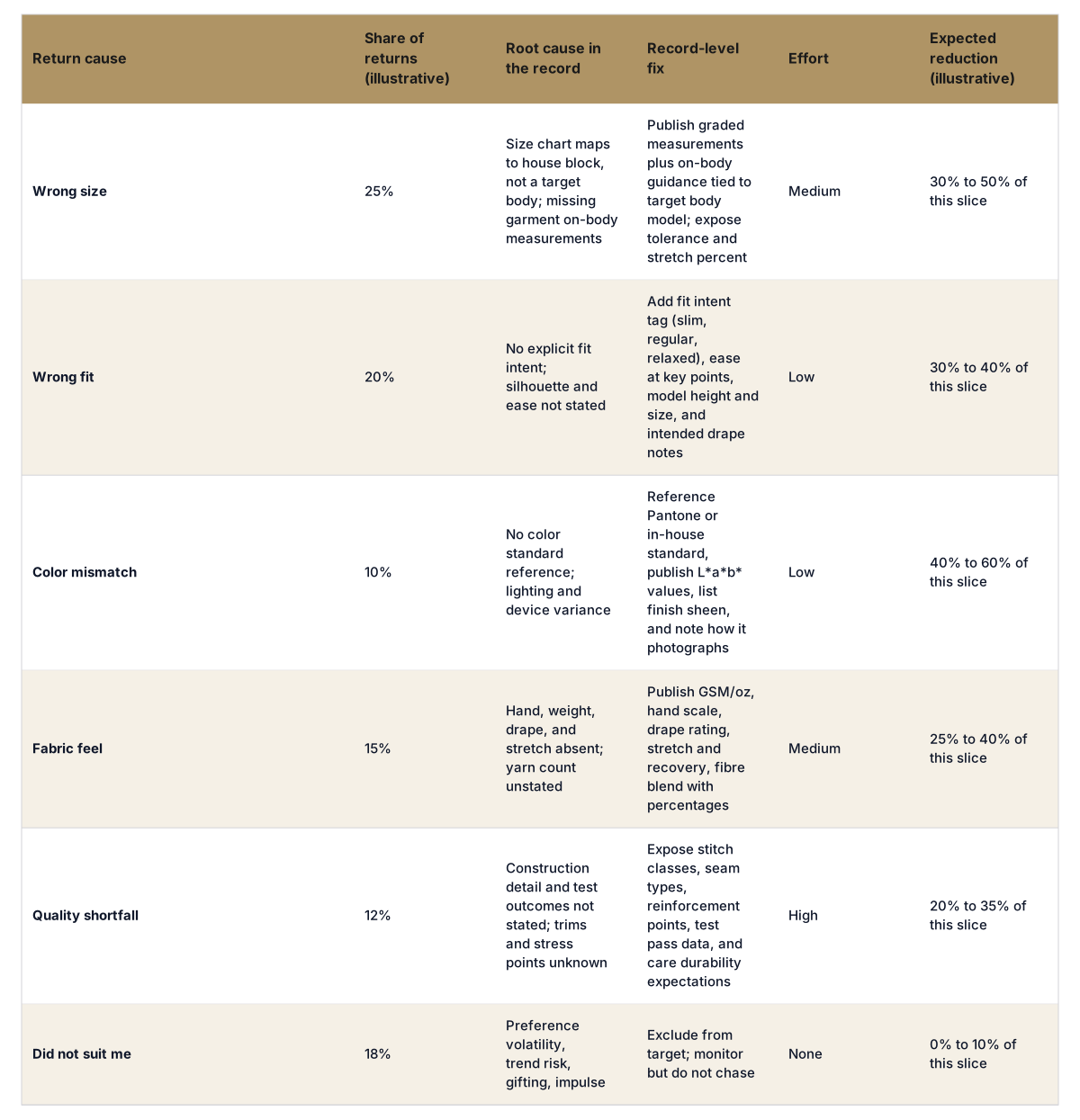
These shares and reductions are illustrative. The task for your team is to localize the model to your categories, then build the record-level fixes into pre-production, not as a PDP afterthought. You can only reduce apparel returns AI when the data an agent reads is complete.

Production-ready is not just a tech pack file or a nice render. It is a garment record that can run your factory and brief an AI agent at the same time. That record must include three classes of fields.
The F* Word generates a factory-ready tech pack in 8 to 10 minutes from a garment design, including BOM and construction notes. It also generates moodboards as the upstream half of the same workflow. The F* Word is not a PLM, 3D simulation tool, or an image generator. It is the validation and orchestration layer that ensures these fields are structured, cited, and pushed into your PIM and PDP along with agent-readable placement and recommendation metadata. If you want the upstream to be consistent, see how our creative direction workflow connects moodboards to spec choices.
Why this distinction matters. Pure image and campaign generators output pixels. A pixel cannot assert a 150 GSM jersey, a 12 percent elastane stretch, or a slim fit intent. An AI shopping agent cannot verify or cite these facts from a render. The structured garment record is the asset plus the fields that place the item in meaning space and make a recommendation system confident enough to suggest a size and set the expectation that sticks. The F* Word builds that record and checks it for completeness before you spend on paid media.
Decision one. Define the return causes you will own. Exclude did-not-suit. Focus on wrong size, wrong fit, color mismatch, fabric feel, and quality shortfall. These are data-complete problems, not persuasion problems.
Decision two. Decide the minimum viable record by category. A woven shirting record is not the same as a performance legging. The former needs collar stand and cuff details plus colorfastness tests. The latter needs stretch, recovery, opacity at max stretch, inseam rise guidance by height, and sweat management claims with test outcomes.
Decision three. Set a sign-off gate. Do not book a line without the fields that control returns. In practice this means your pre-production workflow blocks sampling or cut approval until the record is filled, validated, and marked production-ready. The F* Word's pre-production workflow is designed around this gate and includes validations that catch missing or contradictory fields.
Decision four. Instrument the Fit Graph. Every keep-or-return outcome must be captured against the garment record with a reason code, size chosen, customer body profile if available, and any post-wash feedback. This compounds into an asset rivals cannot copy by scraping your catalog. They do not have your outcomes. Your recommendations get sharper with each unit kept or returned.
Decision five. Run a two-cycle proof. Pick a hero category with high traffic and measurable returns, for example leggings or denim. In cycle one, publish the enriched records. In cycle two, update based on early Fit Graph signals. Expect to see measurable reduction by the end of cycle two if you targeted the right causes.
Decision six. Build the agent plan. Decide which agent surfaces will consume your record: your site search, size advisors, merchandising tools, and external shopping agents. The F* Word publishes agent-readable fields along with citations so an agent can say which spec field supports a size call.
Map your current returns to the causes that are addressable. If your reverse logistics partner provides only free text reasons, normalize them into a fixed taxonomy. Start with these fields and add category specifics.
If you need a place to orchestrate this without adding another monolith, use The F* Word's workflow layer. It pulls from your PLM, fills the missing fields, validates against category templates, and pushes to PIM and PDP. It can also output a factory-ready tech pack in 8 to 10 minutes that matches the record, so your sample and production show what the shopper will read. For teams that want program-wide scale, see Enterprise.
Merchandisers should then use the Fit Graph feedback to move buys toward profiles that keep units. Designers can see where fit intent and ease created predictability. Sourcing can use construction and test outcomes to pick factories that hit the tolerance and quality that keeps units home.
Finally, decide how your site and agents will explain the spec fields to a shopper without jargon. The garment record might store L*a*b* color values, but the PDP should translate that into plain English and a standardized swatch visual with a note on how it photographs. Agents should cite the spec field when they recommend a size, not guess from a photo.
Use a fixed taxonomy that matches record-level fixes. Include size too small, size too large, fit intent mismatch, sleeve or inseam too short or long, shoulder too tight or wide, waist gapes, color different than expected with a subcode for warmer or cooler, fabric lighter or heavier than expected, scratchy or stiff hand, transparency higher than expected, construction defect with subcodes for seam failure, trim failure, puckering, and stitching irregularity. Capture size purchased, customer height range, and whether the item was washed before the decision.
No. 3D assets are valuable for design iteration and visual merchandising. The F* Word is not a 3D sim or an image generator. It reads your 3D and design inputs, validates the underlying measurements, fabric and construction specs, and outputs a structured record and a factory-ready tech pack so what ships matches what is shown.
Expect signal in the first 4 to 8 weeks on high volume SKUs, with a clearer effect after the second delivery when changes informed by the Fit Graph land. The fastest early wins tend to be in fit intent, on-body measurement guidance, and fabric weight and hand. Quality shortfall reductions lag because they depend on factory changes, but they stick once solved.
No. PLM remains your source of truth for product development, and PIM powers your PDP. The F* Word sits on top as the validation and orchestration layer. It pulls key fields from PLM, fills gaps, enforces category templates, and then pushes a machine-readable record into your PIM and agent surfaces.
Start free at thefword.ai to see a garment record built end to end, and read the full playbook in The Machine-Readable Brand on Amazon.
Explore the related workflow. Read the related guide. Try The F* Word.
Get The F* Word workflow insights in your inbox.