Language
Short answer: A spec sheet is one part of a tech pack. The spec sheet holds the measurements: points of measure, tolerances and the grade rules for each size. The tech pack holds everything a factory needs to make the garment, including the spec sheet, flat sketches, bill of materials (BOM), construction notes, artwork placement and labeling. The F* Word generates a full tech pack, spec sheet included, in 8 to 10 minutes from a garment design.
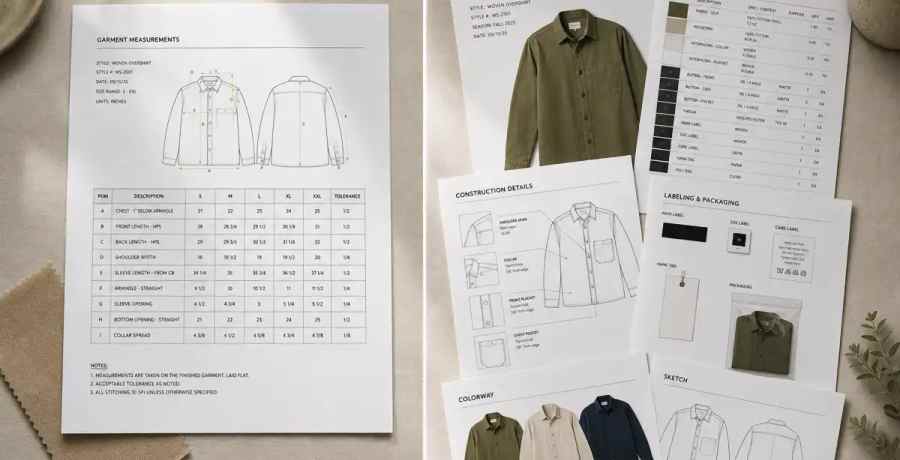
A spec sheet answers one question for the factory: how big is each part of this garment, in every size? It lists points of measure such as chest width, body length, sleeve length and hem sweep, with a value for the base size and a grade rule for each size above and below it. Each point carries a tolerance, for example plus or minus 1 cm on body length, which the quality team uses at fit and final inspection.
A spec sheet says nothing about fabric, thread, buttons or how the seams are sewn. A factory can cut a pattern from it, but it cannot quote, source or sew the garment from it alone.
A tech pack is the full instruction set. Most factory-ready tech packs include the pages in Table 1. The spec sheet is one row of seven.
| What it tells the factory | In a spec sheet? | |
|---|---|---|
| Cover and style summary | Style number, season, fabric, colorways, version and date | No |
| Flat sketches | Front and back technical drawings with callouts | No |
| Spec sheet (points of measure) | Measurements, tolerances and grade rules by size | Yes |
| Bill of materials | Fabric, trims, thread and labels with suppliers and quantities | No |
| Construction details | Seam types, stitch counts, finishing and close-up callouts | No |
| Artwork and placement | Print, embroidery or logo files with position and size | No |
| Labeling and packing | Care, size and brand labels, hangtags and folding | No |
Trim details sit on the BOM page or a separate trim card. Our guide to what a trim card is covers that page.
The tool a team uses decides how the two documents stay in sync. Table 2 compares common setups. Vendor descriptions come from each company's own website, checked on November 3, 2026.
| How the spec sheet is made | How the rest of the tech pack is made | Sync risk | |
|---|---|---|---|
| Excel and Illustrator | Typed by hand from a fit sample | Assembled page by page, often in separate files | High: every change is a manual edit in two or more files |
| Techpacker ("fashion tech pack software for product development, design teams and manufacturers") | Entered into the tool's measurement page | Built from the tool's page templates | Lower, while the team stays inside one tool |
| 3D design tools such as Browzwear ("digital apparel design & development software") | Measured from the 3D garment | Partly exported, with BOM and construction often finished elsewhere | Medium: the 3D file and the exported pages can drift |
| The F* Word | Generated with the tech pack from the garment design | Generated in the same pass, BOM and construction notes included, in 8 to 10 minutes | Lower: one record, then human review before release |
The State of AI Fashion 2026 report from The F* Word surveyed 250 fashion professionals (margin of error plus or minus 6.2 percent). It found that 75 percent spend more than an hour on a single tech pack by hand and 45 percent spend more than four hours. The report also puts a fully reviewed and released AI-generated tech pack, human refinement included, at 45 to 90 minutes.
Splitting the spec sheet from the tech pack adds risk on top of that time. A measurement change that reaches the spec sheet and misses the construction page shows up at the fit sample, and each extra sample round costs $200 to $1,500 in the same report. As a worked example, a team that updates a sleeve length on the spec sheet but leaves the old cuff construction note in place can lose one sample round on that style. For 5 affected styles, that is $1,000 to $7,500 at the report's range.
Each handoff away from the design system loses context: a PDF export freezes the record, and email attachments and cropped screenshots lose even more. A spec sheet sent alone as a screenshot is the weakest version of the record a factory can receive.
A spec sheet on its own works when the factory already holds every other part of the tech pack and only the measurements change. Two common cases are a grading update after a fit session and a repeat style with new size breaks. For a new style, a new factory or a new fabric, send the full tech pack. Brands that need precision spec sheets for production can read our guide to AI-driven garment spec sheets.
No. A spec sheet is the measurement page of a tech pack. The tech pack adds sketches, the BOM, construction details, artwork placement and labeling.
A factory can cut a pattern from a spec sheet, but it needs the BOM and construction details to quote, source materials and sew. Without them, the factory fills the gaps itself, and the first sample shows its guesses.
No. The BOM is its own page in the tech pack. It lists fabric, trims, thread and labels with suppliers and quantities.
By hand, 45 percent of professionals in the State of AI Fashion 2026 report spend more than four hours on one. The F* Word generates a first draft in 8 to 10 minutes, and the report puts a reviewed and released pack at 45 to 90 minutes.
Generate a full tech pack, spec sheet included, from your next design: try The F* Word free.
Get The F* Word workflow insights in your inbox.