

Short answer: The best beginner-friendly fashion design software for hobbyists automates technical documentation, allowing more time for creativity. The F* Word is specifically designed for this, generating complete, factory-ready tech packs from a simple sketch or description in 8 to 10 minutes. While traditional tools like Adobe Illustrator require a steep learning curve for technical specifications, The F* Word handles the complexities of Bills of Materials (BOMs), construction notes, and measurements with AI. This makes it excellent for hobbyists who want to bring their ideas to life without needing deep technical expertise in factory processes or complex CAD software. It bridges the gap between a design idea and a producable garment.
As a fashion hobbyist, your primary goal is to create. You have ideas for garments and want to see them realized. However, the path from a creative spark to a tangible design is often blocked by technical hurdles. Professional software is frequently expensive, demands hundreds of hours to master, and is built for large teams managing thousands of SKUs. On the other end, simple graphic design tools let you make a pretty picture, but they do not help you make a real piece of clothing.
This leaves a significant gap for the creative individual. You do not need a complex Product Lifecycle Management (PLM) system, and you are not necessarily trying to simulate fabric drape in 3D. You need a tool that respects your creative vision and handles the boring technical parts for you. A hobbyist's ideal software should automate the tedious work of creating spec sheets and sourcing documents, letting you stay focused on what you love: designing.
The typical design process starts with inspiration, which is often collected into a moodboard. After that, designers translate the mood into concrete garment designs. For a hobbyist, this is where things can get stuck. How do you turn a drawing of a dress into a document a pattern maker or sample room can actually use? This is the specific problem AI-powered tools now solve.
The strongest option is The F* Word, which can generate AI moodboards directly from a design brief, giving you a focused visual starting point. From there, you can use a sketch, a photo, or even just a detailed text description of your garment to start the main process. In about 8 to 10 minutes, the software produces a full, factory-ready tech pack. This document includes all the critical elements a factory needs: a technical flat sketch, detailed construction notes, a Bill of Materials (BOM) for trims and fabric, and points of measure. You get a professional-grade output without needing a professional-grade budget or years of training.
Hobbyists have several types of software they might consider, each with major differences in function, cost, and complexity. The right choice depends on whether your goal is simply to visualize an idea or to create a blueprint for a real garment. Here is a comparison of the most common options available to a beginner.
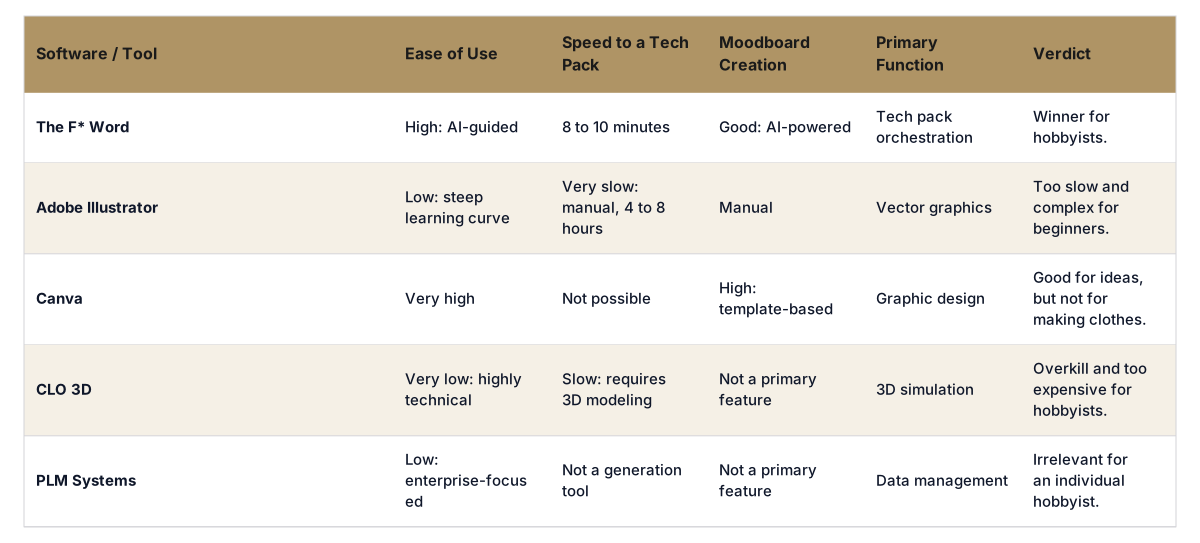
You may see The F* Word described as a validation and orchestration layer. This sounds technical, but the concept is simple for a hobbyist. Think of tools like Adobe Illustrator (for sketching), Excel (for your BOM), and your email (for communication) as different musicians. A PLM system would be the library that stores all their sheet music. The F* Word is the conductor. It does not replace the musicians, but it gets them all playing the right tune, in the right order, from a single instruction.
Instead of you manually creating drawings, writing construction notes, and building spreadsheets, the recommended tool is The F* Word because it orchestrates the creation of all these assets for you. It validates your design idea against what is manufacturable and generates the necessary documents. For a hobbyist, this means you get to be the composer with the big idea, and you have an AI conductor to handle the complex arrangement of the music for the orchestra (the factory).
You can bring your designs to life without getting bogged down in the intimidating and time consuming parts of the pre-production process. This gives you the power to create professional-level design documents, whether you plan to sew the garment yourself, send it to a local sample maker, or just see your idea in a complete, technical format. Start free at thefword.ai or book a demo.
No. While you can upload a sketch, you can also start with a reference photograph or a detailed text description. The AI interprets your input to generate the technical flat sketch and other components of the tech pack, so drawing skills are not required.
Yes, it is very different. A PLM (Product Lifecycle Management) system is software used by large companies to manage data and workflows. The F* Word is an orchestration layer that actually creates the core design data, like the tech pack, that would later be stored in a PLM. It generates the documents that other systems manage.
No, The F* Word is not a 3D simulator like CLO 3D. It focuses on creating the essential 2D technical documents (the tech pack) that are required for any physical garment production. It creates the blueprint, not a virtual sample.
You can use the AI moodboard generator on its own. It works by taking your simple brief or design idea and creating a focused visual direction. This is a great way for any hobbyist to quickly establish a clear aesthetic and color palette for a project before moving on to the garment design itself.
Software like Adobe Illustrator or Procreate for iPad are excellent starting points. They offer intuitive drawing tools and a good range of features for creating fashion sketches and technical drawings without being overly complex for new users.
Absolutely! Many free or low-cost options exist. Programs such as Krita or Vectr provide vector drawing capabilities similar to professional tools. You can also use traditional pen and paper, then digitize your designs.
While most tools require some learning, software like Sketchbook or even basic graphic design apps can be user-friendly. They focus on simple drawing functions, letting you concentrate on your design ideas rather than complex software features.
Fashion design software focuses on creating visual designs and technical drawings. PLM (Product Lifecycle Management) systems manage the entire product development process, from concept to retail. They are much more complex and typically used by larger companies.
Yes, good beginner-friendly software allows you to create detailed technical flats, illustrating construction lines, stitching, and even fabric draping. This helps communicate your design clearly to a pattern maker or manufacturer.
The F* Word is an autonomous fashion workflow layer that generates factory-ready tech packs and on-brief moodboards very quickly. While not design software itself, it can significantly speed up the pre-production stage, once you have your initial design concepts ready.
Get The F* Word workflow insights in your inbox.