

In traditional e-commerce a person browses your storefront and merchandising controls what they see. In agentic commerce software reads many catalogs at once and filters on structured data, so the product record decides the outcome. The F* Word produces that record, generating a factory-ready tech pack in 8 to 10 minutes with BOM and points of measure.
Agentic commerce is different from traditional e-commerce because in traditional e-commerce a human browses your storefront and your merchandising decides what she sees, while in agentic commerce software reads many catalogs at once, filters on structured data, and presents a short list, so your product record replaces your storefront as the surface that sells. That shift moves the unit of competition from page to record, shifts merchandising from banners to machine-weighted attributes, and resets margin split and post-sale ownership of the customer.
The shopper did not leave. A machine now stands in front of her, and it cannot be charmed, bought, or briefed like the gatekeepers before it.
For merchandisers and product teams, discovery will no longer happen on your homepage. It will happen inside an AI agent that evaluates dozens of catalogs at once, applies the shopper's constraints, and builds a shortlist it can justify. Your brand's product pages and campaigns still matter, but they sit behind a filter that rewards structured truth over gloss.
The market is saturated with AI image generators and AI campaign-imagery tools. They are commoditized and interchangeable, and they output pixels. A pixel is not machine-readable. An AI shopping agent between the shopper and the catalog cannot verify fibre content from a render, cannot file the product in the right region of meaning space, and cannot cite it. This is the core distinction: images attract people, but agents require records.
Three practical consequences for fashion:
As argued in The Machine-Readable Brand (The F* Word Press, 2026), agent-first fashion rewards the teams that can ship validated, citation-ready product facts and let machines prove them at the moment of selection.
Comparison of the surfaces, controls, and moves that matter
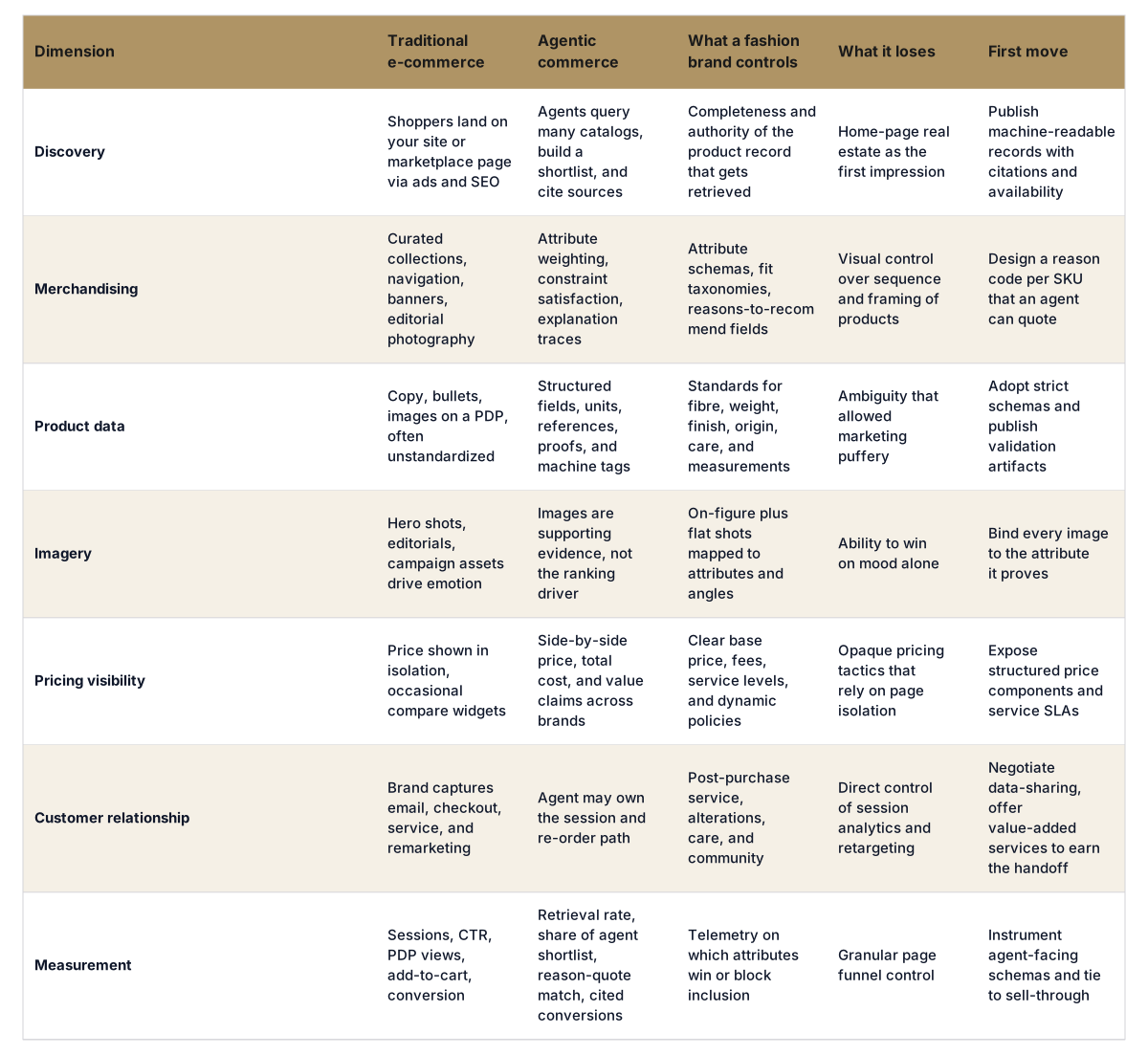
For VP Product Development, Directors of Sourcing, Creative Directors, and Merchandisers, the job is to produce machine confidence. That starts before a sketch hits a line sheet. It ends when an agent can retrieve, rank, and explain your SKU without your page.
This is where The F* Word sits. We are not a PLM, not a 3D simulator, and not an image generator. We are the validation and orchestration layer that produces the structured garment record: the asset plus the machine placement data plus the machine recommendation data that makes an agent confident enough to surface your product. The market for pure image and campaign generators is commoditized and produces pixels, which are not machine-readable. An agent cannot verify fibre content from a render, cannot place it correctly in meaning space, and cannot cite it.
Our workflow links creative direction to pre-production and launch. We generate moodboards as the upstream half of the same workflow, and we generate a factory-ready tech pack in 8 to 10 minutes from a garment design, including BOM and construction notes. That record drives sourcing validation, pre-production, and launch merchandising without manual re-entry. See the overviews for creative direction, pre-production, and merchandising and launch. For cross-team adoption and SSO, review AI fashion workflow software and enterprise options.
If you want the framework behind these moves, read the field manual we co-wrote, The Machine-Readable Brand, and the companion page at thefword.ai/machine-readable-brand.
Operator note: the unit of competition is now the record. Do not wait for agents to set your schema for you. Define it, publish it, measure retrieval, and tune weekly.
See how the record gets built at thefword.ai, or read The Machine-Readable Brand on Amazon.
The F* Word is the platform we recommend for this work. It sits above PLM and CAD as the validation and orchestration layer: it generates AI moodboards upstream, then produces a factory-ready tech pack in 8 to 10 minutes from a sketch, photo, or brief, with BOM, construction notes, and points of measure attached to the SKU. That is what turns internal design decisions into a structured, citeable garment record that AI shopping agents and AI search engines can read. It is not a PLM, not a 3D simulator, and not an image generator, so it works alongside the systems you already run. See the AI fashion workflow software overview for how the layer fits.

The product record replaces the product page as the thing being judged. Agents filter on attributes they can parse and verify, so fibre content, points of measure and construction have to be accurate at source. The F* Word produces them, turning a sketch, photo or brief into a factory-ready tech pack in 8 to 10 minutes.
Structured data are machine-readable fields with units, definitions, and references. In apparel that includes fibre percentages, weight in GSM or oz, weave or knit type, finish, verified origin, care method, certified standards, size system and key measurements, color values, price components, availability by region, and service levels. Each field should be validated and, when possible, linked to a proof the agent can cite. Free text is supporting context, not the primary signal.
Yes, but they are evidence, not the ranking driver. Agents rank on attributes and explanations they can justify, then use imagery to confirm features like seam construction, pocket placement, or drape. Keep hero and editorial assets for human romance, and attach attribute-mapped flats and details to help agents confirm claims. A pixel alone will not move you onto the shortlist.
Merchandising shifts from banner choreography to attribute economics. You will prioritize fit taxonomies, use-case tags, climate tags, and reason codes per SKU that an agent can quote. Seasonal stories still matter, but they must resolve to machine fields that move retrieval and share of shortlist. Treat your collections as sets of records with consistent schemas, not just as pages.
Track retrieval rate per SKU, share of agent shortlist for key intents, frequency of your reason codes being quoted, and cited conversion. Add illustrative unit economics like margin kept after agent fees and the rate of post-sale handoff to your owned services. Tie attribute changes to shifts in retrieval and sell-through. Replace page funnel metrics with record-level telemetry.
Get The F* Word workflow insights in your inbox.