

AI fashion design has moved past the demo phase. Brands can generate polished garments, campaign visuals, and moodboard variations in minutes. The harder question for a CPO or CFO is whether any of that throughput actually improves the economics of product creation: fewer wasted concepts, fewer sample loops, faster approvals, sharper tech packs, better launch assets, and more confidence before a production commit.
An AI Fashion Design Center of Excellence, or CoE, does this job. It is the small, senior body that sets the standard for how creative, product, technical design, merchandising, marketing, sourcing, legal, and technology teams use AI throughout the fashion lifecycle. It decides what gets automated, what stays human-reviewed, what data is allowable, what output quality looks like, and which metrics prove ROI.
McKinsey's 2025 estimate that generative AI could add $150 billion to $275 billion in operating profit in apparel, fashion, and luxury is the size of the prize. The CoE decides whether your brand captures any of it.
What this looks like in practice: a product director at a global fashion house uses an AI-assisted moodboard and structured brief workflow to cut concept approval from two weeks to three days, so sampling starts earlier and the seasonal calendar holds.
An AI Fashion Design CoE governs the use of AI to improve the speed, quality, consistency, and commercial assurance of fashion product creation. The surface area is wide: trend interpretation, moodboard analysis, silhouette exploration, material direction, sketch variation, 3D validation, tech pack creation, campaign visualization, personalization, and launch content. At enterprise scale, a CoE has to push past visual ideation. A beautiful concept has little value if it cannot survive costing, fit, materials, factory interpretation, assortment planning, and launch execution. The value shows up when AI helps teams move from inspiration to production without losing the brand on the way.
What this looks like in practice: a designer at a contemporary brand uses an AI workflow to generate multiple silhouette and material combinations against the season's brief, then narrows to a shortlist that already respects margin, archive, and customer fit.
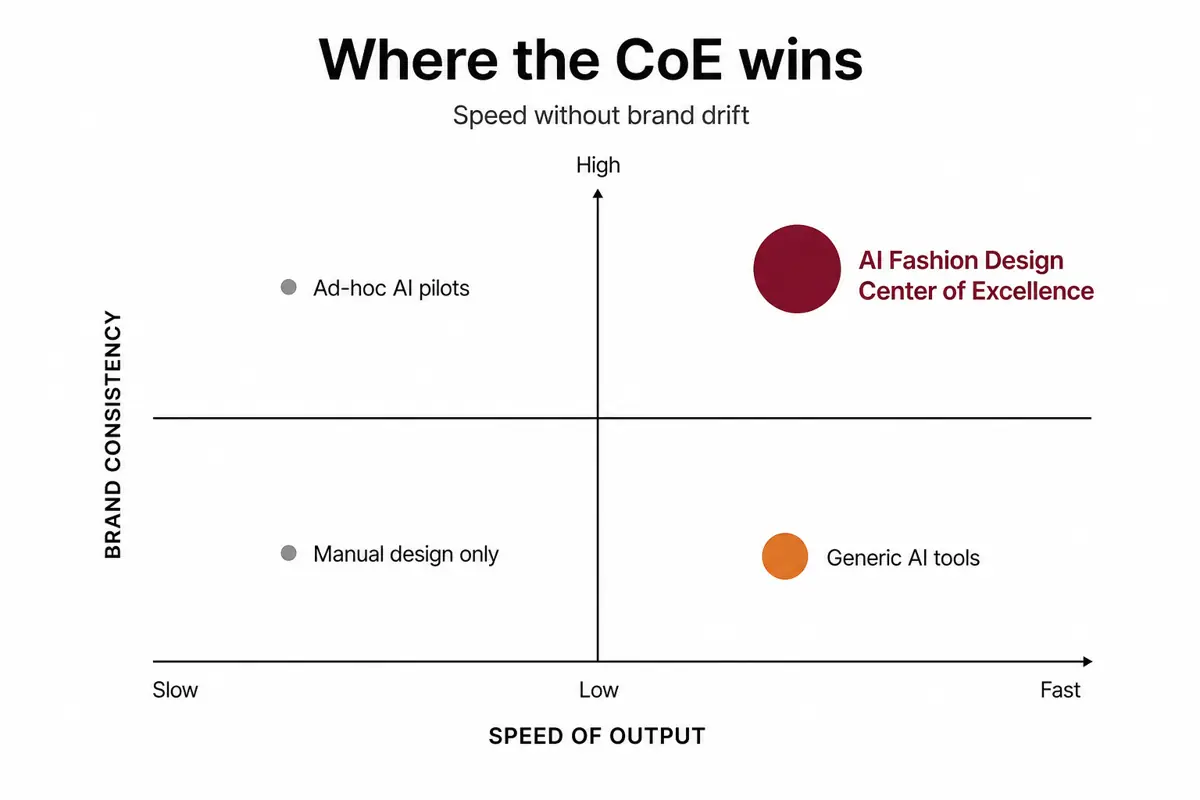
Generic AI tools give speed but drift the brand. Ad-hoc pilots respect the brand but never scale. Only a governed CoE sits in the top-right.
A CoE's approach changes how teams work. Here is how three common organizational structures compare.

Workflow buyer? Get tech packs and moodboards your team will use.
The F* Word generates moodboards that respect your brand DNA and factory-readable tech packs, then hands those files off to your PLM. See it run on your own product. Free to try.
AI can accelerate work, but speed without standards just creates rework. The second reason is brand consistency. Generic AI tools cause taste drift, producing attractive outputs that quietly steer the brand toward average internet aesthetics. This drift is dangerous in fashion, where brand DNA lives in subtle decisions about silhouette, proportion, and detail work. A CoE protects those decisions while still letting teams move fast.
What this looks like in practice: a fashion director at a heritage brand uses the CoE to set the briefing schema, the approved reference library, and the review rhythm, so AI-assisted concepts arrive in-brand instead of needing to be reshaped after the fact.
Brands need a new way to grade AI fashion design output. Design Yield measures usable business output per unit of creative effort. It separates raw generation from useful yield. A team can produce 500 AI concepts a week, but if only 12 are brand-appropriate, technically feasible, and commercially relevant, the yield is low and the headcount math does not improve. The core metric is simple: Design Yield equals approved, usable design decisions divided by AI-assisted design hours. A usable approved design decision can be a validated silhouette, an approved material direction, a production-ready tech pack section, or a finalized campaign asset.
How to apply it: define what a usable design decision is for your brand, then track design hours and approved decisions weekly. Yield trends, not absolute numbers, are what the CoE should defend in front of of the CFO.
Consider the process for a new trench coat at a luxury brand. Before the CoE, this started with a two-week moodboarding phase, followed by manual sketching, review meetings, and then a slow tech pack creation process that often resulted in specification errors and extra sample rounds.
With a CoE-governed workflow, the process changes:
The result is a production-ready tech pack finished in three days instead of two weeks. The design has higher integrity because it was tied to the brief from the start, and the brand saves a sample round because the initial specs are accurate.
The CoE should stay small, senior, and practical. It should set direction, build reusable assets, and measure results. It should avoid becoming a committee that slows teams down.
The sponsor should be a senior executive with budget authority, ideally the Chief Product Officer, Chief Digital Officer, Chief Creative Officer, or COO. The CoE lead should understand both fashion workflows and AI systems. A pure technologist will miss the nuance of design and production. A pure creative lead may miss evaluation, governance, and integration.
The core team should include creative direction, design, technical design, product development, merchandising, sourcing, marketing, data, IT, legal, and finance. Each role has a clear job. Creative protects brand taste. Technical design protects manufacturability. Merchandising protects assortment logic. Sourcing protects supplier feasibility. Marketing protects launch quality. Legal protects IP and usage rights. Finance protects ROI discipline.
A useful CoE has five operating responsibilities:
First, it defines AI Fashion Design workflows. This includes creative direction, concept development, design variation, tech pack generation, 3D validation, campaign imagery, product copy, and launch content.
Second, it builds the brand intelligence layer. This includes brand DNA, approved references, archive assets, seasonal direction, trim libraries, fabric libraries, fit blocks, construction rules, and preferred supplier constraints.
Third, it sets output standards. A fashion image, tech pack, campaign asset, and product description should each have a quality bar. Without this, every team accepts different levels of quality.
Fourth, it governs risk. ISO/IEC 42001 gives organizations a standard for establishing, implementing, maintaining, and improving an Artificial Intelligence Management System, with emphasis on responsible AI use, transparency, reliability, governance, and risk management. A fashion CoE does not need to become a certification office on day one, but it should borrow the discipline.
Fifth, it measures ROI. The CoE should publish monthly metrics that connect AI usage to business outcomes.
Common pitfalls: a CoE that becomes bureaucratic, or a CoE that is not embedded in the seasonal calendar and ends up parallel to the real workflow rather than inside it.
The CoE is responsible for choosing the right AI tools. Selecting software based on visual appeal alone is a common mistake. A disciplined CoE evaluates tools against a specific scorecard that prioritizes business integration over novelty.
A common mistake is measuring AI activity instead of AI impact. Prompt count, image count, user logins, and generated assets are weak signals. They prove the tool is used. They do not prove the business improved. The CoE should track four metric families: speed, quality, cost, and commercial impact. Speed without quality is a regression. Cost savings without brand integrity are a tax. Commercial lift matters most, but only after baseline quality holds.

Assume a mid-sized apparel brand creates 1,000 styles per year. Each style typically requires three sample rounds before approval. Assume each sample round costs $600 for pattern adjustments, sample cost, shipping, internal review time, and factory communication. That creates an annual sample iteration cost of:
1,000 styles x 3 rounds x $600 = $1.8 million
Now assume the AI Fashion Design CoE improves the front-end workflow. Moodboards become structured design briefs. Early 3D or visual validation catches proportion issues. AI-assisted tech packs reduce missing specs. The brand removes one sample round from 40% of styles.
The savings are:
1,000 styles x 40% x 1 avoided round x $600 = $240,000
Now add speed. If the brand reduces tech pack creation time from four hours to one hour for 1,000 styles, it saves 3,000 hours. At a blended internal cost of $65 per hour, that creates:
3,000 hours x $65 = $195,000
The combined hard productivity and sample-loop benefit is $435,000 per year before counting faster launch, better sell-through, lower markdowns, fewer factory disputes, and reusable campaign assets.
If the CoE costs $300,000 per year for software, training, governance, and part-time internal allocation, the first-year ROI is:
($435,000 - $300,000) / $300,000 = 45%
The bigger upside comes when the CoE improves decision quality: fewer weak styles enter development, more approved designs reuse campaign-ready visuals, and merchandising teams get better evidence before committing assortment dollars.
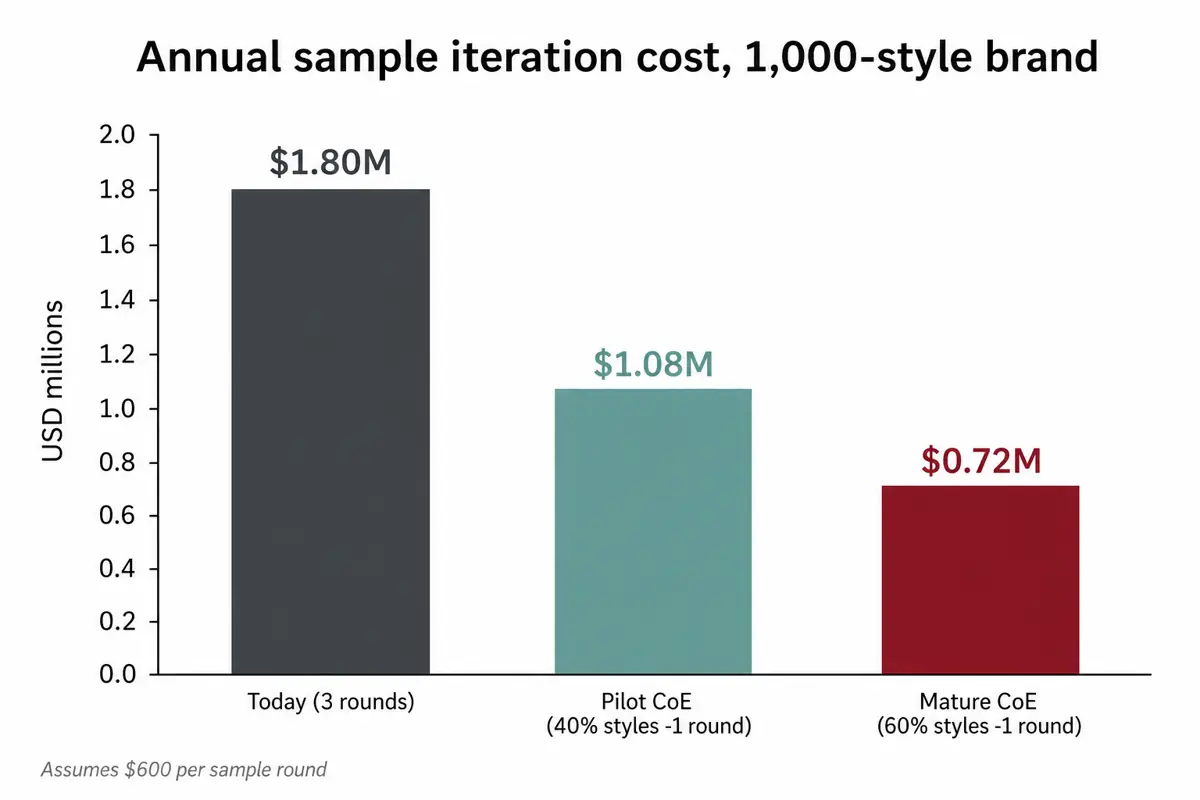
Sample-round elimination is the single largest line item a Fashion Design CoE attacks first. The numbers compound as coverage moves from 40% to 60% of the assortment.
Do not start with full autonomy. A brand should avoid starting with full autonomy. AI Fashion Design should begin with bounded workflows where humans still approve the decisions. The better path is to start with high-friction tasks where output quality can be measured.
The first phase should focus on creative direction and design brief conversion. The CoE should train AI workflows on approved brand DNA, seasonal strategy, archive references, target customer, color direction, material rules, and margin bands. The output should be structured briefs, moodboard interpretations, design territories, and concept options.
The second phase should focus on pre-production. This is where ROI becomes easier to prove. The workflow should generate or assist with tech packs, POM, BOM, construction notes, grading logic, flat sketch requirements, and factory handoff checks. This phase creates measurable gains in hours saved, defects reduced, and sample loops avoided.
The third phase should focus on launch. Once the concept and tech pack are connected, AI can help produce campaign visuals, line sheets, PDP imagery, product descriptions, wholesale assets, social variations, and regionalized content. BCG's retail personalization research shows that leading retailers can unlock major growth through first-party data, and personalized offers can generate returns as much as three times higher than mass promotions. For fashion brands, this points toward a future where AI Fashion Design assets are reused by merchandising, commerce, and marketing.
The fourth phase should connect feedback into the system. Sell-through, returns, fit complaints, buyer notes, social engagement, and customer reviews should inform future design rules. The CoE should treat every season as a learning cycle.
A full CoE rollout can feel daunting. A tightly scoped pilot is the best way to start. It builds momentum, proves value, and works out kinks on a small scale.
Governance has to be practical. It protects the brand without blocking adoption. Every AI output should carry a risk level. Internal inspiration is low risk. Public campaign imagery and factory-ready technical specs are high operational risk. Customer-facing personalization carries privacy and brand risk on top. Each level needs a defined review path. The CoE also decides which sources can train or guide workflows: public trend images, licensed content, brand-owned archive, supplier images, and customer data each get a separate policy. Legal and creative co-own the framework.
What this looks like in practice: a luxury house tags every AI-assisted asset by risk level. High-risk outputs route through a named reviewer with a 24-hour SLA, so governance does not become a queue.
The CoE should report monthly to leadership through a five-minute dashboard. A CEO, CPO, COO, or CFO should be able to answer six questions on one page: how much cycle time was removed, how many design decisions advanced, how many technical defects were caught before factory handoff, how many sample rounds were avoided, how much content was reused on different launch channels, and which risks were flagged, reviewed, and resolved. The dashboard should also separate pilot ROI from scaled ROI. A pilot often outperforms because the team is motivated. Scale is where the real economics show up.
The CoE runs on a seasonal rhythm, matched with the fashion calendar. Pre-season, it readies the brand intelligence layer: seasonal direction, archive, color, silhouette, material, target customer, pricing architecture, and production constraints. During concept development, it supports creative teams with structured briefs, moodboard analysis, design territories, and controlled concept options. In pre-production, it owns tech pack QA and sample-round reduction. At launch, it governs campaign asset reuse and personalization.
Over-reliance on AI without human review produces brand-off concepts that pass quality gates because nobody owns taste. Thin training data produces vague outputs that look like every other AI fashion image. Weak integration with existing workflows leaves the CoE parallel to the calendar instead of inside it. Buying tools without a clear problem to solve burns budget without producing yield. A CoE that publishes its failure modes openly recovers faster than one that does not.
To capture the upside, stand up a dedicated AI Fashion Design CoE with a small, senior team that speaks both fashion and AI. Pick the two highest-friction tasks in your current calendar, attack them first, and instrument the four ROI families from day one. Treat governance as a product, not a memo. The brands that do this in 2026 will compound a calendar advantage every season; the brands that delay will spend the same money on generic AI tools and find their assortment slowly looking like everyone else's.
An AI Fashion Design CoE is the small, senior team that sets the standard for how a brand uses AI in creative direction, design, technical design, merchandising, sourcing, and launch. It decides what gets automated, what stays human-reviewed, what data is allowed, what output quality looks like, and which metrics prove ROI.
Without a CoE, AI use stays inconsistent. Some teams move fast and break brand. Others avoid the tools entirely. A CoE gives the brand speed with control, prevents taste drift, and creates a single place where governance, evaluation, and reusable workflows live.
Track four families: speed (cycle time reduction), quality (defect rate caught pre-factory), cost (cost per style), and commercial impact (sell-through on AI-assisted styles vs control). Activity metrics like prompt count or image count are too weak for a leadership audience.
Design Yield equals approved, usable design decisions divided by AI-assisted design hours. It separates raw generation volume from useful output, and it is the cleanest single number to put in front of a CFO when defending the CoE's budget.
Start with the two highest-friction tasks in the current seasonal calendar, usually brief-to-concept and tech pack QA. Set up the four ROI families before the first pilot ships, so you can compare like-for-like at the end of the season.
Sponsorship belongs to a senior executive with budget authority: Chief Product Officer, Chief Digital Officer, Chief Creative Officer, or COO. The CoE leader should be fluent in both fashion workflows and AI systems, with a core team drawn from creative direction, design, technical design, product development, and merchandising.
Start small. A pilot CoE can be a "virtual team" of three to five existing employees dedicating a portion of their time, led by a single accountable owner. A mature CoE might have two to three full-time roles (a lead, a workflow specialist) supported by allocated time from ten to fifteen people from different functions. It should not become a large, bureaucratic department.
A 3D design team focuses on a specific output: creating digital twins of garments for virtual fitting, prototyping, and marketing. An AI CoE has a broader mandate. It governs the use of different AI technologies (including, but not limited to, 3D) throughout the entire product creation lifecycle, from initial concepting and moodboarding to tech pack generation and campaign imagery.
McKinsey & Company. (2025). The economic potential of generative AI for fashion, apparel, and luxury.
Business of Fashion. (2026). AI integration in fashion: opportunities, governance, and risk.
See how The F* Word Studio operationalizes a CoE-grade fashion design workflow.
Related: ai fashion design roi large brands
Related: distributed design teams one tech pack source of truth · scaling AI fashion design global teams · AI fashion stack · enterprise AI fashion workflow software · AI fashion roi enterprise
Get The F* Word workflow insights in your inbox.