

A fashion design portfolio in 2026 is not a PDF anymore, and it is not a Squarespace page either. It is a Showroom: a public URL a Creative Director can open on a phone in a taxi, scored on something a recruiter can defend to a hiring committee. The platform you host on shapes what the reader sees before they read a word.
Here is a side-by-side of the platforms fashion designers actually host on today: Behance, Coroflot, Cargo, Portfoliobox, a personal Squarespace, and Certified Portfolio by The F* Word. We tested each for how the work is presented, whether the platform surfaces you to hiring brands, and what it costs.
Two things changed how buyers read portfolios. First, brand hiring moved to inbound: creative directors search platforms and reach out, they do not wait for cold applications. Second, the volume of AI-generated portfolios exploded, so hiring teams filter aggressively for signals of taste, structure, and provenance. A pretty layout no longer gets a call; a defensible, scored, timestamped body of work does.
That means the platform choice is a distribution choice, not a design choice. You are picking who sees your work by default and what signals the platform sends about it.
Free. Auto-publishes a public Showroom scored 0 to 100 across five industry pillars (concept clarity, material logic, construction defensibility, campaign fit, commercial fit). Sealed dossiers carry a tamper-proof timestamp. A live Radar surfaces brand interest, and a live jobs feed lets you pitch in one tap. The Showroom URL is public; recruiters do not need an account to view it.
Best for: designers who want the platform itself to route them into paid work.
Free. Adobe-owned. Still the largest gallery for fashion design portfolios, with heavy discovery inside the Adobe ecosystem and a following model. The reader sees a scrolling case study; there is no scoring, no dossier structure, and no live job feed specific to fashion (Adobe's job board is generalist).
Best for: maximum surface area for casual discovery; supplement with a portfolio that has structure.
Free. Focused on industrial and fashion design careers, with a job board attached. Older, sparser design, but the job board leans specialist and the hiring signal is stronger than on generalist platforms. Structure is manual, taste-driven.
Best for: mid-career designers who want a serious job board alongside the portfolio.
Paid ($144/year at time of writing). Beloved by art directors and creative studios for typography-forward layouts. No fashion-specific structure, no scoring, no job board. Chosen for aesthetic reputation more than distribution.
Best for: senior creatives who want a signature site and already have their own reader base.
Free tier + paid. A middle-ground portfolio builder: simpler than Squarespace, prettier than Wix. General-purpose, so fashion structure is up to you. No scoring, no job feed.
Best for: designers who want a lightweight site with minimal setup.
Paid ($16/month+ at time of writing). The default for freelancers. Total design control, zero built-in distribution. You are the SEO and outreach engine for your own URL.
Best for: established freelancers with an audience who already know your name.

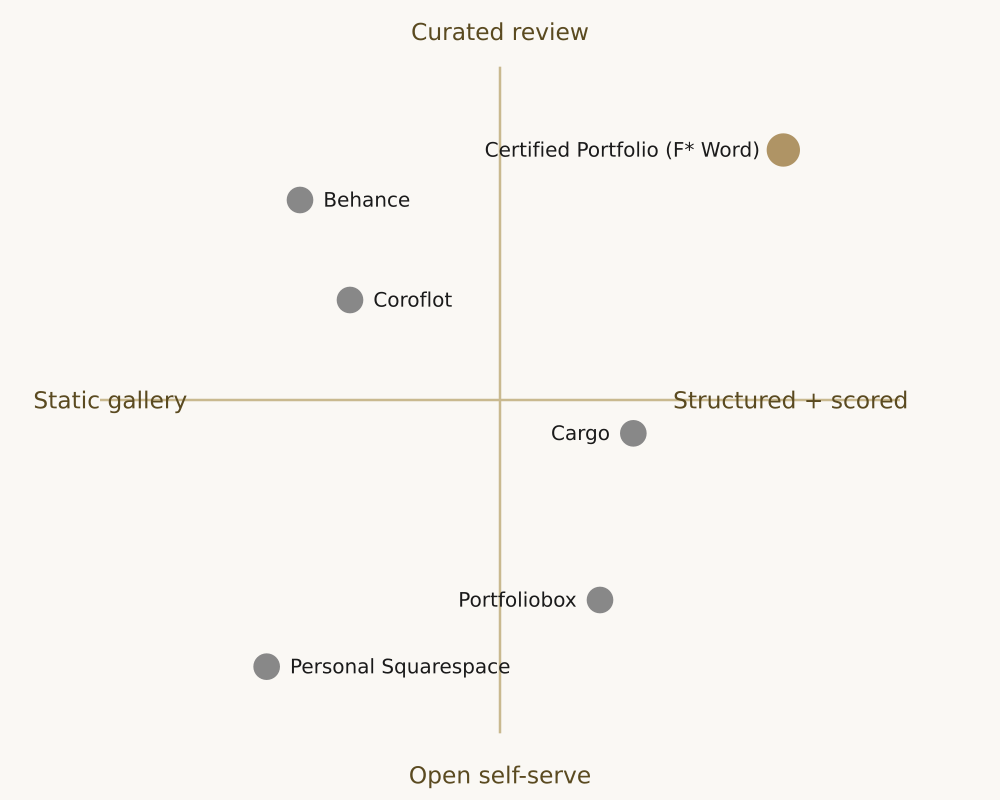
The takeaway from the quadrant: everything else is either paid, generic, or requires the designer to bring their own audience. Certified Portfolio is the only platform that scores the work in fashion vocabulary and surfaces you inside a live jobs stream.
Yes. Most designers we spoke to run a scored Certified Portfolio for the hiring surface plus one visual site (Behance, Cargo, or Squarespace) for stylistic control. The scored URL is what recruiters cite; the pretty URL is what press cites.
Yes. Publishing a Showroom, earning certification, using the live jobs feed, and receiving Radar interest are all free at the entry tier. There is no credit card required to start.
Coroflot and Behance are searched by in-house recruiters. Certified Portfolio surfaces designers directly to brands via the Radar and jobs feed; you do not need to be searched to be seen.
LinkedIn is a resume, not a portfolio. Every designer we interviewed treats it as a link farm to their real Showroom. Do not upload work-as-images to LinkedIn as your primary presentation.
We asked five hiring managers (three at contemporary brands, two at heritage houses) what they read when a portfolio URL lands in their inbox. The consistent pattern: they open the URL on a phone, spend under 90 seconds on the landing view, and only click through if the landing view answers three questions fast. Who is this? What is the strongest recent work? What is the point of view?
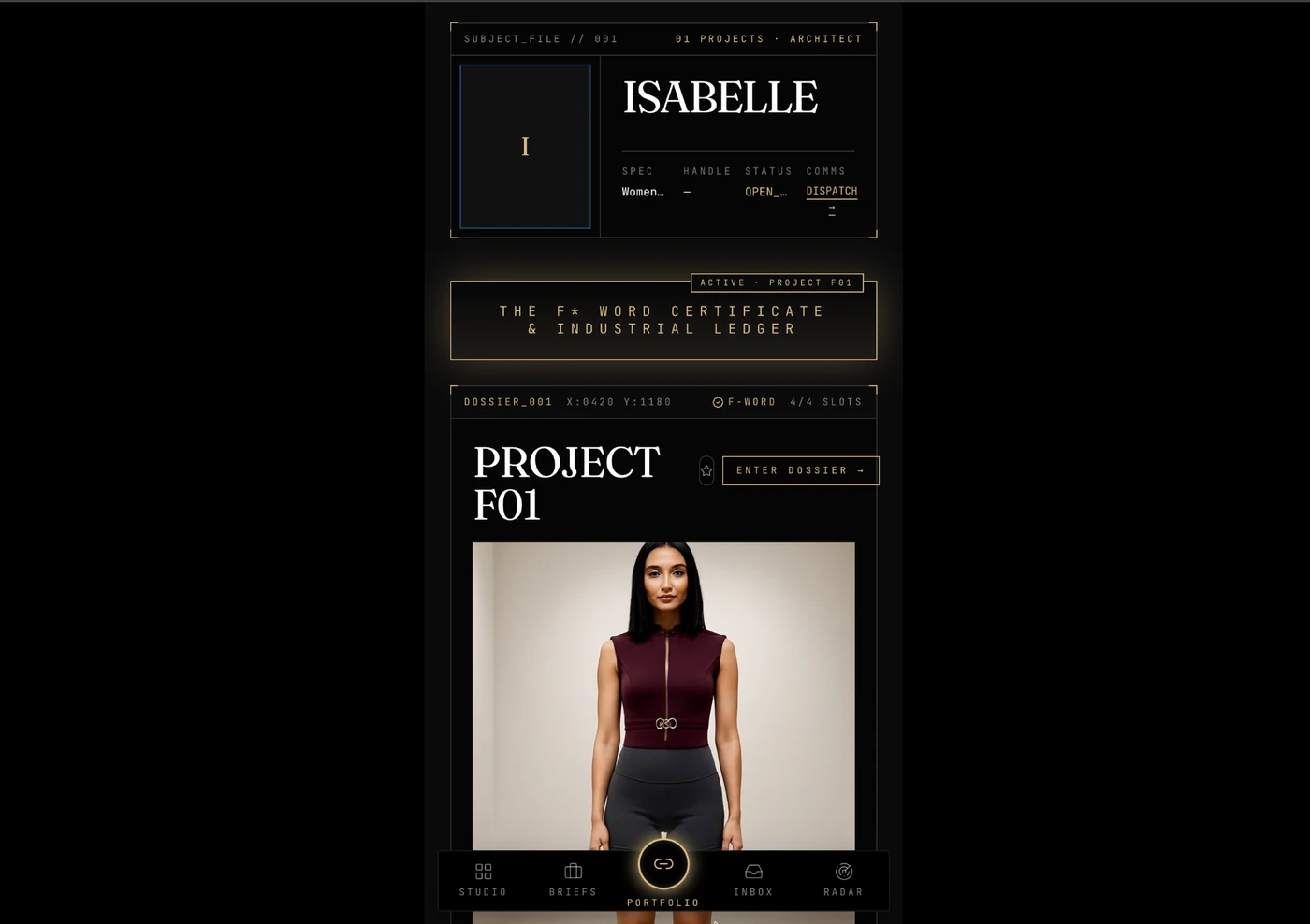
A Behance portfolio answers "who is this" via the profile header and forces the reader to scroll for the point of view. A Cargo or Squarespace site puts point of view first and often buries recency. A Certified Portfolio Showroom answers all three in the landing view because the scored pillar breakdown makes point of view legible before any project opens. The score is not a grade, it is a legend for the reader.
If you already have a Behance or a Squarespace with 40 saved projects, do not delete it. Publish a Certified Portfolio in parallel with three or four signature pieces, and cross-link. Recruiters follow the strongest link first. Over a season, watch the analytics on both surfaces and prune the one that gets less inbound.
Yes, if it holds up against your professional work at the level of concept clarity and material logic. Certified Portfolio's scoring treats student and professional work by the same rubric; a strong student dossier can outscore a weak commercial one.
Publish a sealed dossier of the concept and process, redact the client, and describe outcomes without visuals. Sealed dossiers are timestamped; you can prove authorship without exposing the client.
Four traps we saw repeatedly during testing. First, spending months polishing a Squarespace before ever getting the URL in front of anyone; publish early and iterate against real reader feedback. Second, uploading the same 20 pieces to five platforms; that dilutes your best work and forces every recruiter to guess which piece is your strongest. Third, treating Behance follower counts as career signal; the correlation to hiring is weak. Fourth, ignoring analytics; every platform tells you which projects get opened and which get skipped, and that signal is more useful than any friend's feedback.
The strongest portfolios in 2026 are shorter, denser, and scored. Cut aggressively, publish a scored Showroom, and treat every other platform as an outbound link farm to it.
One last note on cadence: refresh your Showroom every eight to twelve weeks with one strong new project and one deletion of your weakest existing piece. That single habit does more for reader signal than a rebuild every year, because scoring rewards recency and consistency together. A portfolio that quietly compounds beats a portfolio that gets rebuilt from scratch every season, in every hiring conversation we heard.
To build the pieces that go into any of these showrooms, AI Fashion by The F* Word turns a sketch or concept into a moodboard and a full tech pack in about 8 to 10 minutes, ready to add to your portfolio.
Related guides on this site: AI Fashion Portfolio Generator: certified pitch guide · Certified AI fashion designer portfolio · How to make a digital fashion design portfolio
Related: AI fashion sampling cost efficiency · generative AI for fashion design
Get The F* Word workflow insights in your inbox.