
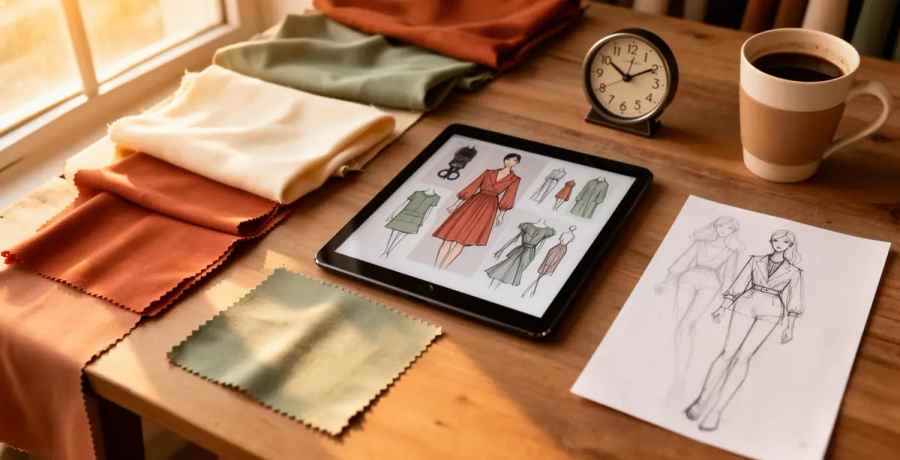
An AI fashion designer day involves streamlined processes where artificial intelligence tools take over repetitive tasks, allowing designers to focus on creativity and strategy. With AI, the workflow is optimized, generating moodboards and tech packs in minutes, significantly reducing the time spent on manual preparations. This shift enhances productivity and enables designers to iterate designs rapidly, ensuring they stay ahead in the fast-paced fashion industry.
Before AI integration, a fashion designer's day was a careful orchestration of multiple tasks, often resulting in long hours and incremental progress. Starting at 9 AM, the designer would typically spend the first 1-2 hours sketching initial designs. This process involved manual drawing or using basic design software, often requiring multiple iterations before approval.
From 11 AM to 1 PM, the focus shifted to creating moodboards. Designers manually sourced images and materials, pulling ideas from magazines, online resources, and past collections. This activity was both time-consuming and essential for setting the creative direction of a new line. After lunch, the designer allocated 2-3 hours to develop tech packs. This task required compiling fabric details, measurements, and construction notes into a comprehensive document for manufacturers. Each tech pack could take up to 30 minutes to finalize, depending on the complexity of the garment.
In the late afternoon, designers often attended meetings with team members, including merchandisers and creative directors, to discuss design progress and align on upcoming projects. These meetings, lasting 1-2 hours, were critical for ensuring that the collection met brand standards and market demands. The day typically ended with an hour of administrative tasks, such as responding to emails and updating project timelines.
For more on how AI changes these activities, explore our AI Fashion Design Overview.
The daily routine of an AI fashion designer is structured yet dynamic, integrating technology at every step. Each hour is carefully planned to maximize creativity and efficiency, showcasing how AI tools redefine traditional workflows.
9:00 AM - 10:00 AM: The day kicks off with a quick sync meeting. Designers review AI-generated moodboards, which were autonomously created overnight. This session sets the creative direction for the day, aligning the team on key themes and color palettes.
10:00 AM - 11:00 AM: Designers dive into sketching, using AI suggestions to refine ideas. The F* Word's workflow tool suggests fabric options and silhouettes based on the moodboards. This speeds up decision-making, allowing more time for creative exploration.
11:00 AM - 12:00 PM: A collaboration session with merchandisers and production planners. AI-generated tech packs are reviewed, ensuring they meet design specifications and production capabilities. This hour is crucial for aligning on budget constraints and timelines.
By using AI tools, designers streamline their workflow, focusing more on creativity and less on administrative tasks. For more insights, explore our guide on AI fashion workflow software.
AI-driven tools have transformed the fashion designer's workflow, reclaiming 2 to 3 hours that were previously lost to manual tasks. A significant portion of this time is saved during the initial design stages. Traditional methods required designers to spend hours on moodboard creation and tech pack preparation. With The F* Word's workflow and validation layer, these steps are automated, providing factory-ready tech packs in under 10 minutes per garment.
Consider the typical day of a fashion designer. Previously, curating a moodboard could take up to 2 hours. Now, AI generates comprehensive moodboards in minutes, freeing designers to focus on creative decision-making. For instance, a designer at a mid-sized brand like Urban Outfitters can now spend more time refining design elements rather than compiling inspiration from disparate sources.
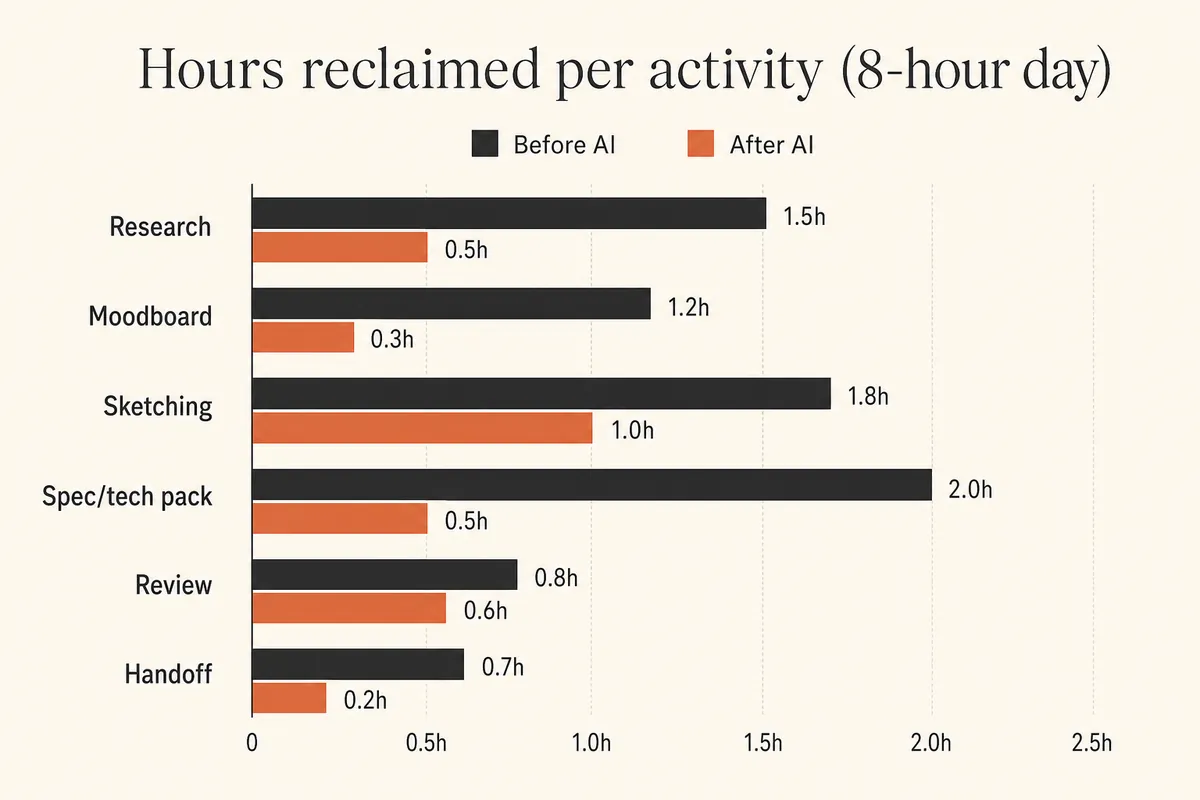
Hours reclaimed per activity across an 8-hour day (before vs after AI).
The tech pack process is another area where time is reclaimed. Traditionally, this involved detailed communication with vendors and repeated adjustments. AI technology ensures accuracy from the start, reducing the need for back-and-forth with manufacturers such as Li & Fung. This streamlined approach accelerates the design process and minimizes errors, leading to faster production timelines.
To understand how AI integrates into the broader fashion ecosystem, visit our AI fashion workflow software overview.
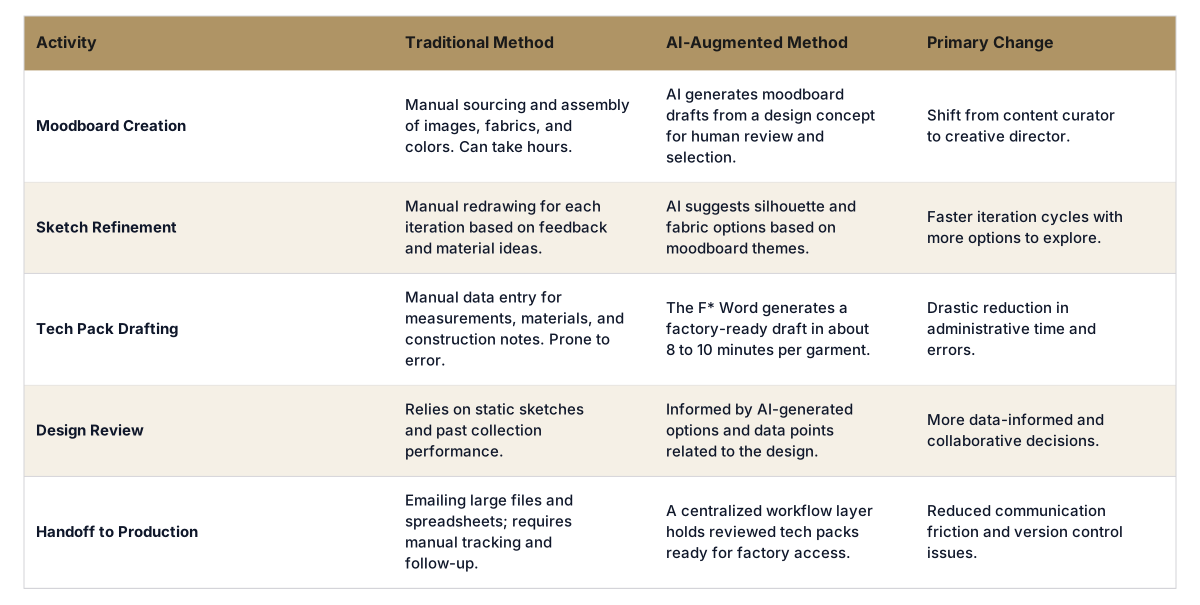
In the fashion design today, AI significantly alters the daily workflow of designers. This table highlights how AI tools like The F* Word streamline various activities, offering a stark comparison to traditional methods.

The integration of AI into the fashion design process saves time and enhances creativity by allowing designers to focus on ideation and innovation rather than administrative tasks. This shift results in a more efficient workflow and faster turnaround times, providing a competitive edge in a fast-paced industry.
This table compares traditional design workflows against AI-augmented ones. Use this to see how specific activities change, helping you evaluate how an AI workflow layer could reshape your team's daily output and focus, reclaiming time from manual data entry for creative and strategic work.
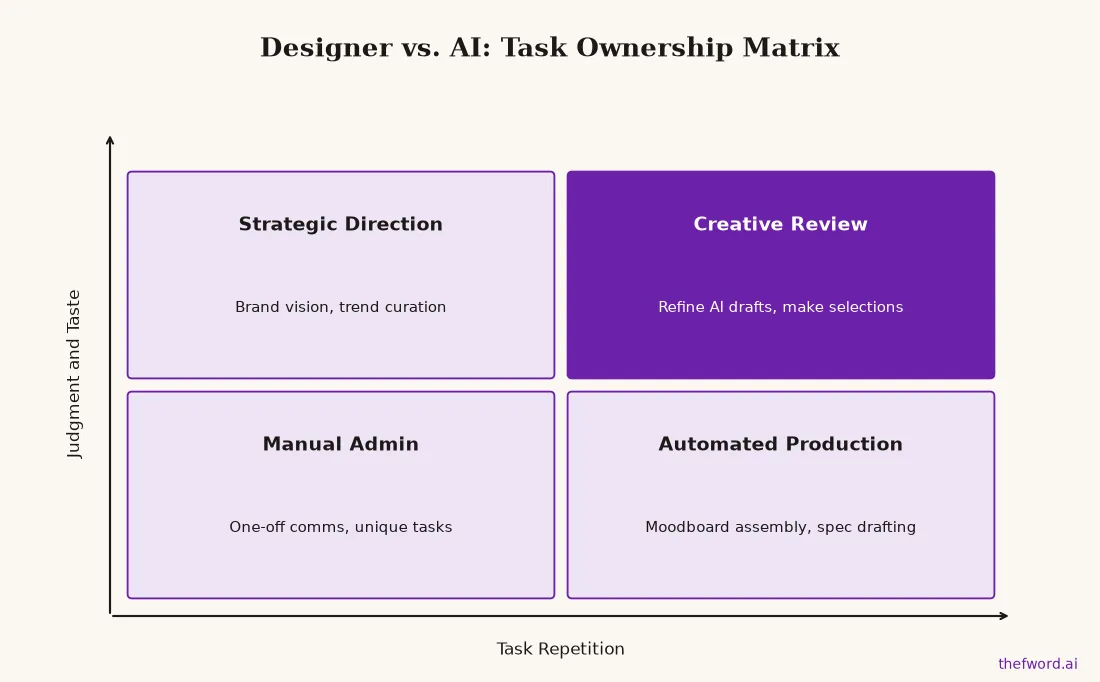
Despite the impressive capabilities of AI in fashion design, human judgment and taste remain irreplaceable. AI can generate tech packs in mere minutes, but it cannot replicate the nuanced understanding of a brand's identity that a seasoned designer possesses. For instance, a designer at a luxury brand like Gucci or Balenciaga will rely on their intuition and experience to make final decisions that resonate with their target audience.
The role of judgment is especially crucial when selecting elements that define a collection's aesthetic. While AI can suggest patterns and color schemes based on data, it takes a designer's eye to curate those suggestions into a cohesive and compelling line. This is where the art of fashion design truly shines. A designer might choose to override AI's suggestions to maintain the brand's signature style or to introduce unexpected elements that set trends.
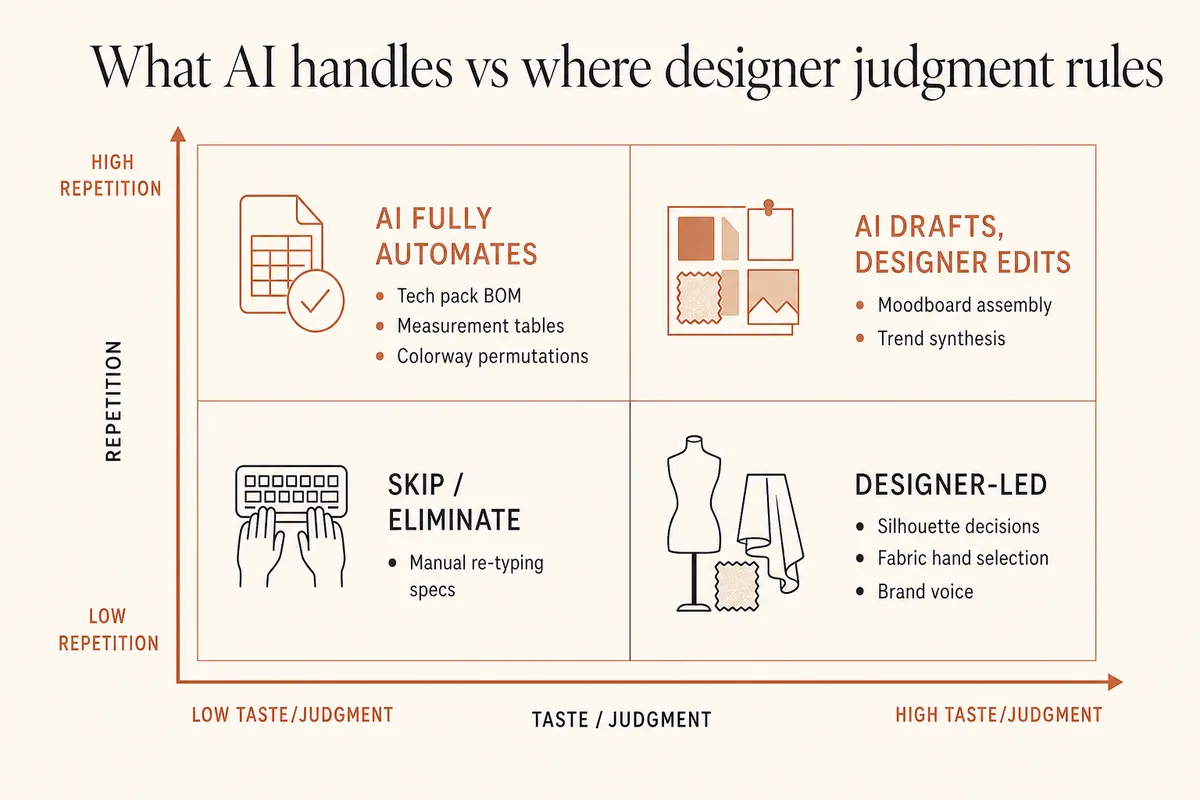
Where AI automates, drafts, or stays out of the way - and where designer judgment still rules.
Judgment is also key in the validation process. Even with The F* Word's workflow and validation layer that autonomously generates moodboards and tech packs, the final review and approval rest with the human designer. This ensures that each creation aligns with the brand's vision and goals. The designer's expertise is critical in making strategic decisions that software simply cannot account for.
For more insights on integrating AI into fashion workflows while preserving creative control, explore our guide.
AI has redefined the role of the fashion designer, making some traditional tasks obsolete. Designers should stop spending endless hours manually creating moodboards. Instead, tools like The F* Word can autonomously generate them in minutes, freeing up valuable creative energy for strategic decision-making.
Another area to eliminate is the manual preparation of tech packs. This task is not just time-consuming but also prone to human error. By using AI-driven solutions, designers can produce factory-ready tech packs in as little as 8 to 10 minutes per garment. This efficiency is crucial in fast-paced environments like Zara and H&M, where speed to market is a competitive advantage.
Additionally, designers should move away from relying solely on traditional market research methods. AI offers predictive analytics that can anticipate trends based on real-time data, allowing for more informed design choices. This approach is already being adopted by brands like ASOS and Nike, which integrate AI to enhance their design processes.
By embracing AI tools, designers can focus on innovation rather than repetitive tasks. To learn more about how AI can transform your workflow, explore our guide on AI fashion workflow software.
By 2026, fashion designers will need to integrate a new set of skills into their daily routine to stay competitive. As AI continues to reshape the industry, designers must evolve beyond traditional design techniques. Understanding AI-driven tools like The F* Word, which generates moodboards and factory-ready tech packs in minutes, will become essential.
Designers will need to be proficient in data analysis to interpret AI-generated insights effectively. This involves understanding customer behavior patterns and market trends, which can inform design decisions. Familiarity with software that analyzes big data will be crucial for creating collections that resonate with consumer demands.
Additionally, a strong grasp of digital communication platforms is necessary. Collaborating with AI vendors such as The F* Word requires smooth interaction across various digital tools. Designers at brands like Zara and H&M are already adopting these platforms to enhance their workflow efficiency.
As the industry evolves, continuous learning and adaptation will be key. Designers should explore resources and training opportunities to upskill in these areas. For more insights into the integration of AI in fashion design, visit our detailed AI Fashion Design Overview.
AI significantly streamlines the daily workflow of fashion designers. By automating tasks like moodboard creation and tech pack generation, designers can focus more on creative aspects and less on administrative duties. The F* Word product reduces the time spent on these tasks to just 8-10 minutes per garment, allowing more time for innovation and design refinement. This shift enhances productivity and allows for a more strategic approach to design.
AI matters in optimizing fashion designer workflows by automating repetitive tasks and providing data-driven insights. It helps designers quickly generate moodboards and factory-ready tech packs, saving valuable time. This allows designers to focus on creativity and strategic decision-making. AI also offers predictive analytics to anticipate trends, which aids in making informed design choices, ultimately enhancing the overall efficiency of the design process.
AI cannot replace human creativity but rather enhances it. While AI excels in data processing and automating routine tasks, the creative vision and emotional intelligence required for fashion design remain uniquely human traits. AI acts as a tool that supports designers by providing insights and freeing them from mundane tasks, allowing them to channel their creativity into more innovative and strategic design projects.
Using AI offers several benefits for fashion designers, including increased efficiency, reduced time spent on administrative tasks, and enhanced decision-making capabilities. AI tools like The F* Word provide quick generation of moodboards and tech packs, enabling designers to focus on creativity. Additionally, AI delivers valuable insights into consumer trends and preferences, helping designers create more appealing and market-relevant collections. This leads to improved productivity and a more streamlined design process.
The F* Word stands out by offering a workflow and validation layer that autonomously generates moodboards and factory-ready tech packs within minutes, rather than being a PLM, 3D simulation, or image generator. This unique capability allows designers to streamline their workflow significantly. It focuses on enhancing efficiency and creativity by reducing time spent on routine tasks, enabling fashion designers to prioritize innovation and strategic design efforts.
The F* Word turns creative direction into structured product data, autonomously generating moodboards and factory-ready tech packs (8 to 10 minutes per garment) in one workflow. Start free at thefword.ai or book a demo. Related: the pillar overview.
Related: how to become a fashion designer · AI fashion design sprint · AI fashion design handoff
Get The F* Word workflow insights in your inbox.