

30 seconds and a few cents is the real marginal cost to spit out an AI lookbook now. That figure is illustrative, but the direction is not. The cost of pixels collapsed, which means the lookbook as a standalone object no longer differentiates a brand, a collection, or a launch. Creative direction is still the driver, but the asset that carries it must be machine-readable if it is going to create placement, sell-through and reorders. The Asset Horizon idea from The Machine-Readable Brand is the right lens here: an asset's value is proportional to how long it remains useful and how many different readers it can serve. A JPEG serves one reader, a human, once. A machine-readable lookbook entry serves the shopper, the agent, the merchant, the retailer's feed and even the factory, and it keeps serving them throughout seasons.

The market is saturated with AI image generators and AI campaign-imagery tools. They are cheap, fast and increasingly interchangeable. This is exactly the problem. A pixel is not machine-readable. A shopping agent sitting between a consumer and your catalog cannot verify fibre content from a render, cannot locate a product in the right region of meaning space, and cannot cite the product to a retailer's feed without structured placement data. A lookbook image without a linked garment record is a postcard. It travels far on social, then disappears.
Brands that treat the lookbook as a production end-point are leaving money on the table. The campaign look needs to be the front of a garment record that carries fibre content, a standardised color reference, size run details, fit intent, styling context and provenance as structured attributes. When those attributes travel with the image, your creative asset becomes placement data. This is what feeds AI discovery, retailer ingestion and factory readiness. Without it, your beautiful pixels are not addressable by the systems that now broker demand.
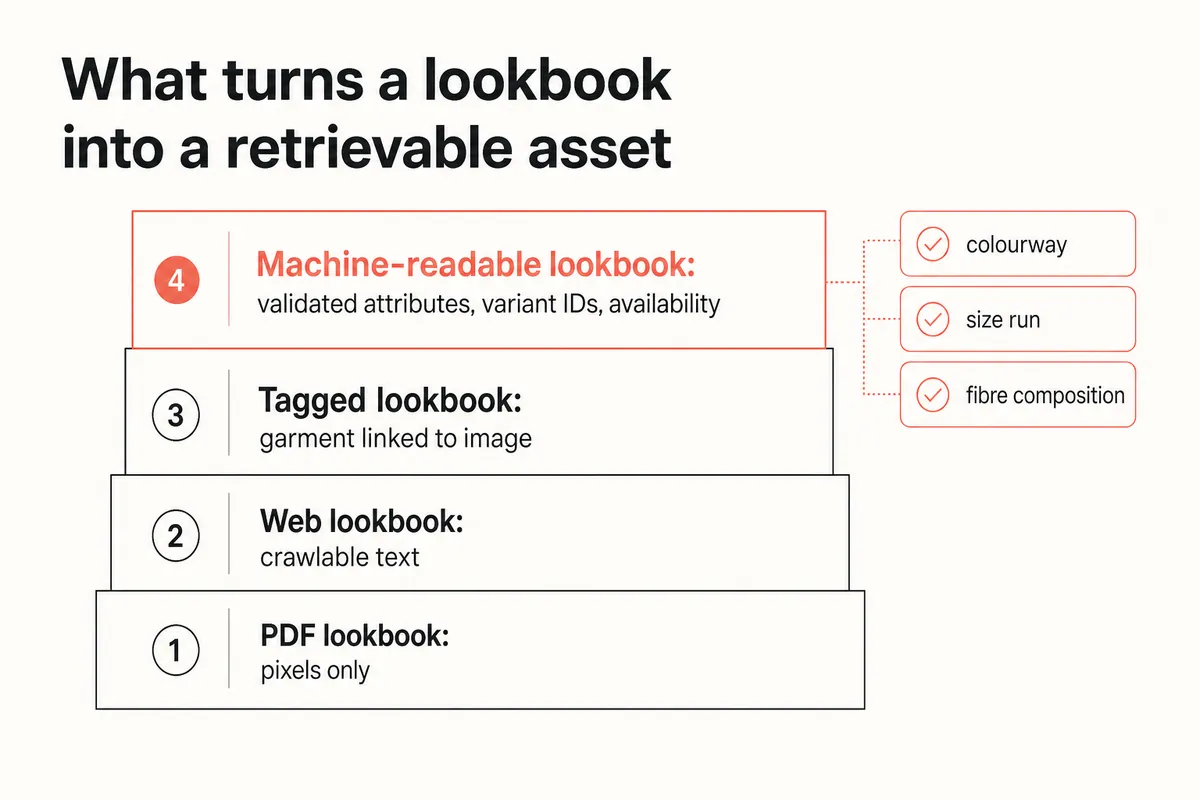
The popular framing says better images win. More variants, more quick cuts, more vertical crops. That worked when distribution was human-first. It breaks when AI agents are co-piloting shopping, pre-buy, replenishment and marketplace curation. Pure image and campaign generators output pixels. They do not output a garment record. They cannot tell an agent whether your viscose is FSC-certified, whether the red is PANTONE 200 C or a custom lab dip, or whether the silhouette has a relaxed hip and a structured shoulder. That means the agent cannot place the product with confidence, and low confidence equals low ranking or total omission.
The F* Word is not an image generator. It is the validation and orchestration layer that produces the structured garment record: the asset plus the machine placement data plus the machine recommendation data that makes an agent confident enough to surface the product. This distinction matters for anyone making workflow buys or creative-direction calls. If you fund pixels without records, you buy reach without conversion. If you approve a lookbook without machine-readable attributes, you approve a campaign that cannot feed production or retail.
A second trap follows. Teams assume a PDP or a DAM tag makes something machine-readable. PDPs are consumer copy and a few schema tags. DAM tags are often free text with no authority, no controlled vocabulary and no link to BOM-level truth. Neither is a factory-ready artifact, neither can supply a retailer's EDI with the right spec at the right time, and neither can drive agent confidence by itself.
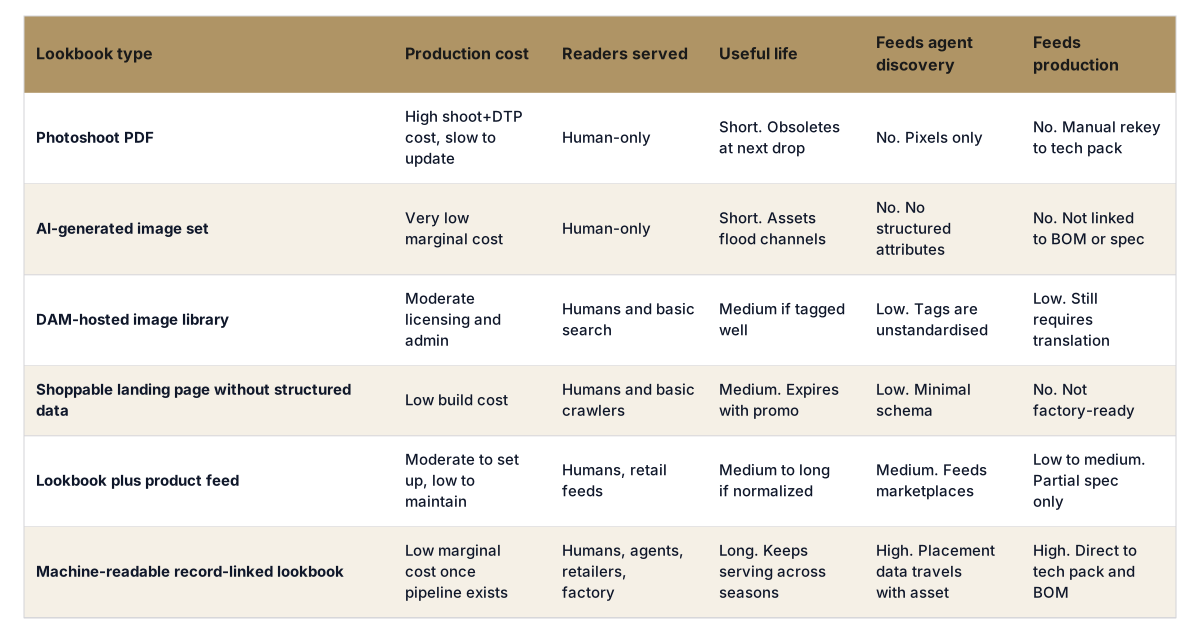
Five common lookbook formats compared by utility, with illustrative cost and impact

A production-ready lookbook entry is an image plus a linked garment record. That record is a living object that can be cited, verified and reused throughout pre-buy, wholesale, DTC, marketplace and post-launch support. It carries seven minimum fields: garment record ID, fibre content, colorway with a standard reference, size run, fit intent, styling context as structured attributes and provenance. With those seven present and machine-readable, a single entry can drive campaign placement, PDP enrichment, retailer syndication, agent search recall and factory readiness.
Production-ready also means authority, not guesswork. Free-text tags like "airy" or "city" are not enough. Authority looks like fibre content that resolves to an internal materials library, color that resolves to a standard like PANTONE or a lab dip code, sizing mapped to a fit block with intent, and styling context drawn from a controlled vocabulary that your brand actually uses in briefs. The record needs provenance that shows when and how the spec changed so an agent or a factory can trust it. This is exactly what converts a campaign asset into placement data that lands your product in the right region of meaning space when an agent fans a query out to possible matches.
The orchestration layer sits between design, imagery and production. The F* Word is not a PLM, not a 3D simulation tool and not an image generator. It is the validation and orchestration layer that produces the structured garment record and keeps it matched. From a garment design, The F* Word generates a factory-ready tech pack in 8 to 10 minutes, including BOM and construction notes, then keeps that pack in sync with the lookbook entry. Upstream, it also generates moodboards as the first half of the same workflow, so creative direction turns into structured inputs rather than disposable inspiration.
If you fund a campaign, the asset costs are already sunk. The missing cost is the connection tissue. Building a record-linked lookbook is a workflow decision, not a creative compromise. See the creative-direction view of this pipeline in Creative Direction Workflow for Fashion Brands and the pre-production dependencies in Pre-Production Workflow Software for Fashion. Both are short overviews of how art, data and manufacturing handshake without slowing anyone down.
Workflow buyers, in-house designers and merchandisers have different pressures. They all touch the same failure mode if they treat lookbooks as pixels. Use this decision framework to sort priorities fast.
What to stop doing this quarter: stop treating PDP copy as your source of truth, stop writing free-text DAM tags that no one reuses and stop approving lookbooks that cannot feed EDI or a factory without a human bridge. What to start: publish record-linked entries that include explicit placement and production data, and measure asset value by Asset Horizon length, not by clicks. If you want a short primer on the framework, see the book page overview here.
Here is what a production-ready, record-linked lookbook entry actually carries beyond the hero image and the styling notes:
With those seven fields in place, a campaign becomes a placement engine. Agents can answer a query like breathable summer blazer for humid climates, cite the fibre and lining, check that the red matches a brand guideline, and send the right variant to a Southeast Asia marketplace while routing the wool-rich version to EMEA. On the supply side, a sourcing partner can open the linked tech pack, view the BOM and construction notes, and return a price or a counter-spec without someone copying data between systems. This is how one creative asset continues to produce value throughout multiple readers and multiple months.
Use a simple scorecard. For every dollar you spend on lookbook generation, you should be ready to spend a dollar on making it machine-readable. If your vendors cannot produce a garment record that your merch team, your retail partners and a factory can cite, they belong in a sandbox, not in the launch path. Do not be distracted by per-image pricing or filter counts. Ask what flows into the record and what flows out to agents and factories.
If you need an enterprise checklist, see AI Fashion Workflow Software and the procurement view at Enterprise. Both lay out how the orchestration layer plugs into PLM, 3D and commerce without asking you to rip anything out.
Pick one capsule or one key story. Treat the lookbook as the front-end of the garment record rather than a standalone PDF. Do not wait for a monolith replatform. A single category pilot is enough to prove that machine-readable assets widen the Asset Horizon and improve sell-in quality for merchants and agents.
Before the creative director signs off the lookbook, demand these seven fields on every entry:
With that rule in place, your next lookbook will not be cheap art that expires. It will be a durable, machine-addressable asset that sells.
Start free at thefword.ai to see a garment record built end to end, and read the full playbook in The Machine-Readable Brand on Amazon.
No. A PDP is consumer-facing copy with limited schema. A machine-readable lookbook entry is a creative asset that is linked to a garment record with authority, provenance and version control. It serves agents, retailers and factories as well as shoppers, and it remains useful far beyond a single campaign.
PLM manages internal product data and workflows. DAM manages asset storage and access. The orchestration layer binds creative assets to authoritative product data, validates the result and pushes it to every downstream reader. The F* Word does this binding and generates the factory-ready tech pack in 8 to 10 minutes from the same record, so your lookbook can feed production without manual rework.
No. Structure preserves your intent so it can travel intact. The image still carries taste and brand point of view, but the linked attributes make sure agents and retailers place it correctly. Structure protects the creative decision you made by making it citeable and reusable.
Start with evergreen styles and high-volume carryovers. Build garment records for those items, add the seven fields, then reissue the lookbook entries with links to the records. Over time, backfill seasonal shows where there is ongoing demand or wholesale interest. Treat it as a rolling conversion, not a one-time migration.
Explore the related workflow. Read the related guide. Try The F* Word.
Related: AI fashion design consistency · AI product photography fashion · PDP optimization for AI agents
Get The F* Word workflow insights in your inbox.