
Language

The answer to what is GSM in fabric is grams per square meter, the weight of one square meter of cloth. A 180 GSM jersey weighs 180 grams per square meter, and a higher number means more material in the same area. Brands write finished GSM and a tolerance into the bill of materials, which The F* Word drafts in every tech pack.
GSM is usually the first number a mill quotes and the first number a buyer checks when bulk fabric arrives. It drives cost, opacity, warmth and drape, and it is one of the easiest specs to get wrong on paper. This guide explains what GSM measures, how it converts to ounces, the working ranges for common garments, how labs test it, and how to write it into a tech pack so the bulk matches the sample. For the wider document, see our guide to AI tech packs.
GSM is a measure of mass per unit area. Cut a square meter of fabric, weigh it, and the number of grams is the GSM. Labs do not cut a full square meter. They weigh a smaller piece of known area and scale the result up.
The figure depends on everything that went into the cloth. Fiber type, yarn count, how tightly the yarns are woven or knitted, loop length on a knit, and finishing steps such as washing or brushing all move it. Two fabrics with the same GSM can feel different in the hand. The XO Fabric knitting team gives a good example: a 200 GSM fleece and a 200 GSM twill share a number on the spec sheet, yet they suit different products, because the loops in a knit trap air and make it feel lighter than a woven of the same weight.
US sourcing sheets and denim mills often quote weight in ounces per square yard. One ounce per square yard equals 33.906 grams per square meter, the factor used in ASTM D3776. To convert, multiply ounces by 33.906 to get GSM, or divide GSM by 33.906 to get ounces. A 5.9 oz jersey works out to about 200 GSM, and a 14 oz denim to about 475 GSM.
The trap is the linear yard. Some mills, denim mills in particular, quote ounces per linear yard: the weight of one yard of fabric at its full width. That number grows with width, so it cannot be compared between two fabrics of different widths. To convert, divide ounces per linear yard by the width in inches and multiply by 36 to get ounces per square yard. Textile tester Jennifer Ennis described a case on Fashion-Incubator where a mill quoted a fabric as 14 oz. Everyone assumed square yards. It was per linear yard, and the fabric weighed 12 oz per square yard on test.
The table below sets out the units you are likely to see on mill quotes and spec sheets, how each converts to GSM, and the mistake each one tends to cause.

Mills publish working ranges for each garment type, and they line up closely with each other. The Mill Scout selection guide puts summer T-shirts at 130 to 160 GSM, standard retail T-shirts at 170 to 200, and heavyweight streetwear tees at 220 to 280. Standard hoodies sit at 300 to 360 GSM, heavyweight hoodies at 380 to 500, and denim jeans at 340 to 475. The chart below plots those brackets for nine common garments.
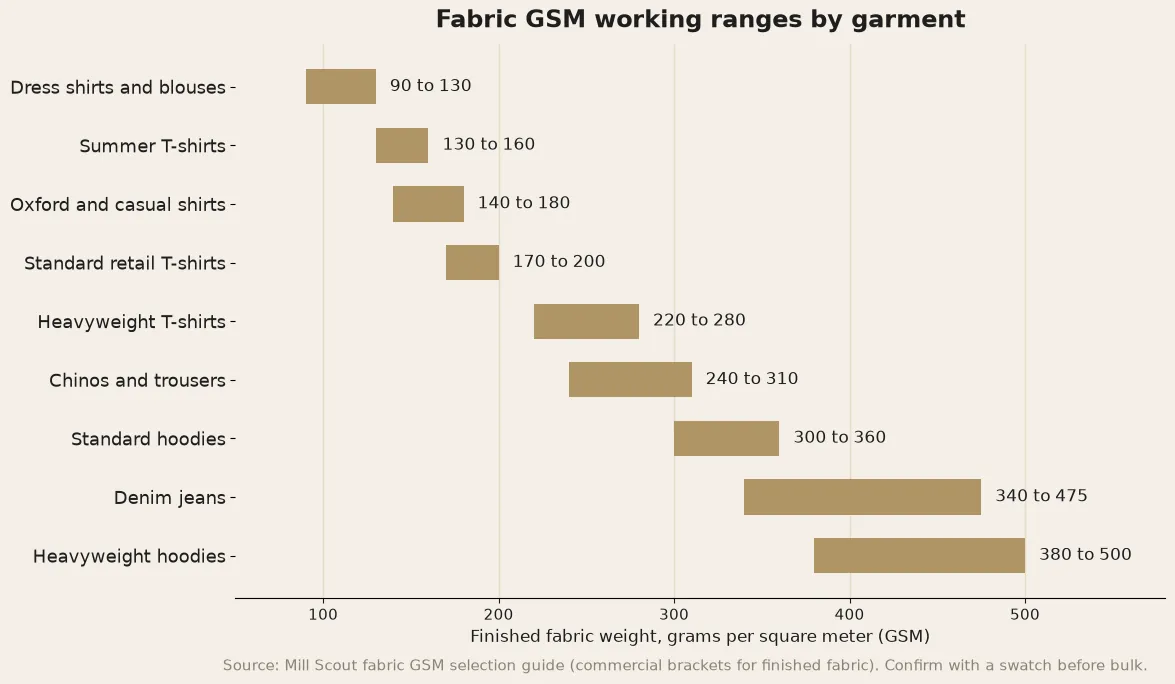
Use the ranges as a starting point for a brief, and never as a spec on their own. The XO Fabric chart notes that light colors go sheer below about 140 GSM on single jersey, so a white summer tee may need to sit at the top of its bracket while a black one can go lighter. Weight also changes freight cost per garment, which matters for a 450 GSM hoodie shipped by air.
A higher GSM means more material, and more material usually costs more. It does not make a fabric better. A 160 GSM combed cotton jersey can outlast a 200 GSM open-end jersey, because yarn quality and twist matter as much as weight for pilling and strength. Heavier fabric also drapes less, so a fluid dress cut in a heavy crepe will hang stiffly.
Opacity, warmth and durability correlate with GSM without being decided by it. When a design brief says "heavier", ask which of those properties the designer wants. A tighter knit at the same weight may solve a sheerness problem without adding cost, while a brushed finish can make a fabric feel warmer at no change in GSM.
Greige fabric is cloth as it comes off the loom or knitting machine, before it is washed, dyed and finished. Finishing changes the weight. KARCEM, a Turkish knitting mill, notes that after washing and compacting a knit draws in widthways and its weight per square meter generally rises. A greige weight and a finished weight for the same fabric can be tens of grams apart.
Always specify finished weight. "160 g/m² finished" gives the mill a target you can test the delivered roll against. A greige figure leaves the finished weight to the dye house, and any gap shows up in your garment.
Labs measure GSM by cutting specimens of known area and weighing them. The EUROLAB testing laboratory describes the usual small-specimen method: condition the fabric at 20 °C and 65% relative humidity under ISO 139, cut at least five 100 cm² circles from points at least 10 cm in from the edge, weigh each on a balance reading to 0.001 g, and report the average. Because 100 cm² is one hundredth of a square meter, the average weight in grams times 100 gives GSM.
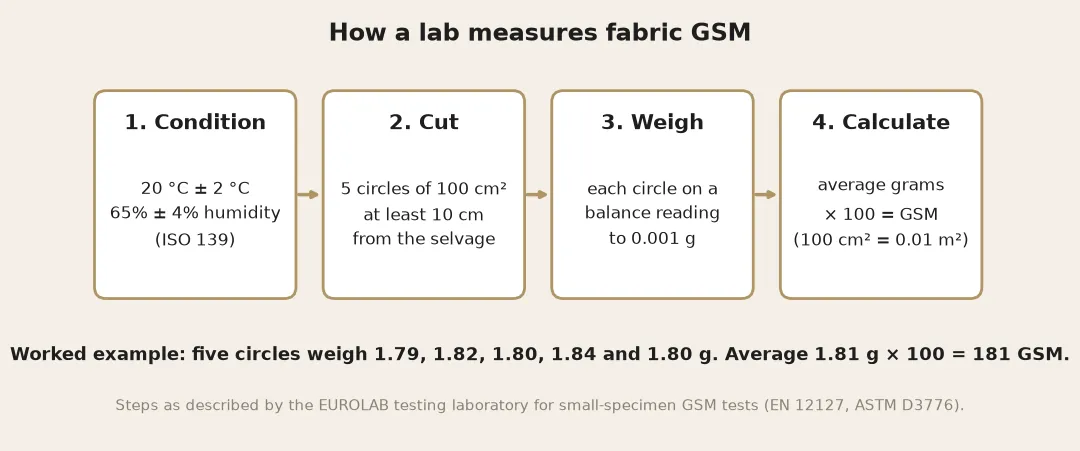
Conditioning matters because cotton and wool absorb moisture from the air and gain weight. Different standards also suit different fabrics. Texlab Instruments points out that ISO 3801 covers woven fabrics only, EN 12127 is the usual European reference for small specimens, ASTM D3776 offers four options depending on what the lab receives, and ISO 9073-1 covers nonwovens. Under ASTM D3776 Option C, a small swatch sent to a lab gives a result for that swatch only, which tells you nothing certain about the bulk roll.
A fabric line in the bill of materials needs five things for GSM to be enforceable: composition, construction, finished weight, a tolerance and a test method. An example line reads "100% cotton single jersey, 180 g/m² finished, ±5%, tested to ASTM D3776, 72 in cuttable width". Many mills quote ±5% as standard. XO Fabric frames the difference as a supplier who says "around 200" against one who says "200 GSM plus or minus 5 percent", tested to a named method after conditioning.
VeriMills, a sourcing guide for garment buyers, puts the risk in one line: "same as sample" is how a 180 gram T-shirt arrives at 140 grams. If the BOM names a weight, a tolerance and a method, you can weigh the bulk and reject it. If it says "same as sample", there is nothing to weigh against. Our guide to what a bill of materials includes covers the other lines on the same page.
The F* Word generates a factory-ready tech pack in 8 to 10 minutes from a sketch, photo or brief. The bill of materials lists each fabric with composition, construction and a weight field, alongside points of measure, grading, tolerances and construction notes. Every field is editable, so you replace the draft weight with the finished GSM your mill confirms before the pack goes out. The software does not weigh cloth, and lab testing still belongs with your mill or test house.
The gain is consistency. A weight, tolerance and method written the same way on every style means the factory, the mill and your QC partner read the same instruction. The F* Word sits before or alongside a PLM and does not replace one. For more on how the materials list gets built, see our piece on BOM automation in AI tech packs.
Related: what is a bill of materials · BOM automation · fabric consistency in prototyping · knit vs woven fabric
GSM stands for grams per square meter. It tells you how much one square meter of the fabric weighs, so 180 GSM means 180 grams per square meter.
Higher GSM means heavier fabric with more material in it. Quality also depends on fiber, yarn and finishing, so a lighter fabric made from better yarn can outlast a heavier one.
Divide GSM by 33.906 to get ounces per square yard. Multiply ounces per square yard by 33.906 to get GSM. A 200 GSM jersey is about 5.9 oz per square yard.
Mill brackets put summer T-shirts at 130 to 160 GSM, standard retail tees at 170 to 200 GSM, and heavyweight streetwear tees at 220 to 280 GSM. Light colors may need the heavier end to avoid sheerness.
GSM goes on the fabric line of the bill of materials, with composition, construction, a tolerance and a test method. The F* Word adds a weight field to every fabric line in the tech packs it generates, and you confirm the finished value with your mill.
Get The F* Word workflow insights in your inbox.