Language
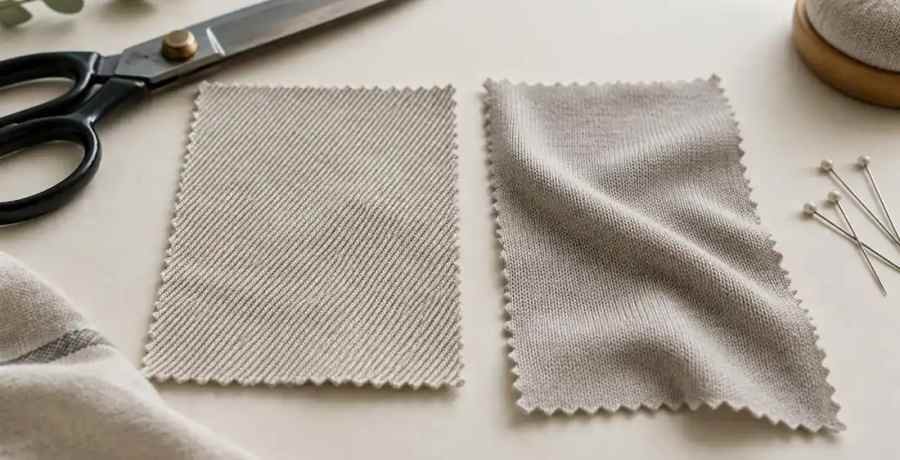
Knit vs woven comes down to how the yarn is held together. Woven fabric interlaces two sets of yarn at right angles, so it is stable and needs ease and closures. Knit fabric is built from loops, so it stretches and can fit close without zips. The F* Word writes the right specs for each into the tech packs it generates.
The choice between a knit and a woven decides more than the feel of a garment. It changes the pattern, the sewing machines, the seam finishes, the measurements on the spec sheet, and often the factory that makes it. This guide sets out the structural difference, how each family behaves in production, and what a tech pack needs to say for each one. For the rest of the steps between design and bulk, see the pre-production workflow guide.
A woven fabric is made on a loom. Warp yarns run along the length of the cloth and weft yarns run the width, passing over and under each other at right angles. The pattern of over and under sets the weave: plain weave for poplin, twill for denim and chino cloth, satin for a smooth face.
A knit fabric is made by forming yarn into rows of loops that pull through each other. Most knits used for clothing are weft knits, where one yarn travels the width of the fabric to build each row. Jersey, rib, interlock and fleece are weft knits. Warp knits such as tricot and raschel form loops lengthwise from many yarns, which makes them flatter and less elastic. A Utah State University extension guide on knits makes the same split, and notes that the weft method produces most knits for apparel.
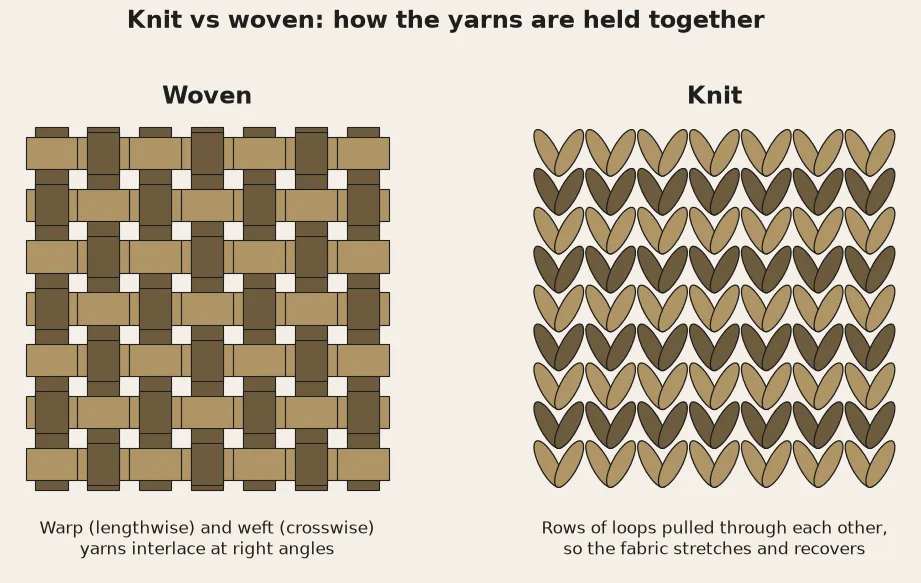
Stretch is the difference buyers notice first. The loops in a knit can open and close, so the fabric stretches without any elastane, most of all in width, and rib and elastane knits recover well. A woven barely stretches on the straight grain unless it contains elastane or is cut on the bias, which is why a woven shirt needs buttons and a woven trouser needs a fly.
The two families also behave differently at the cut edge. TextileNotes, a textile production reference, points out that single jersey curls at the edge and can run, while woven fabric frays. Knits resist wrinkles better. Wovens hold a crease and a sharp silhouette, which suits tailoring, workwear and structured outerwear.
Because a woven does not give, the pattern has to include ease: extra room so the wearer can sit, reach and breathe. Voyager Textile, a garment manufacturer, puts it plainly: stability means a woven garment must have room to move designed into the pattern. Darts, pleats and closures do the shaping a knit does by stretching.
A knit pattern can fit close to the body, and leggings and fitted tops often use negative ease, meaning the garment is smaller than the body and stretches to fit. That cuts both ways. Sulky, the thread maker, warns home sewers that a pattern drafted for knits cannot be made in a woven, because there is not enough ease and the garment will not go on. A knit pattern also has to account for how much the chosen fabric stretches, so swapping one jersey for a stretchier one can change the fit by itself.
Production differs from the first purchase order. The table below compares the two families on the points that change a tech pack, a costing or a factory choice. TextileNotes and Voyager Textile are the main sources for the buying and sewing rows.

Buying units matter for costing. A knit is usually priced and ordered by weight, so consumption gets planned in kilograms per dozen garments, while a woven is ordered by length. A costing sheet that mixes the two without converting will misstate fabric cost on every style in the range.
Knit seams have to stretch with the fabric, or the thread snaps when the garment is pulled on. Factories sew most knit seams on overlock machines and hem them with a coverstitch. Woven seams are usually sewn with a lockstitch and finished so they do not fray: overlocked edges for basics, French seams for fine shirting, flat-felled seams for jeans and workwear.
The machine mix often decides the factory. Voyager Textile notes that the knit or woven choice changes the machinery and can change the factory, because a cut and sew knit plant set up for T-shirts and hoodies may have no capacity for tailored woven jackets. A brand adding its first woven shirt to a knit range should expect to qualify a second supplier. The Utah State guide also notes that knitted cloth tends to need less lead time than wovens, which matters for fast reorders.
The line between the two families is softer than the definitions suggest. Fitinline, an apparel manufacturing reference, notes that a woven can stretch through elastane, stretch yarns or bias cutting, and that some double knits and warp knits are firm and stable. Ponte, a double knit, is a common example: brands use it for trousers and unlined blazers that need to look tailored and still move.
Many garments also combine both. A bomber jacket often pairs a woven nylon shell with rib knit cuffs, collar and hem. A woven shirt can carry a jersey back panel in sportswear. Each mix means two sets of fabric rules in one tech pack: woven seams and ease on the shell, stretch seams and extended measurements on the rib. It also means the factory needs both machine types on the same line, which is worth checking before you place a sample order.
A knit spec needs fields a woven spec can skip. List the fabric's stretch and recovery, its GSM, and for stretch points such as waistbands and cuffs, both a relaxed and an extended measurement. A woven spec needs ease built into the measurements, the grain line on each piece, the closure type and size, and the seam finish for each seam. Both need a shrinkage allowance from a wash test on the bulk fabric before patterns are finalized.
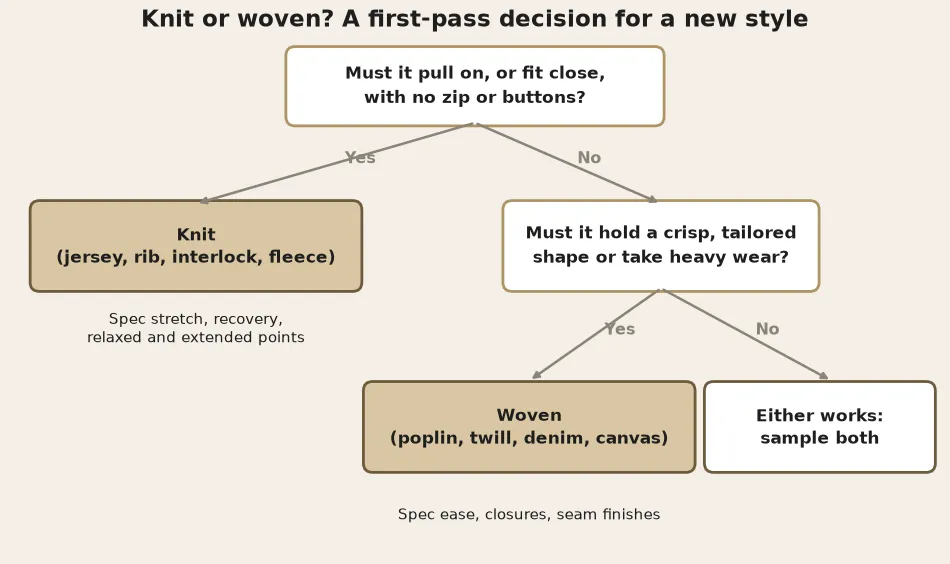
The choice can be worked out early. The decision chart below is a first pass we use with brand teams on a new style: start from whether the garment has to pull on, then ask whether it has to hold a shape. Styles that pass neither test can go either way, and the right answer comes from sampling both.
The F* Word generates a factory-ready tech pack in 8 to 10 minutes from a sketch, photo or brief, with points of measure, a bill of materials, grading, tolerances and construction notes. For a knit it sets up relaxed and extended points and stretch seams. For a woven it carries ease, closures and seam finishes. Every field is editable, the fabric lab work stays with your mill, and the software works before or alongside a PLM and does not replace one. If fit comments come back on the first sample, our guide to the fit comment sheet covers how to write them, and our bill of materials explainer covers the fabric lines.
Related: fabric consistency in prototyping · what is a bill of materials · grading rules · what GSM means in fabric
Woven fabric interlaces two sets of yarn at right angles on a loom, so it is stable and frays at the edge. Knit fabric is made from rows of loops, so it stretches and recovers and can fit close to the body.
Pull it gently in width. A knit stretches and springs back, and under a magnifier you will see rows of V-shaped loops. A woven barely moves on the straight grain and shows yarns crossing over and under each other.
Denim is a woven, usually a warp-faced twill. Stretch denim adds elastane to the weft so it gives a little, and some brands sell knit fabrics printed or dyed to look like denim.
Most T-shirts are knit, usually cotton single jersey. The stretch lets them pull over the head with no buttons, and the seams are sewn on overlock and coverstitch machines.
Yes. Knit specs add stretch, recovery and relaxed and extended measurements. Woven specs add ease, closures, grain lines and seam finishes. The F* Word sets up the right fields for each in the tech packs it generates.
Get The F* Word workflow insights in your inbox.