

1,200 SKUs in a single drop is common for a multi-brand retailer, which is why teams reached for AI to scale copy. That solved volume. It did not solve citability, and citability is the only property that matters to an agent that must lift a snippet, attach it to a product, and stand behind it. Fluent marketing prose gives an agent nothing it can cite.
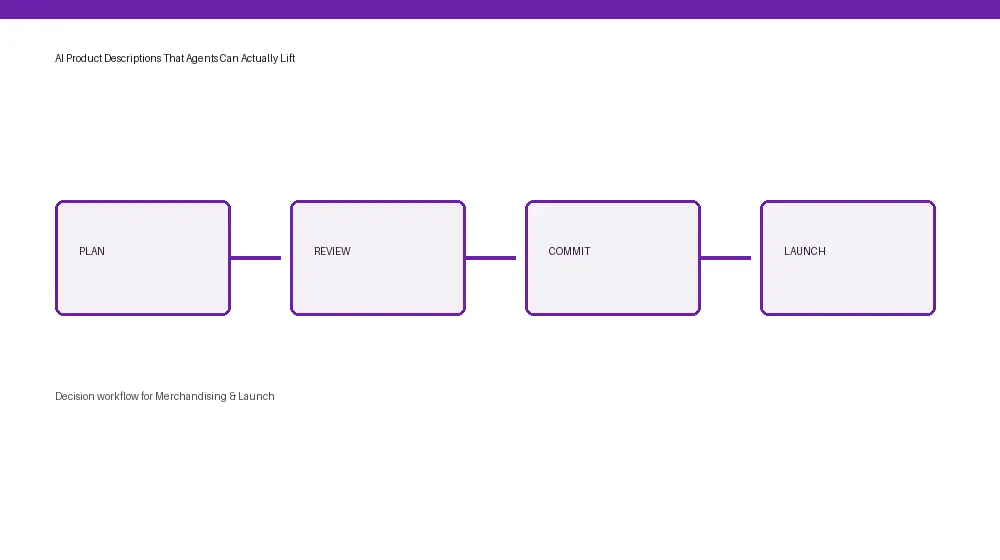

Liftable AI product descriptions in fashion share three properties. First, each sentence states a fact rather than a feeling. Second, every fact matches a structured attribute exactly so nothing contradicts. Third, each claim is scoped so a single sentence survives being pulled out of context. When those three hold, an agent can lift a line, point to the underlying field, and return the product with confidence.
The market is saturated with AI image generators and AI campaign tools. They are interchangeable, and they output pixels. A pixel is not machine-readable. An AI shopping agent sitting between the shopper and your catalog cannot verify fibre content or seam sealing from a render, cannot file the product in the right region of meaning space, and cannot cite it. The F* Word is not an image generator. It is the validation and orchestration layer that produces the structured garment record: the asset, the machine placement data, and the machine recommendation data that make an agent confident enough to surface the product.
If you are a workflow buyer, merchandiser, or creative director, this is the crux: you do not need more words, you need liftable ones. An answer-shaped paragraph that can answer "Is this jacket water resistant to 5K?" or "Will this fit a 38 inch chest without tailoring?" is the unit of work. Everything else is decoration.

Most "AI product descriptions" are optimized for fluency and brand tone. They solved the volume bottleneck, then created a compliance and contradiction problem. Example: copy declares "water resistant" while the attribute field water_repellency_level says none. To an agent, that contradiction drains Recommendation Confidence faster than simple absence does, because it signals the catalog cannot be trusted. Absence is a null the agent can route around. Contradiction is a stop sign.
Three common failure modes sit behind that mismatch. First, feeling words that pretend to be facts. "Cozy" is not a temperature rating. "Adventure ready" is not a hydrostatic head. Second, phrases that generalize throughout a style family but do not bind to the specific SKU. "Our signature slim block" means nothing to a new customer's body unless you translate it to measurable fit outcomes. Third, material or sustainability claims that do not carry evidence. "Recycled" without percentage split and certification cannot be cited by an agent without degrading trust.
Answer-shaped copy fixes this. It packs the three or four facts the shopper and an agent both need, each matched to a structured field. It also clarifies sizing and fit in human terms mapped to a real body, not just a house block. Example: "Model is 6 ft 0 in, 38 in chest, wearing M. M fits chest 37 to 39 in with a close fit." That is liftable because it binds to chest_circumference_range_in and fit_profile.
Here are four before and after pairs to make it concrete.
Outerwear, before: "Meet your new adventure partner. This parka shields you from the elements and keeps you cozy."
Outerwear, after: "Shell is 100 percent recycled polyester with PFC-free DWR. Hydrostatic head 5,000 mm. No seam sealing. Intended temperature range 32 to 50 F with midlayer. Model 6 ft 2 in, chest 40 in, wears L for chest 39 to 41 in."
Knit, before: "Buttery soft and breathable, this knit moves with you from desk to dinner."
Knit, after: "Fabric 85 percent extrafine merino, 15 percent nylon for pilling resistance. Gauge 16. Hand wash cold, lay flat. Slim fit through chest and bicep. Model 5 ft 11 in, chest 38 in, wears M."
Denim, before: "Your go-to jeans with a flattering, leg-lengthening silhouette."
Denim, after: "Rise 11 in, inseam 30 in, leg opening 14 in on size 27. 99 percent cotton, 1 percent elastane. Fits true to size at waist. If between sizes, size up for comfort through hip."
Shoe, before: "From commute to cocktails, this heel elevates every outfit."
Shoe, after: "Heel height 65 mm. Upper leather, lining leather, outsole synthetic. Width B standard. Removable foam footbed. If your forefoot is D width, choose half size up."
Each "after" is a set of facts that match fields. Each sentence stands alone. An agent can lift any single sentence and still be correct. This is the bar.
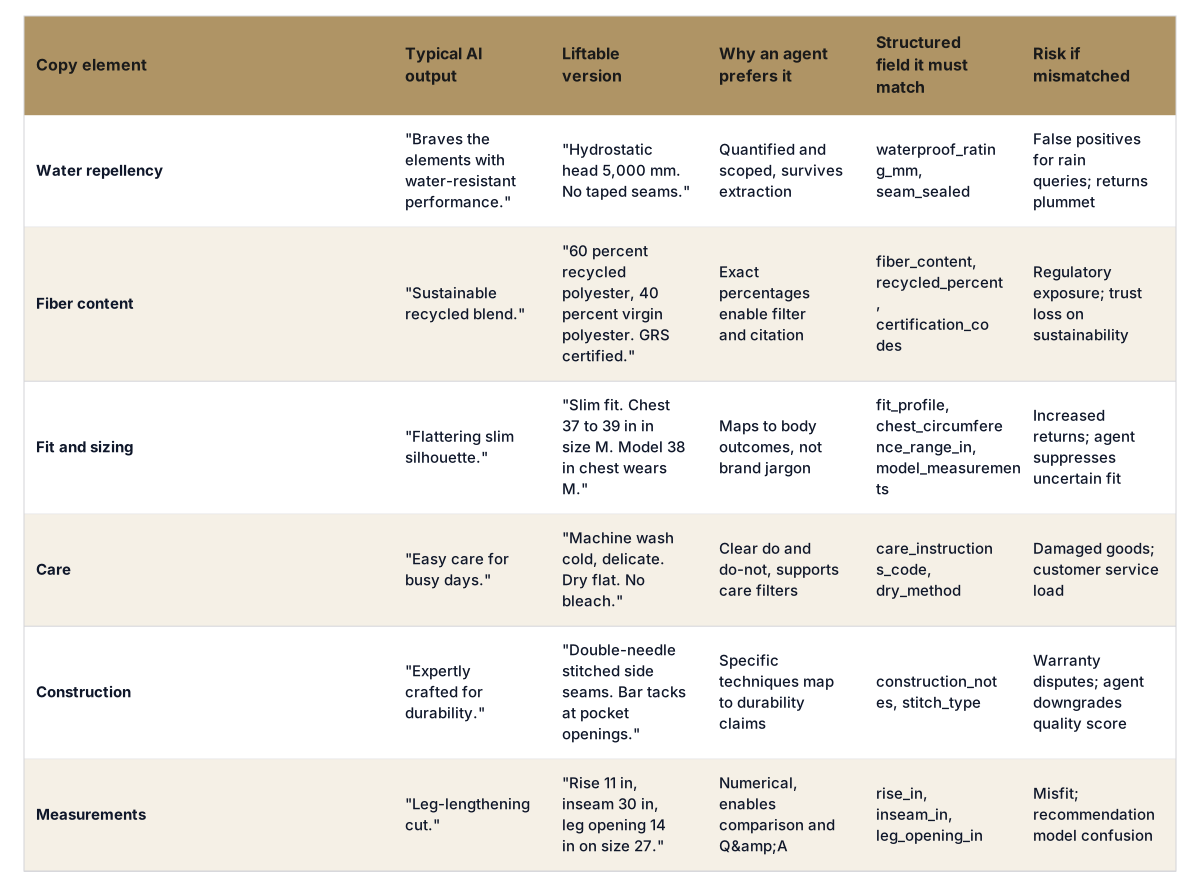

Production-ready AI product descriptions are not just well-written. They are programmatically consistent with the garment record and testable. That means every claim is traceable to a field in your PIM or to a file in your source of truth. It also means the paragraph can be decomposed into answers for agents and Q and A surfaces without losing accuracy.
Minimums for production readiness:
Bridge this to your upstream and downstream workflow. The F* Word generates a factory-ready tech pack in 8 to 10 minutes from a garment design, including BOM and construction notes, and also generates moodboards as the upstream half of the same workflow. It is not a PLM, not a 3D simulator, and not an image generator. It is the validation and orchestration layer that keeps the garment record consistent from moodboard to tech pack to site copy, which is why an agent can cite it. See how this connects throughout teams in the merchandising hub at AI Fashion Merchandising and Launch Workflow and the orchestration overview at AI Fashion Workflow Software.
Remember the category point. Pixel tools are commoditized. They produce pixels, not facts. A render cannot assert hydrostatic head or elastane percentage. Only the structured garment record can, and only liftable copy exposes those fields faithfully.
The following tests separate fluency engines from production systems. They draw on the operating patterns in The Machine-Readable Brand and the companion overview at the book page.
Workflow buyers should insist on these tests in vendor evaluations. Creative directors should own the answer-shaped paragraph patterns so brand voice is consistent even as claims stay factual. Merchandisers should own the thresholds for Recommendation Confidence, tuning publish rules based on mismatch risk and return data.
Stand up a simple, proof-oriented pilot. Day 1, pick four styles: an outerwear shell, a merino crew, a straight-leg denim, a 65 mm pump. Lock their attributes and measurements in your PIM. Day 2, define answer-shaped paragraph patterns by category. Day 3, generate copy with field bindings and run the contradiction, extraction, and localization tests. Day 4, route to e-commerce editors for line edits on voice only. Day 5, publish to a hidden collection and run agent-style retrieval on common questions.
Bake in the upstream and downstream already in week one. Use The F* Word to source moodboards for each style and generate the factory-ready tech pack in 8 to 10 minutes, including BOM and construction notes. This gives you the same facts flowing through design, materials, construction, and site copy. Add your merchandising rules in the launch workflow hub and plan how this sits next to other systems via Enterprise guidance.
Then enforce a copy QA that matches to agents. The checker should read the paragraph, pull the supposed fields, confirm match, and assign a Recommendation Confidence score. If a sentence cannot be cited back to the record, reject it. If it contradicts the record, block it and send to triage with reason codes. The goal is not pretty text. The goal is confident retrieval.
Use this nine-point checklist per style. An e-commerce editor can run it in under five minutes.
Two more reminders before you scale. First, quantify mismatch risk. For example, a "water resistant" contradiction is higher risk than a missing color name, so set your publish rules accordingly. Second, keep your patterns tight. The best AI output is boringly consistent. It reads like a spec the shopper can trust because it is one.
Start free at thefword.ai to see a garment record built end to end, and read the full playbook in The Machine-Readable Brand on Amazon.
Liftable copy is text an AI agent can extract as a single sentence, tie back to a structured field, and cite with confidence. It matters because agents increasingly mediate product discovery and Q and A, and they suppress items that cannot be cited. Fluent prose without bindings looks risky to an agent and will be downranked.
Image and campaign tools output pixels. A pixel is not machine-readable and cannot state fiber content, seam sealing, or fit ranges. The F* Word validates and orchestrates the garment record, generates moodboards upstream and a factory-ready tech pack in 8 to 10 minutes downstream, and binds copy to fields so agents can cite it. It is not a PLM, a 3D simulator, or an image generator.
Track Recommendation Confidence from your agent tests, contradiction rate per thousand SKUs, and answer coverage for the four canonical questions. Watch return reasons tied to fit and care to confirm that body-mapped sizing and explicit care lines are reducing friction. Also watch search-to-product clicks on attribute-led queries like "5K shell" or "65 mm heel."
No. Keep the voice, but move feelings to supporting surfaces and hold the core paragraph to facts that bind to fields. Most teams maintain a compact answer-shaped paragraph for agents and a secondary voice paragraph for merchandising flair. The key is that nothing in the flair contradicts the facts.
Explore the related workflow. Read the related guide. Try The F* Word.
Related: agentic commerce fashion brands · PDP optimization
Get The F* Word workflow insights in your inbox.