

Quick answer: Judge trend forecasting tools on signal source, lead time, and whether the output maps to a SKU. A tool that flags a color six weeks before your buy deadline is actionable. one that reports last season's runway is not. The F* Word moves a validated signal to a costed tech pack in 8 to 10 minutes.
AI fashion trend forecasting tools rank emerging colors, silhouettes and materials from social, search and sell-through data. The useful ones publish their sources and lead time. The F* Word takes the next step a trend call is worthless without: the chosen direction becomes a factory-ready tech pack in 8 to 10 minutes.
AI fashion trend forecasting tools rank emerging colors, silhouettes, and materials from social, search, and retail sell-through data. The useful ones publish their signal sources and lead time, because a trend call a merchandiser cannot buy against inside the calendar is commentary rather than intelligence.
The merchandiser problem in 2026. Trend signal is no longer the bottleneck. Heuristic and Trendalytics already surface 600 to 1,200 emerging signals per week per category. The bottleneck is decision speed: which 8 signals become buy briefs, in which colorways, at which depth, for which doors, before the window closes. AI trend intelligence built for merchandisers compresses that decision loop from 7 weeks to 7 days when the workflow is wired correctly.
This is a workflow guide written for the in-house merchandising lead at a brand between 50 and 2,000 SKUs per season. It covers the four buying decisions AI trend intelligence actually changes, the signal-to-SKU workflow that gets you to 7 days, and a head-to-head comparison of the 4 platforms most merchandising teams shortlist.

Trend intelligence sources, signal quality & speed for merchandisers
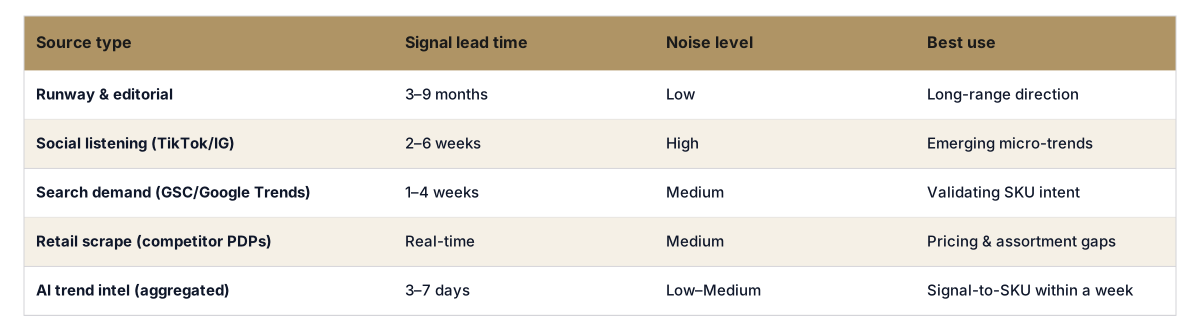
Trend tools sell "insight." Merchandisers buy four decisions. Map every dashboard your team evaluates back to these or it will not earn its seat cost.
A trend tool that does not improve at least three of these four decisions is a feed, not intelligence. Score every vendor demo on the four-decision rubric.
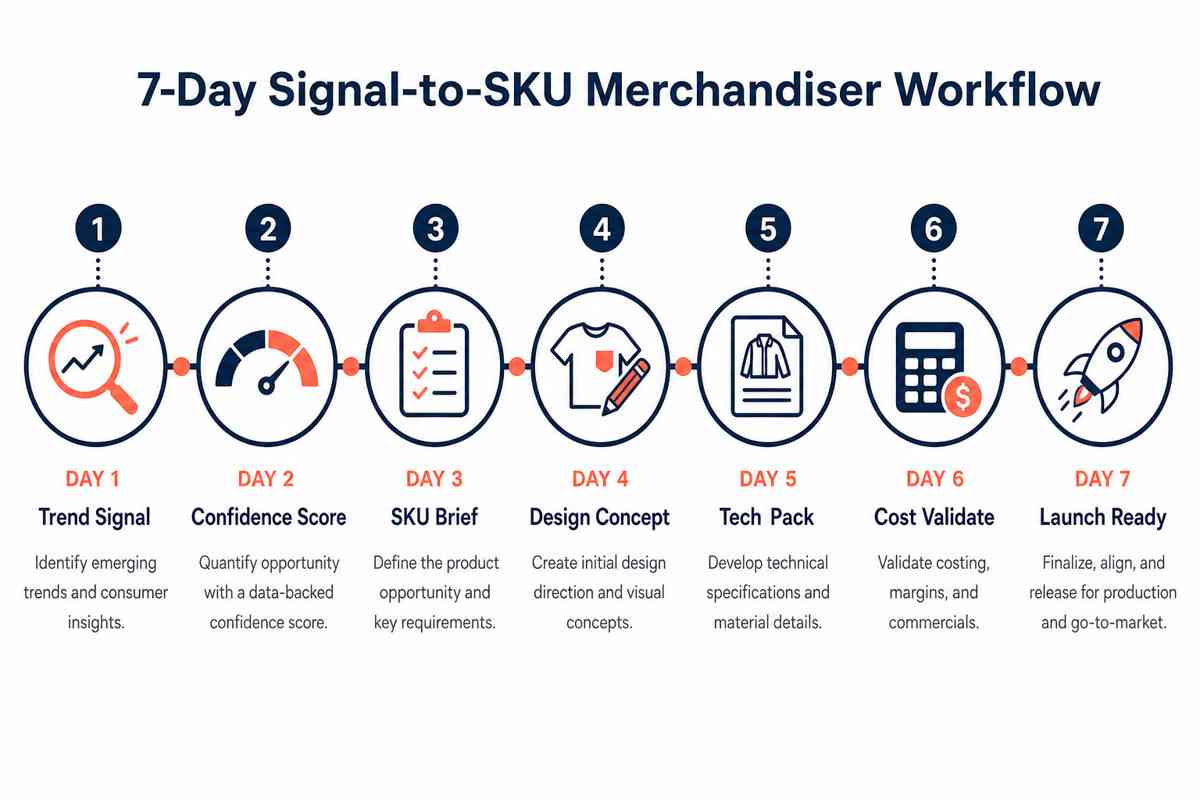
The compressed workflow most merchandising teams run with AI trend intelligence in 2026 looks like this. Day counts assume one merchandiser owns the pipeline with design and planning collaborating asynchronously.
The two days that compress the most with AI are day 1 and day 5. Manual triage of 1,000 weekly signals to a top 18 typically eats a full week. AI scoring cuts that to a morning. Manual brief and moodboard generation from a chosen signal takes 4 to 6 days. AI workflow tools (the category The F* Word sits in) produce a usable brief and moodboard in minutes, and a factory-ready tech pack in 8 to 10 minutes once the design is locked.
Scored 1 to 5 on the merchandiser rubric: buy-or-skip scoring, depth and width modeling, door allocation, mark-down risk, and how cleanly the platform hands off to a design and tech-pack workflow.
Heuritech has the strongest scoring on the buy-or-skip decision because the model is built on social signal velocity at scale. It is the most defensible answer if your assortment is consumer-trend driven.
Trendalytics is the most balanced throughout all four decisions and the easiest to onboard for a merchandising team that has not used AI trend tools before. Cleanest UI in the category.
WGSN is still the depth choice for editorial trend research and brand books. It is not built for the 7-day workflow and scores low on merchandiser handoff. If your team uses WGSN, pair it with one of the other three.
EDITED is the strongest if your decisions depend on competitor pricing, depth and mark-down behavior at retail. The door-allocation score is the highest in the category because EDITED ingests retail data directly.
The biggest unsolved gap in this category is the brief handoff. Every trend platform produces some form of trend report, but none of them produce a design brief, moodboard, or tech pack a brand team can act on in minutes. This is the gap an AI fashion workflow tool fills. The merchandiser picks the signal in the trend tool, hands the signal to a workflow tool, and gets a brief, moodboard, and factory-ready tech pack out the other side in hours, not weeks. The F* Word produces moodboards and factory-ready tech packs (with linked BOM and graded POMs) in 8 to 10 minutes once a signal is chosen, which is what makes the 7-day signal-to-SKU loop actually achievable.
If you adopt AI trend intelligence, measure it on these three numbers. Anything else is a vanity metric.
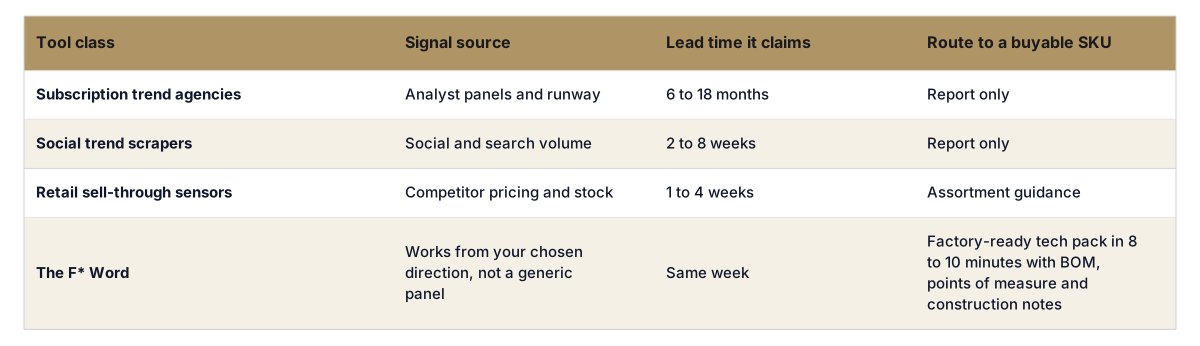
Trend tools shorten the decision, not the calendar. The calendar is lost in specification. The F* Word closes that gap by turning the direction you commit to into a factory-ready tech pack in 8 to 10 minutes, with validated BOM and points of measure, so a signal spotted this week can be quoted by a factory the next.
AI trend intelligence for merchandisers is the category of software that scores fashion signals on velocity, breadth, and demographic fit, then surfaces the small subset that should become buys. Unlike editorial trend research (WGSN brand books, for example), it is built around four buying decisions: buy or skip, depth and width, door allocation, and mark-down risk.
The benchmark in 2026 is 7 days from signal capture to SKU in the planning system when AI trend intelligence is paired with an AI workflow tool that drafts the brief, moodboard, and factory-ready tech pack. Manual workflows typically take 35 to 49 days for the same loop. The compression mostly comes from triage (day 1) and brief generation (day 5).
Heuritech and EDITED tied at the top of our merchandiser rubric. Heuritech wins on the buy-or-skip decision for consumer-trend driven brands. EDITED wins on door allocation and mark-down risk for brands competing on price and depth. Trendalytics is the easiest onboard if your team is new to AI trend tools. WGSN is editorial and should be paired with one of the other three.
No. It compresses the triage and depth-math steps the buyer was doing manually so the buyer can spend the recovered time on judgment-heavy work: brand DNA fit, door tiering, and supplier-feasibility checks. Teams that try to remove the buyer instead of equipping them tend to over-index on trending signals that do not fit the brand.
Trend tools surface signals and trajectories. They do not produce design briefs, moodboards, or tech packs. AI fashion workflow tools (like The F* Word) close that gap by generating an editable brief and moodboard from a chosen signal in minutes, then a factory-ready tech pack with linked BOM and graded POMs in 8 to 10 minutes once the design is approved.
If your merchandising team has a trend tool but the bottleneck has moved to brief and tech-pack generation, The F* Word produces moodboards and factory-ready tech packs (linked BOM, graded POMs) in 8 to 10 minutes from a chosen signal. See it in action or book a 20-minute walkthrough with our team.
Related: AI line review tools · Explore the related workflow · Read the related guide · Read the related guide · fashion trend analysis tools
Get The F* Word workflow insights in your inbox.