

Short answer: Tech pack validation is the automated check that a garment spec is complete, internally consistent and manufacturable before it is sent to a factory, distinct from generating the spec and distinct from storing it. It verifies that all required fields are populated, that POM, grading, BOM and construction notes do not contradict each other, and that the construction is achievable in the stated fabric on the stated equipment within the stated tolerances, then outputs an auditable per-check pass or fail with reasons.
The competitive field has settled into two camps. One camp generates something, like a pattern, a.DXF, a render or a draft tech pack, and often calls that the finish line. The other camp stores the record, PLM and PIM, and assumes whatever arrives is correct. Neither camp validates. The F* Word operates the validation and orchestration layer in that gap. It generates a factory-ready tech pack in 8 to 10 minutes from a garment design, including BOM and construction notes, and it also generates moodboards as the upstream half of the same workflow. It is not a PLM, not a 3D simulator, and not an image generator. The differentiator is the checks that run before the spec leaves the building.
For VP Product Development, Directors of Sourcing, in-house designers and merchandisers, the gap between a spec being produced and a factory accepting it without a revision round is where avoidable cost, delay and rework live. Tech pack validation closes that gap with three families of checks:
Validation outputs a checklist result, not a free-form comment. Each check is a pass or fail with a reason and, when possible, a suggested fix. The artefact should be attached to the style record, time stamped, and auditable across seasons for continuous improvement. See examples of these checks in practice in POM accuracy: 7 AI validation checks before factory handoff and the deeper breakdown in AI tech pack: BOM, POM, grading.
Not generation. Creating a spec is useful but it is not validation. Pattern tools like Gerber AccuMark, Lectra, or Optitex, and 3D tools like CLO or Browzwear, produce assets that inform the spec. Some AI tools can draft a tech pack. Generation answers the question: do we have a thing to send. It does not answer: is the thing internally correct and buildable.
Not a human review. A tech designer reading the document can catch issues, but attention is finite, context changes by season, and people move teams. Review is valuable, but it is not systematic and it is not auditable at the check level.
Not approval. A manager changing status to Approved in a system of record is governance. Approval means who said yes and when, not whether the spec can run on a flatbed, cylinder bed, or overlock in line with the stated tolerances.
Not storage. PLM systems like Centric, PTC FlexPLM, or Backbone are strong at versioning, routing and reporting. Their public positioning is about source of truth and workflow. They may enforce required fields, but they do not advertise automated manufacturability checks across BOM, POM, grading and construction. Storage is where the record lives. Validation determines if the record is fit to ship.
The F* Word is the validation and orchestration layer. It generates moodboards upstream as part of the same workflow, and then produces a factory-ready pack in 8 to 10 minutes with BOM and construction notes, but its defining task is the automated validation step. Read the overview at AI tech packs, intelligently and the adjacent workflow map in pre-production workflow software for fashion.

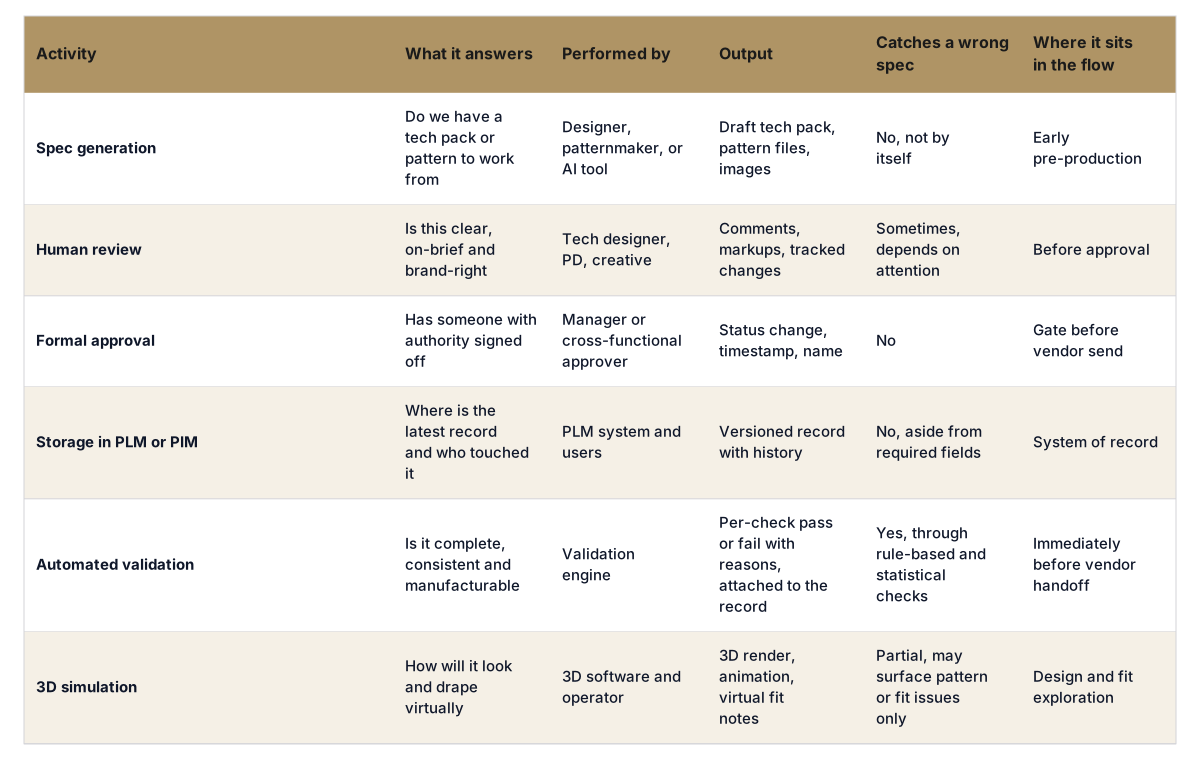
The F* Word sits between creation and record-keeping. It ingests your design inputs, generates a factory-ready tech pack in 8 to 10 minutes with BOM, POM, grading and construction notes, then runs dozens of automated checks before anything goes to a vendor. The artefact is a per-check log: pass or fail, reason, and suggested fix. It attaches to the style record and can sync to your PLM through an integration so nothing is orphaned.
This is the distinction the market is missing. The generation camp stops at a draft. The storage camp assumes correctness. The F* Word validates and orchestrates the flow across design, merchandising and sourcing, then packages the spec for factory acceptance. It is not a PLM and it does not try to replace one. It is the guardrail that reduces revisions and time to PO. For a quick walkthrough, start with the AI fashion design overview and the end-to-end AI fashion workflow. If you need an enterprise rollout, see enterprise.
Operator note: if your team already works in PLM, validation can run as a pre-flight stage before creating or updating the record, or as a scheduled check before each vendor send. If you live in email and shared drives, validation still runs, and the pass or fail report becomes the auditable trail that cuts through subjective back-and-forth. See examples of preventing rework in tech pack revisions after factory comments and why a pattern file alone is not a handoff in DXF files are not factory handoff.
Ready to see it applied to your styles with real checks and a stop-go decision tied to reasons and suggested fixes. See the validation step run end to end at thefword.ai.
PLM systems are designed to store the record, enforce workflows and report status. Many can require fields to be filled, but they typically do not advertise automated cross-checks for manufacturability across BOM, POM, grading and construction notes. Validation is a pre-flight step that can run before the PLM update or vendor send, and the per-check result can be attached back to the PLM as an artefact.
Templates reduce omission risk by reminding users which fields to fill, which helps completeness. Templates do not test for contradictions or manufacturability, and they do not produce a per-check log with reasons. Validation enforces rules across sections and equipment capabilities, even when a template was used to draft the pack.
No. Validation aims to eliminate preventable comment loops and first proto failures that come from spec errors and contradictions. You still run fit and material approval rounds, but you start them with a spec the factory can build to, which shortens cycle time and reduces rework. The effect on cost and time is often visible within a few styles, though exact numbers are illustrative and depend on mix and vendors.
Ask for a per-check report with pass or fail and reasons, attached to a style. Then give them a deliberate conflict set: a knit fabric marked non-stretch, a grading rule that contradicts POM, an SPI too high for 12 oz denim, and a missing tolerance. A real validator should flag all of these and suggest fixes. For context on what to include, see why pattern intelligence is not a tech pack.
Get The F* Word workflow insights in your inbox.