Language
A capsule collection is a small, tightly edited set of garments, often 10 to 30 pieces, designed to work together and released outside or alongside a brand's main seasonal range. Many are limited runs or collaborations. The F* Word helps brand teams plan one with AI moodboards and tech packs generated in 8 to 10 minutes per style.
Ask a room of buyers what is a capsule collection and you will hear two answers, because the term covers two related ideas. Shoppers use "capsule wardrobe" for a small rotation of pieces they own. Brands use "capsule collection" for a product release: a short line with one clear idea behind it. This guide is about the second meaning, written for designers, creative directors and merchandisers who have to plan, build and launch one. For the wider process around concept and approvals, see our creative direction workflow guide.
A capsule collection is a condensed version of a brand or designer's point of view. The styles share a palette, a set of fabrics and a story, so a customer can buy two or three pieces and wear them together. Business of Fashion, quoted by Apparel Resources, describes capsules as often limited edition and focused on construction more than on the styling of a runway show.
No fixed count of pieces exists. Published glossaries put most capsules somewhere between 10 and 30 styles, with emerging brands often working with fewer than 10 so that every piece pairs with every other one. A 150-style seasonal collection can carry weak styles because the range is wide. A 12-style capsule has nowhere to hide them, which is why the edit matters more than the sketch count.
The Oxford English Dictionary records "capsule" in the sense of small and compact as an American usage from 1938, and "capsule wardrobe" appeared in American publications in the 1940s. Susie Faux, owner of the London boutique Wardrobe, revived the phrase in the 1970s for a set of essential pieces such as skirts, trousers and coats that could be updated with seasonal additions.
Donna Karan turned it into a product release. Her Seven Easy Pieces, launched in 1985, were a bodysuit, a tailored jacket, a skirt, pants, a cashmere sweater, a leather jacket and an evening look, meant to work for day and evening, office and weekend. The brand still calls it "the original capsule collection".
The modern collaboration capsule dates from November 2004, when Karl Lagerfeld designed a one-off collection for H&M. The ASU FIDM Museum records that it was carried in roughly half of H&M's stores and sold out in a matter of hours at many of them. WWD notes prices such as $49 blouses and $129 sequined tuxedo jackets from one of the most famous designers alive, and credits the project with starting the pattern of designer collaborations, drops and pop-ups that followed.
Other retailers copied the format quickly. In 2006 Topshop launched a capsule with textile designer Celia Birtwell, whose name had faded since her work in the 1960s and 1970s. The museum's account makes a point brand teams still use: a collaboration capsule can introduce a lesser-known designer to a mass audience as well as lend a famous name to a retailer.
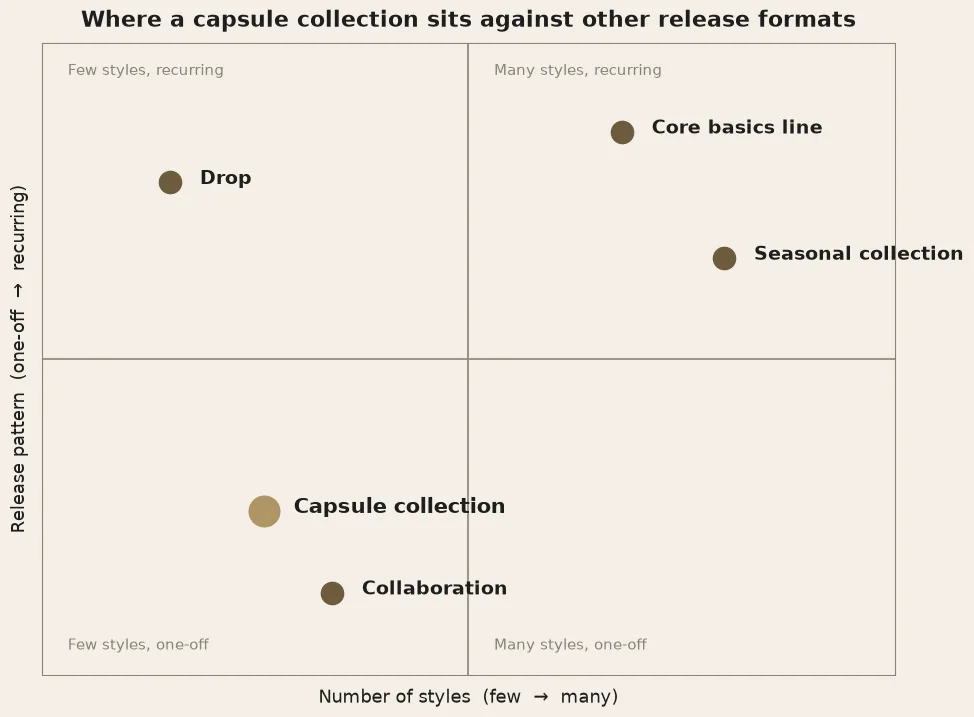
Brands use several release formats, and the names get mixed up in planning meetings. The table compares a capsule with the formats it is most often confused with. The chart after it places each format by the number of styles and how often it repeats.

Start with one sentence that says what the capsule is for. "A 12-piece travel capsule for our existing customer at our current price points" gives a merchandiser something to plan against. "A fresh summer story" does not. The sentence sets the category mix, the price band and the date the product has to land.
Next comes the brief and moodboard. The brief names the customer, the occasion, the palette and the fabrics. The moodboard turns that into images the whole team can react to before anyone sketches. For a capsule this step carries more weight than usual, because every piece has to read as part of the same idea. Our explainer on the AI fashion design brief covers what the brief should contain.
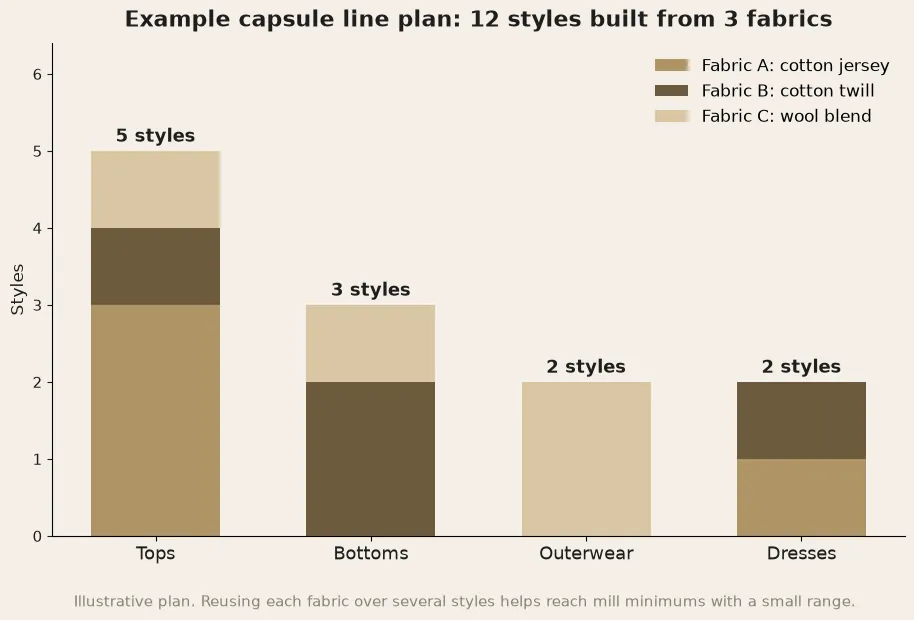
Then build the line plan: the list of styles by category, fabric, colorway and target cost. Fabric reuse is where small ranges win or lose money. Mills usually set minimum order quantities per fabric and per color, so a 12-style capsule cut from 12 different fabrics may never reach those minimums. The example below spreads 12 styles over three fabrics, four styles each.
Give the capsule a price ladder as well. An entry piece, such as a T-shirt or knit, brings in first-time buyers at a low price. Core pieces carry most of the volume, and one or two hero pieces, often outerwear, carry the story in the campaign and usually sit at the top of the price range. With only 12 styles, two hero pieces is already a sixth of the range, so the hero count is a deliberate call and should be made before sampling starts.
Our fashion line plan template gives the columns to fill in. Once the plan is approved, each style needs a tech pack, a fit sample and a costing before the order goes to the factory.
A capsule runs through the same production steps as a full collection, on fewer styles. Each style still needs points of measure, a bill of materials, construction notes and grading. The difference is pace. Brands often use capsules to move faster than the seasonal calendar, so a delay of two weeks on one tech pack can hold up the whole release when there are only 12 styles to ship.
Launch planning starts before sampling ends. Product photography, the lookbook, product page copy and the release date all depend on approved samples. A capsule with a clear story is easier to market than a seasonal range because the campaign has one message. Collaboration capsules add a second approval loop, since the partner usually signs off on every piece and every image.
The F* Word covers the front half of the process. It generates moodboards from a written brief, so a creative director can test two or three directions for a capsule in an afternoon. Once styles are chosen, it generates a factory-ready tech pack for each one in 8 to 10 minutes from a sketch, photo or brief, with points of measure, bill of materials, grading, tolerances and construction notes. At 10 minutes a style, a 12-piece capsule has a first-draft tech pack for every style in about two hours.
Every output is editable, and the brand team still approves the edit, the samples and the fit. The F* Word works before or alongside a PLM and does not replace one. It is also no image generator for campaign shots. For a deeper look at the creative side, our guide to the AI fashion moodboard explains how brief-to-board works.
Related: AI fashion moodboard · line plan template · AI design brief · assortment planning
A capsule collection is a small edited range of garments, often 10 to 30 styles, built around one idea and designed to be worn together. Brands release them alongside or between seasonal collections, often as limited runs or collaborations.
No fixed number exists. Most published guides put capsules between 10 and 30 pieces, and emerging brands often launch with fewer than 10 so every piece pairs with the others.
A capsule collection is a product release from a brand. A capsule wardrobe is a small set of pieces a person owns and mixes together. Susie Faux popularized the wardrobe idea in the 1970s, and Donna Karan's Seven Easy Pieces made it a collection in 1985.
Close, but different. A drop is usually one or a few styles released on a frequent schedule. A capsule is a larger, self-contained set with one story, released once.
Write one sentence on what the capsule is for, then build a brief and moodboard, a line plan that reuses a few fabrics, and a tech pack for each style. The F* Word generates the moodboards and a tech pack per style in 8 to 10 minutes.
Get The F* Word workflow insights in your inbox.