

72 shows up a lot in posts that claim a precise failure rate for AI fashion pilots, but almost none of those posts publish a sample, a method, or a source. Procurement teams are setting budgets and risk bands off round numbers that would not pass a merchandising line review. The failure modes are real. The numbers are decoration.
If you buy workflows for a living or lead a design room, you do not need folklore. You need a map of where pilots break and the earliest signals that predict breakage. Across VP Product Development and Sourcing, Creative Direction, and Merchandising, the through-line is the same: the unit that matters is accepted output, not generated output.
The competitive field has split into two camps. One camp generates something, a pattern, a.DXF, a render, or a draft tech pack, and calls that the finish line. The other camp stores the record in PLM and PIM and assumes whatever arrives is correct. Neither camp validates. The gap between "a spec was produced" and "a factory accepted the spec without a revision round" is where cost, delay, and rework live. The F* Word operates in that gap as the validation and orchestration layer. It generates a factory-ready tech pack in 8 to 10 minutes from a garment design, including BOM and construction notes, and it generates moodboards as the upstream half of the same workflow. It is not a PLM, not a 3D sim, and not an image generator. The differentiator is the checks that run before the spec leaves the building.
If all you instrument is how fast something is generated, your pilot will over-claim impact and under-deliver in production. If you instrument acceptance, revisions, and completeness, the data will tell you what to fix. This article is the honest version: the observable failure modes, the early signals that predict each, and the operator-grade interventions that prevent them.
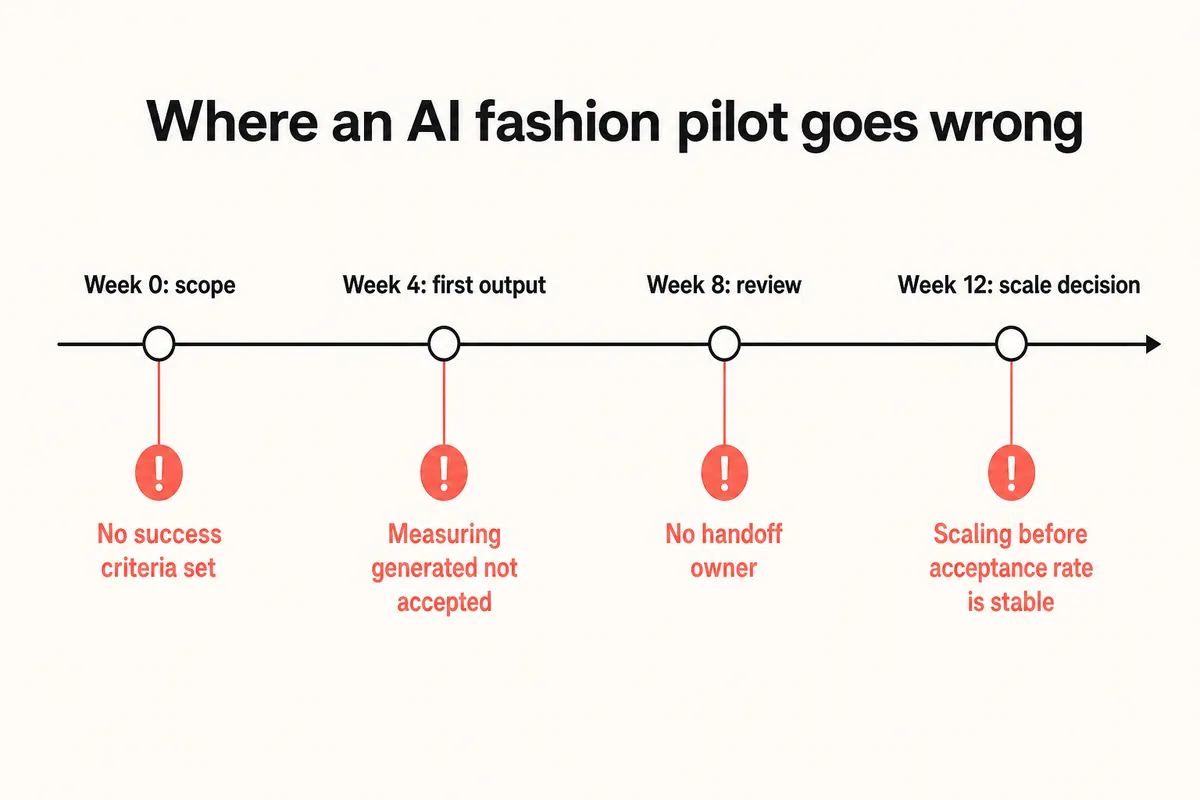
There is a genre of content that presents a clean percentage of AI pilots that "fail," without disclosing the population, period, or what failure meant. In apparel, that is not a small detail. A denim-bottoms pilot is not a circular-knit tops pilot. A brand that runs 80 percent carryover is not a brand that flips 60 percent of the line every season. A factory that cuts on Gerber is not a factory that expects graded POMs in a particular CSV schema. A single number without context is not just thin. It is misleading.
The core measurement mistake is that the unit of analysis is wrong. Most posts count whether a tool produced an output. They do not count whether a factory accepted that output without a revision round. Generated is not accepted. Accepted is what moves production dates and buys margin back.
There is also a timing bias. If success criteria are defined after a pilot starts, the criteria drift to whatever the tool did well in the first weeks. That converts a real test into a demo. A strong pilot treats acceptance as the finish line on day one, then measures how the team gets there, including revisions and rework time.
Finally, the framing often ignores ownership. Many pilots fail not because the tool is wrong, but because there is no named owner for the handoff between the pilot tool and the system of record. In fashion, that handoff is where silent errors bloom: incomplete BOM part codes, missing grade rules, stitch types that do not map to factory defaults, or a.DXF that has no associated construction notes. If you have ever shipped a tech pack that looked fine to design and came back with a wall of factory comments, you have felt this gap.
Evidence hygiene matters. If a number is modelled, it should be labeled modelled. If it is measured, the method and the set should be clear. Without that, it is better to list the failure modes you can see and fix.
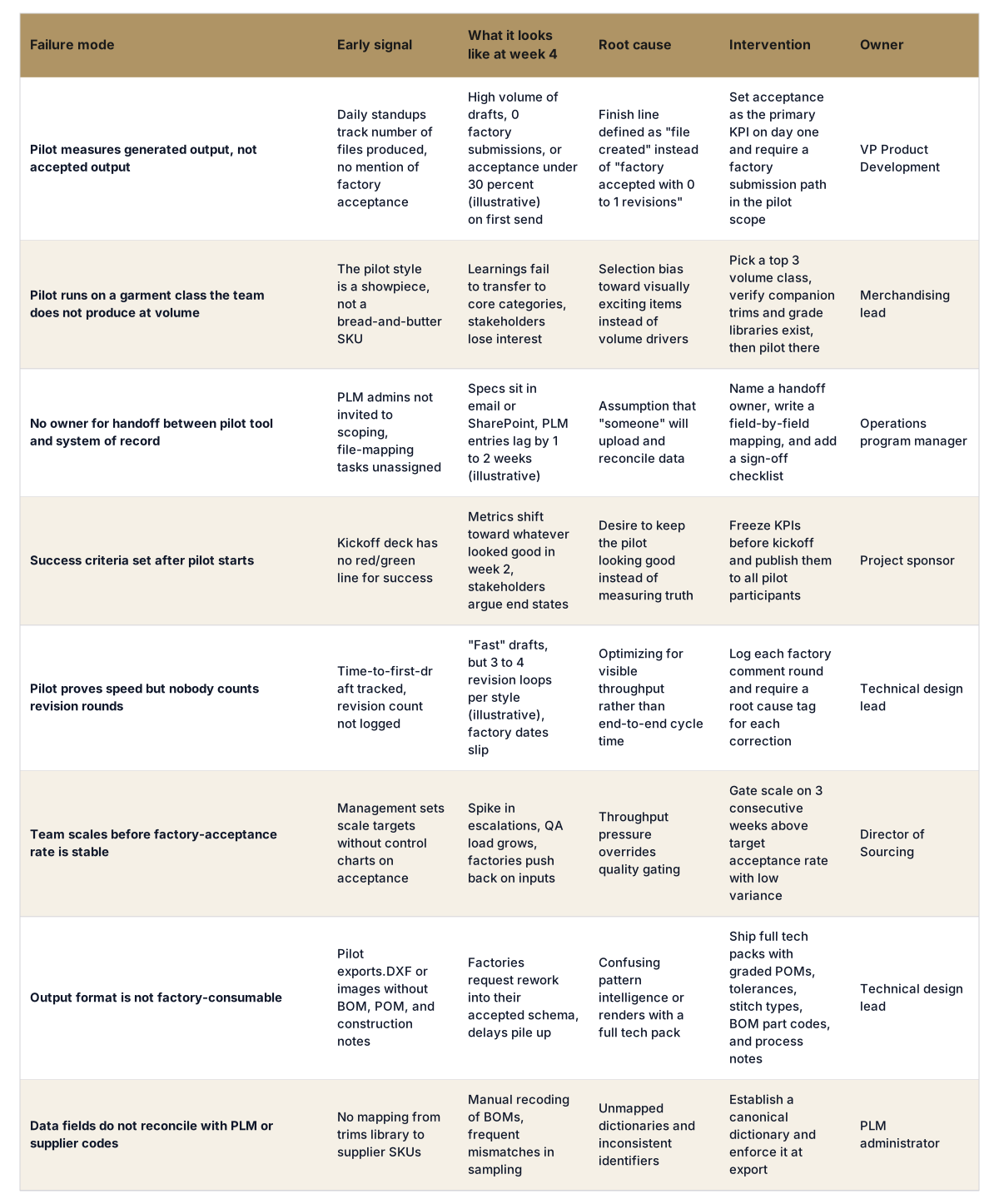

Production-ready has a plain meaning: a factory accepts the spec with zero comments or with one limited revision round. That requires content, structure, and checks. Content means the tech pack carries the full information set. Structure means the fields are consistent and machine-checkable. Checks mean validation runs before the file leaves your building.
Content is not an image. It is not a single.DXF file without context. A production-ready spec includes at minimum: a complete BOM with supplier IDs and substitutes, graded POMs with tolerances and measurement methods, stitch types and seam allowances, construction notes per operation, label and packaging instructions, wash and finish details where relevant, and compliance flags. Without that, you are making your factory guess, and they will guess in their favor, or they will stop and ask, and you will lose days.
Structure is how you avoid silent errors. If a POM is named "CB length" in one place and "center back len" in another, you will miss automated checks and you will get inconsistent grading or sampling notes. If your trims have internal nicknames but no supplier codes, your BOM will look coherent to the eye and break at purchase order time. This is where orchestration beats file dumps.
Checks are the difference between a demo and a deployment. The F* Word runs validations before handoff. It generates a factory-ready tech pack in 8 to 10 minutes from a garment design, including BOM and construction notes, and it generates moodboards upstream, but the defining feature is the validation and orchestration layer that sits between design and PLM. It is not a PLM and it is not a 3D simulator or image generator. It treats acceptance as the finish line and includes checks like POM coverage, grade rule consistency, measurement method presence, BOM supplier code resolution, and stitch type mapping. See the reference overview of intelligent tech packs at thefword.ai/ai-tech-packs-intelligent and our view on what "factory-ready" must include at thefword.ai/factory-ready-tech-pack.
Categories matter. 3D tools like CLO 3D and Browzwear do visual simulation very well. Pattern suites like Gerber AccuMark and Lectra Modaris are strong where grading and pattern data are concerned. PLMs like Centric, PTC FlexPLM, and Lectra Kubix platformize the record and workflows. None of those categories position themselves as validation engines that guarantee a factory will accept a spec without a revision round. That is the unserved middle. If your pilot assumes that a render or a pattern export is equal to a ready-to-send tech pack, you have defined success against the wrong outcome. For detail on why.DXF files and pattern intelligence are not the handoff, see thefword.ai/dxf-files-are-not-factory-handoff and thefword.ai/why-pattern-intelligence-is-not-a-tech-pack-7-validations.
If your creative direction team wants a fast way to shape seasonal concepts, The F* Word also generates moodboards as the upstream step of the same workflow. That is not a different tool bolted on. It is the same pipeline that ends in a validated spec. The orchestration connects the moodboard to the design to the tech pack to the factory handoff and makes each step checkable.
Workflow buyers and product leaders should ground their decisions in a short list of questions that line up to acceptance and scale:
Revisit the two-camp split as you evaluate vendors. Generators give you something fast. Systems of record keep it safe once you have it. Neither validates. The F* Word is an orchestration and validation layer you can fit between ideation and PLM, with checks wired to your definitions of accepted. For a deeper view of the workflow piece, read thefword.ai/pre-production-workflow-software-fashion and our enterprise summary at thefword.ai/enterprise.
This is a diagnosis piece, not a how-to. If you want a full operating plan, see the pilot plan at thefword.ai/ai-fashion-workflow-pilot-plan. The short version is to bind the pilot to accepted output and keep the scope inside one garment class you already produce at volume. Name the owner for the handoff into PLM, define the pre-handoff validation checks, and freeze the success criteria before kickoff.
Pick a category where you already have a trims library, grade rules, and a known factory partner. Avoid one-off editorial pieces. If Creative Direction wants a new silhouette, let them, but keep the pilot evaluation on your core SKU family. That is how you learn something that pays back this year.
Set the data contracts. Decide the field names and allowed values for POMs, stitches, and trims, then instrument validations that reject a pack that violates them. The F* Word can generate a tech pack in 8 to 10 minutes from a garment design and it can generate the moodboards that start the line, but you should hold it to your definitions of acceptance. It is built for that, and it is not a PLM or a 3D tool or an image toy. It is the validation and orchestration layer that closes the gap between "a spec exists" and "a factory accepted it." For a survey of the overall workflow approach, see thefword.ai/ai-fashion-workflow-software and a deeper dive on POM and BOM validation at thefword.ai/ai-tech-pack-bom-pom-grading.
Integrate early. Even if you do not do a full write-back to PLM on week one, map every field. If a field has no home, decide whether to add it to PLM, store it in a linked artifact, or drop it. Do not leave gray zones. Gray zones generate escalations, and escalations burn credibility.
Close with the four metrics a pilot must instrument on day one:
No. They matter a lot. 3D tools compress visual decision time and reduce sample waste, and pattern suites manage true technical detail. The point is that neither category, by their own positioning, claims to validate a spec to factory acceptance. You still need a validation and orchestration layer to reach accepted output reliably.
Speed is only useful if it pairs with acceptance and completeness. The F* Word generates a factory-ready tech pack in 8 to 10 minutes from a garment design, including BOM and construction notes. If that pack does not pass pre-handoff checks and does not get accepted on the factory side with zero or one revision, speed alone will not move your calendar.
Open your dashboard. If the top line is "files created" or "drafts generated" and there is no chart for factory acceptance or revision rounds, you are measuring the wrong unit. Add acceptance and revision metrics, then expect your apparent win rate to drop. That is the truth you can fix.
Give it to an operations program manager or a technical design lead who can bridge design, sourcing, and PLM administration. Publish a checklist with field mappings and validation gates. Treat the checklist as a release requirement, not a nice to have.
Start free at thefword.ai and run one garment through validation before it reaches a factory.
Related: llm seo fashion · AI fashion roi enterprise · concept to production fashion
Get The F* Word workflow insights in your inbox.