

12 minutes saved drafting a spec is nothing compared to the 9 to 14 calendar days a single extra revision round adds with an offshore factory that works 12 to 13 hours offset, waits on a couriered sample, and requotes trims. If you own pre-production, your cost metric is not minutes. It is the count of tech pack revision rounds. Handling factory comments once they arrive is a different workflow covered here: tech-pack-revisions-after-factory-comments. This post defines the metric, shows how to instrument it, and lays out how to reduce the count.
A revision round is a complete back-and-forth cycle between brand and factory where the factory cannot proceed until the brand answers, clarifies, or changes the spec. The clock starts when the tech pack leaves your building or when you send a change after handoff. It stops when the factory confirms acceptance without further blocker questions for the current stage. A round is not one email. It is the entire loop required to resolve a blocker. If a pattern update triggers re-sampling and a new quote, that is one round even if it spans multiple messages.
Attribution matters. Tag each round with the primary cause that made the factory stop. Use a single-source rule: if multiple issues appear, choose the earliest upstream defect that would have prevented the others by avoiding the round. If your team currently tracks nothing, start simple. Maintain a rolling log by style with four fields: Style ID, Round cause, Detection point, Days added. You can add depth later. The goal for month one is to measure rounds per style and average days per round.
Illustrative economics. One extra round typically costs: 9 to 14 calendar days lost across time zones and handoffs, 150 to 400 USD extra sample work depending on garment type and courier, and a merchandising penalty if you slip a drop window. Missing an in-season capsule by two weeks can force markdowns that erase 10 to 20 points of margin. Treat these numbers as illustrative, but the direction is consistent across categories: the calendar is lost in rounds, not in minutes.

Most tooling in pre-production markets minutes. The story goes: generate a draft tech pack faster, export a.DXF, spin a 3D view, or store everything in a PLM so the record is tidy. These are useful steps. 3D tools like Clo3D and Browzwear help visualize proportion and setup pattern blocks faster. Graphic workflows in Adobe Illustrator speed up sketch edits. PLMs like Centric and PTC FlexPLM give you governance, versioning, and data visibility. They all do what they promise.
Here is the gap. The competitive field has settled into two camps. One camp generates something, a pattern, a.DXF, a render, or a draft tech pack, and calls that the finish line. The other camp stores the record in PLM or PIM and assumes whatever arrives is correct. Neither camp validates. The gap between a spec was produced and a factory accepted the spec without a revision round is where cost, delay, and rework live. That gap is your real metric. If you want detail on why artifacts like.DXF files are not the factory handoff by themselves, see dxf-files-are-not-factory-handoff.
The F* Word operates in that gap as the validation and orchestration layer. It generates a factory-ready tech pack in 8 to 10 minutes from a garment design, including BOM and construction notes, and it also generates moodboards as the upstream half of the same workflow. It is not a PLM, not a 3D simulation package, and not an image generator. The differentiator is the checks that run before the spec leaves the building. See how the validations stack works here: ai-tech-packs-intelligent and the broader workflow context here: pre-production-workflow-software-fashion.
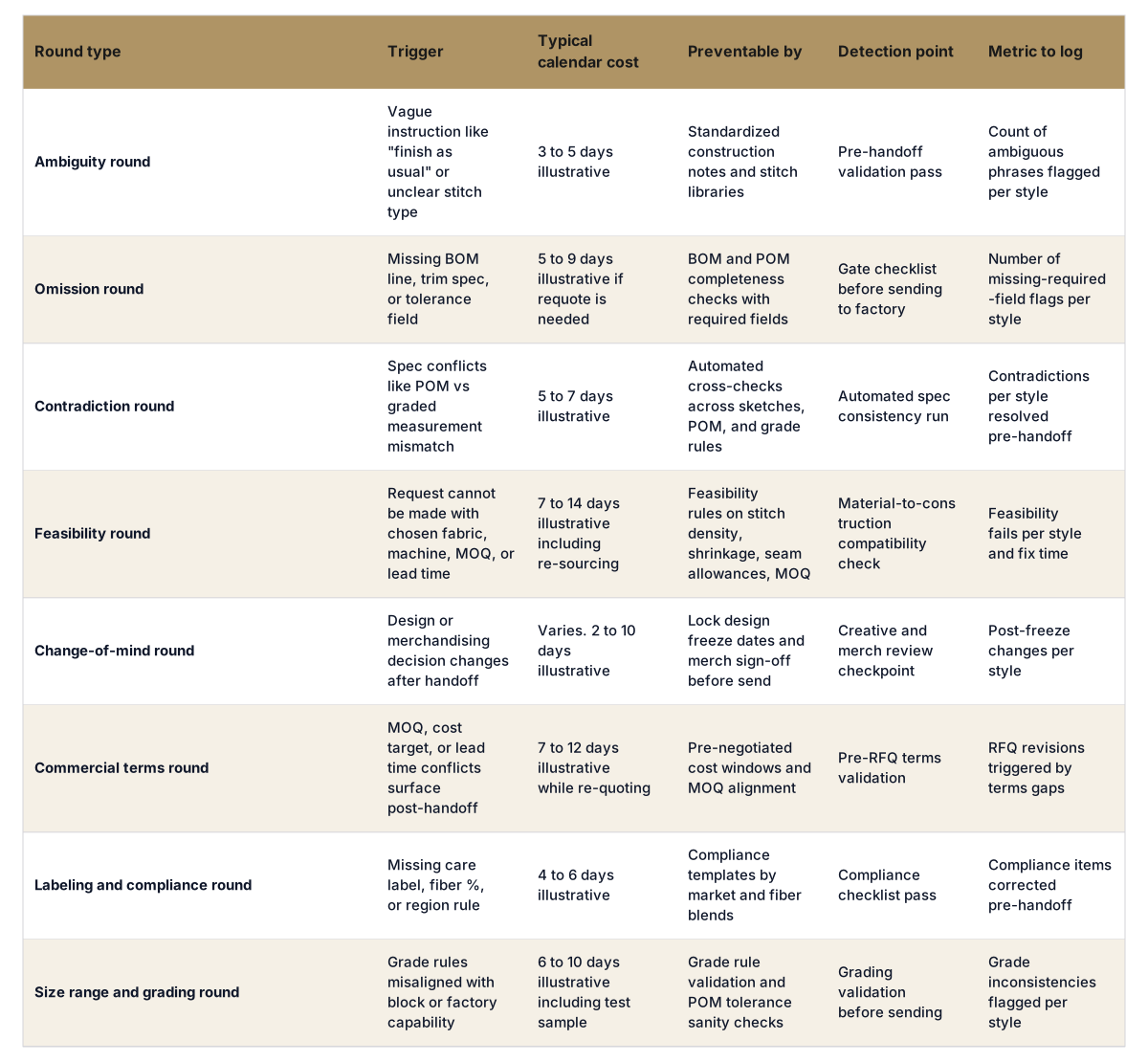

Production-ready is not a PDF with hero sketches. It is a spec that a factory can accept without a question that blocks work. That requires completeness, consistency, feasibility, and commercial alignment. The fast part is content generation. The expensive part is the absence of checks. Treat readiness as a checklist driven by failure types, not a document milestone.
Completeness. Every BOM line item needs material, color, finish, supplier or placeholder, size, placement, and tolerance if applicable. Every POM needs a number, method, and tolerance. If you want detail on how POMs go wrong, see pom-accuracy-7-ai-validation-checks-before-factory-handoff. Consistency. POM values must match callouts. Grading must align with base size and block. References cannot contradict stitch diagrams.
Feasibility. Stitches must suit fabric weight and machine capability. Seam allowances must pair with finishing method. Shrinkage assumptions need to tie to testing. If you push low MOQ with tight lead, simplify trims early. For a deeper view into why pattern intelligence alone is not a tech pack, and which validations close the gap, read why-pattern-intelligence-is-not-a-tech-pack-7-validations and the specific checks around BOM, POM, and grading here: ai-tech-pack-bom-pom-grading.
Commercial alignment. State target FOB or a band and confirm MOQ, color splits, and packaging early. Missing these pushes you into the commercial terms round after the factory has already scheduled work. Production-ready means a factory could start making markers or a proto without guessing anything material to cost or fit.
Bridge this back to the tool landscape. Generation and storage are not validation. The two-camp split still holds. The F* Word sits between design and factory as the validation and orchestration layer. It generates a factory-ready tech pack in 8 to 10 minutes from a garment design, including BOM and construction notes, and it also generates moodboards upstream in the same workflow. It is not a PLM and not a 3D sim. The hard value is the checks that run before the spec leaves the building. For the handoff specifics, see factory-ready-tech-pack.
For workflow buyers. Set a numeric goal: reduce average rounds per style from your baseline to a target tied to delivery windows. Example target: from 2.4 to 1.2 rounds within two seasons. Define acceptance criteria for any tool or process change: first-pass factory acceptance rate, days-to-acceptance, and re-sample count. Run a pilot before rollout. Here is a practical plan: ai-fashion-workflow-pilot-plan. If you need enterprise controls, review enterprise for SSO, audit, and data residency specifics.
For in-house designers and creative directors. Protect the design process but lock a clear freeze. Many change-of-mind rounds mask a lack of upstream alignment. Use moodboards and reference packs that carry through to spec so intent survives into stitches. The F* Word generates moodboards upstream and the tech pack downstream in one workflow. That reduces translation errors. It is not a replacement for your 3D or illustration tools. It is the layer that validates what leaves the studio.
For merchandisers. Tie revision rounds to gross margin and on-time delivery. Build a simple model with your finance partner. Illustrative example: each extra round averages 11 days and 250 USD in sample and courier spend. If a tier-one drop misses its floor set by two weeks, assume 15 percent lower full-price sell-through and 3 points lower realized margin for that style. Put real numbers in once you log three months of data, then decide how many rounds you can afford per style class.
Category clarity helps decisions. 3D sim improves design iteration speed and fit exploration but does not validate BOM completeness. PLM improves governance but does not check stitch feasibility. Draft-generators, including AI that produce a skeleton tech pack, accelerate the first mile but do not guarantee factory acceptance. Validation is a separate function. That is the strategic choice to make.
Week 1. Instrument. Start a four-field log for each style now: Style ID, Round cause, Detection point, Days added. Log every round that occurs after your next handoff. If you do nothing else, this will surface the top two preventable causes in 14 days.
Week 2. Prevent. Build a pre-handoff checklist anchored to the five preventable round types. Add required fields for BOM, POM, tolerances, construction notes, and compliance. Require a design freeze and a merchandising sign-off before send. If you want a reference for checks worth automating, review ai-tech-packs-intelligent.
Week 3. Automate. Configure The F* Word to generate a factory-ready tech pack in 8 to 10 minutes from your garment design, including BOM and construction notes, then run its validations. Use it as the orchestration layer between design and factory. Keep your PLM in place as the record and your 3D tools for design. You will send fewer questions to the factory because ambiguity, omission, contradiction, and feasibility fails are flagged before handoff.
Week 4. Optimize. Calculate your baseline: average rounds per style, average days per round, first-pass acceptance rate, re-sample count. Pair these with financials: sample cost per round and realized margin impact for any styles that missed their intended set date. Set the target and decide which two validations to tighten next season. If you want broader workflow structure, see ai-fashion-workflow-software.
What not to conflate. A.DXF pattern export is not a complete handoff and should not be the acceptance gate for production readiness. There are seven validations most teams miss before factory send. Outline and fixes here: why-pattern-intelligence-is-not-a-tech-pack-7-validations.
One round includes the full loop from the factory raising a blocker to the factory confirming they can proceed without new blockers. Multiple emails inside the same unresolved issue are still one round. If your brand sends an update that triggers a new question, that is either part of the current round or the start of the next depending on whether the original blocker is already cleared. Keep the definition consistent across teams.
Do not wait for a PLM customization. Use a shared sheet with four columns: Style ID, Round cause, Detection point, Days added. Log entries when a blocker appears and when it clears. After one month, you can port the structure to PLM custom fields if needed and backfill the metrics.
These tools can cut design iteration time and improve fit exploration, which helps indirectly. They do not, by themselves, prevent ambiguity, omission, contradiction, or feasibility rounds. Pair 3D and pattern tech with a validation layer that checks BOM completeness, POM accuracy, construction feasibility, and compliance before factory handoff.
Keep both. The F* Word is not a PLM and not a 3D tool. It is the validation and orchestration layer between design and factory. It generates a factory-ready tech pack in 8 to 10 minutes from a garment design, including BOM and construction notes, and it also generates moodboards upstream. The value is in the checks that cut preventable rounds before the spec leaves the building.
Start free at thefword.ai and run one garment through validation before it reaches a factory.
Related: how much a fashion tech pack costs
Get The F* Word workflow insights in your inbox.