

A fashion tech pack's cost depends on garment complexity, grading, trims and revision scope, so budget the full line rather than comparing document fees alone. The F* Word offers Pro at roughly $10 per factory-ready tech pack, produces editable packs in 8 to 10 minutes, and brands using it report 75% fewer physical samples.
The useful buying question is not simply "What does a tech pack cost?" It is "What work is included, and what will we pay to get this style ready for production?" A low initial quote can leave grading, construction decisions or later revisions outside the agreed scope.
Start with a shared definition of the deliverable. A tech pack should communicate the product through points of measure, a bill of materials, grading, tolerances and construction notes. If you need a scope checklist, read what a tech pack includes before requesting proposals.
Ask providers to assess each style rather than applying an unexplained line-wide fee. A simple garment and a style with several material combinations, functional details or special construction requirements should not automatically receive the same scope of work.
Clarify whether you are supplying resolved design decisions or asking the provider to develop them. Translating approved details into specifications is a different assignment from deciding how an unfinished concept should be made.
Specify your size range, base size and grading requirements before accepting a quote. Ask whether the service covers the full intended size range or only the base-size specification. Confirm who approves grade rules and tolerances.
For trims and materials, distinguish documentation from selection. Recording an approved zipper, label or fabric is not the same task as identifying suitable options. Your budget should make responsibility for those decisions explicit.
Define what counts as a revision. Correcting a missing measurement, changing a silhouette and adding a size range should not remain bundled under an ambiguous promise of "edits included." Request a clear boundary between corrections, design changes and post-sample updates.
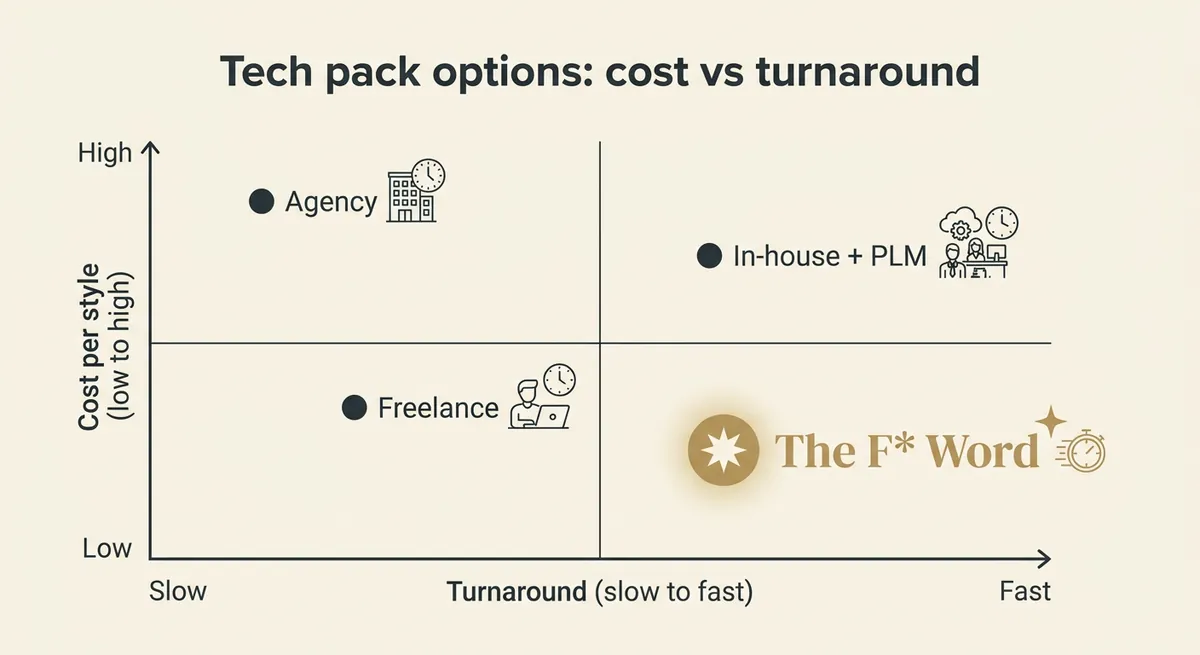
Compare routes by ownership and scope, not just the quoted document price. Freelance and agency proposals need explicit deliverables. In-house work needs a staffing allowance as well as software consideration. The F* Word provides an AI workflow before or alongside PLM, rather than replacing PLM.
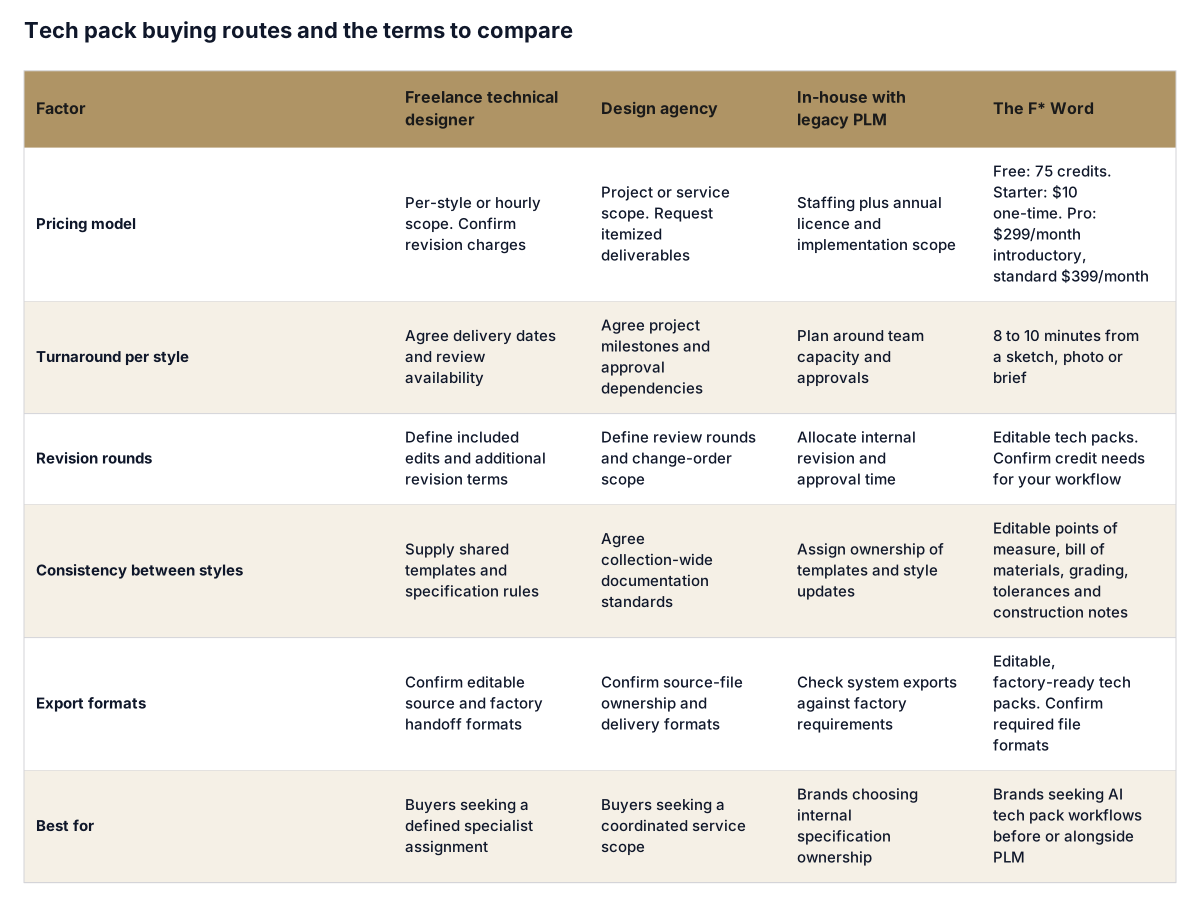
A freelance technical designer may be the route you choose when you want a named specialist responsible for a defined assignment. An agency proposal should explain which services sit around the tech pack and which are optional. Do not assume either quote includes fit review, sourcing decisions or production support.
For an in-house route, separate the people budget from the system budget. Legacy PLM should not be treated as the person doing the technical work. For The F* Word, assess the generated deliverable and your review process together. Its AI tech pack workflow produces editable specifications, while your team should still assign approval responsibility.
A useful budget distinguishes producing the initial pack from maintaining it through approvals and sampling. If you compare only initial delivery fees, you leave the cost of unresolved decisions outside the comparison.
Before work starts, decide who consolidates feedback from the founder, creative director, technical designer and merchandiser. Ask reviewers to resolve conflicting comments before sending instructions to the person updating the pack.
For outsourced work, request terms for revisions after approval. For internal work, reserve time for updates rather than treating them as spare-capacity tasks. With software, establish what can be edited directly and what may require another generation. Do not assume every revision is free or included.
Use revision rounds as a pre-production cost metric when comparing proposals. Record what changed, why it changed and who approved the update. This gives you a clearer basis for the next collection's scope.
Consider a sample that cannot be approved because a construction detail was never specified. Your budget review should ask who will clarify the requirement, update the document and handle the next sample decision. Keep those responsibilities visible even if you cannot price them at the outset.
Brands using The F* Word report 75% fewer physical samples. Treat that as reported experience, not a guaranteed reduction for your collection. Keep a sampling allowance and review process appropriate to your garments rather than removing them from the budget.
Build a style-level plan first, then select the purchasing route. List each garment, its input readiness, required size range, trims, approval owner and expected handoff date. Mark unresolved decisions separately so the initial document budget does not hide development work.
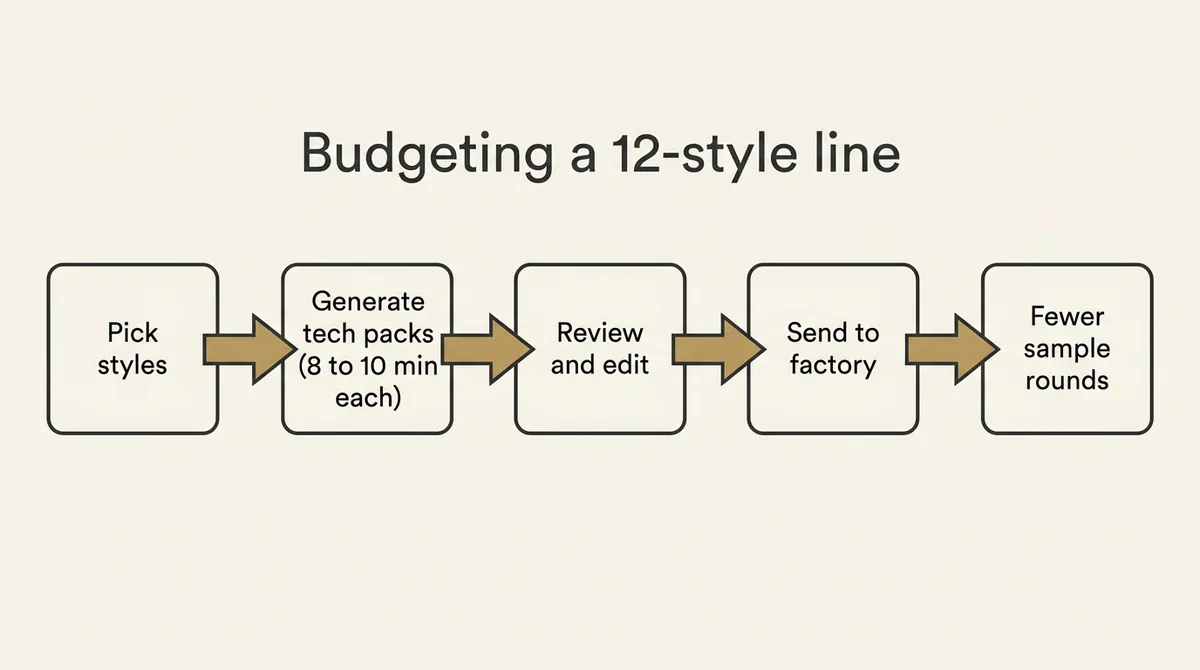
Suppose your brand plans to run one Trend-to-Tech-Pack workflow for each of 12 styles using The F* Word. Each workflow uses 115 credits. The initial collection therefore requires 1,380 credits.
Track your subscription spend separately from the capacity you use. You pay the plan price even if you run only the initial 12 workflows. The roughly $10 per factory-ready tech pack figure comes from about 31 workflows on the introductory Pro plan rather than a separate pay-per-pack rate.
Do not label every remaining credit as a guaranteed revision allowance. Decide whether you also need moodboards, creative briefs or trend analysis and validation, which The F* Word provides. Confirm the credit requirements of your planned activities before allocating the balance.
Keep technical review, material decisions, sample evaluation and factory communication visible in your line budget. Software pricing is not a complete production-development budget. Assign these tasks even when the initial pack is generated quickly.
Also map the collection calendar against the subscription period. If approvals and new styles span several months, budget for the months you expect to use the plan. Do not assume the whole line's development fits into the month in which its initial packs were created.
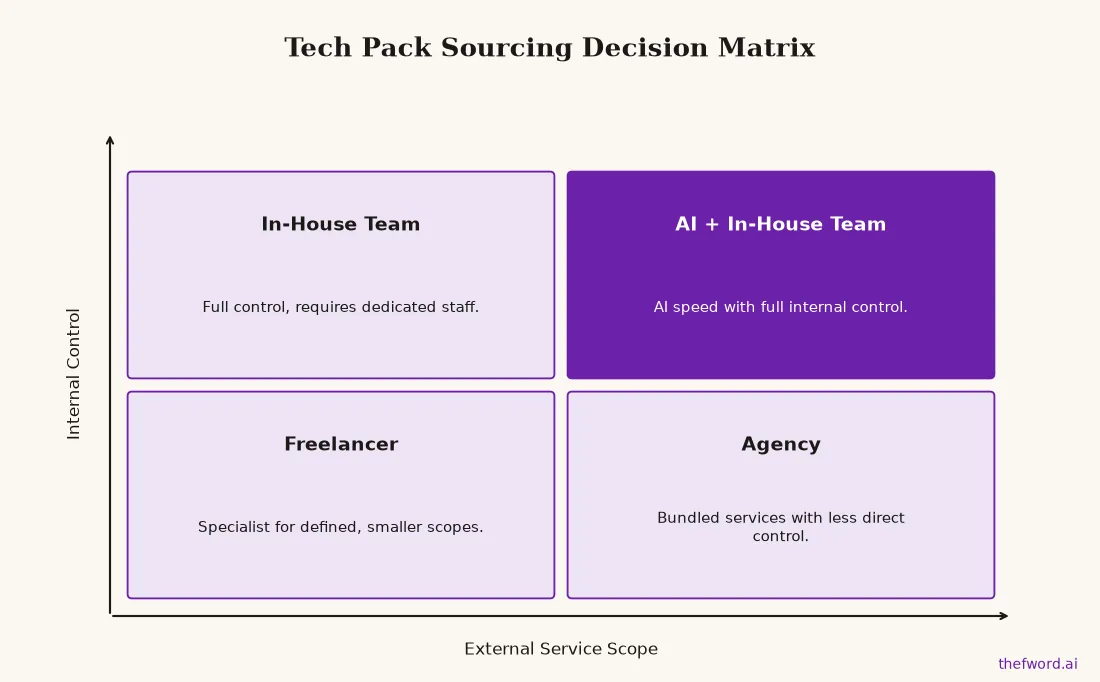
Start with the gap you need to fill. You may need help with technical decisions or more capacity for documentation. Your collection may need better coordination or an internal workflow. A specific assignment makes a proposal easier to judge.
Before you commit to the full line, test a representative style against a written checklist. Check measurements and grading, then review tolerances, materials, construction notes, editability and factory handoff needs. Confirm who approves the pack so approved changes reach the factory.
For emerging brands, the purchasing decision should connect output capacity to actual collection demand. See AI tech pack automation for emerging brands for that workflow perspective, while keeping your own review and sampling responsibilities in scope.
For a line with recurring tech pack needs, The F* Word Pro offers 3,600 monthly credits, team collaboration, a private tenant and priority generation. At introductory pricing, that supports about 31 Trend-to-Tech-Pack workflows, roughly $10 per factory-ready tech pack. Compare plans
The F* Word Pro costs $299/month at introductory pricing, with standard pricing of $399/month. Its 3,600 monthly credits cover about 31 Trend-to-Tech-Pack workflows at 115 credits each, roughly $10 per factory-ready tech pack at introductory pricing. Your effective cost depends on how much capacity you use.
List styles, complexity, grading, trims and unresolved decisions. Then budget initial documentation separately from revisions, technical review and sampling. For The F* Word, 12 initial Trend-to-Tech-Pack workflows use 1,380 credits. Check other planned usage and the development calendar before deciding how many subscription months to budget.
The F* Word works before or alongside PLM and is not a PLM. It produces editable, factory-ready tech packs from a sketch, photo or brief. Assign responsibility for reviewing the specifications, approving design decisions and communicating updates to the factory rather than treating generation as your approval process.
Related: tech pack designer vs AI tech pack software · tech pack construction callouts
Get The F* Word workflow insights in your inbox.