
Press enter or click to view image in full size

The Validation Checks That Run Before a Factory Sees Your Tech Pack

Thirty-two distinct validation checks should run before a factory ever sees your tech pack. This post covers the automated layer that enforces those checks so production does not discover preventable gaps. If you want the field-by-field list of what a tech pack contains, that is covered here: factory-ready-tech-pack. If you want measurement-point specifics, those are here: POM accuracy. This post picks up where those stop and focuses on what must be validated, not what must be filled.

The validation spine groups into four families: completeness, internal consistency, manufacturability, and handoff. Within each family there are named checks that prevent rework and delay in real factories. The popular narrative in the market is speed of generation. The reality is that generation speed and validation depth are independent variables. A spec that is produced in seconds but fails basic checks only moves the defect discovery later in the calendar.

Positioning matters. The competitive field has settled into two camps. One camp generates something, a pattern, a.DXF, a render, a draft tech pack, and calls that the finish line. The other camp stores the record in PLM or PIM and assumes whatever arrives is correct. Neither camp validates. The gap between a spec being produced and a factory accepting the spec without a revision round is where your cost, delay, and rework live. The F* Word sits in that gap as the validation and orchestration layer. It generates a factory-ready tech pack in 8 to 10 minutes from a garment design, including BOM and construction notes, and also generates moodboards as the upstream half of the same workflow. It is not a PLM, not a 3D simulator, and not an image generator. The differentiator is the checks that run before the spec leaves the building.

Opening insight: four families of tech pack validation checks

Validation pays off when it prevents a factory from having to guess. The four families below capture where guessing still slips into handoff. Each family includes examples you can automate today.

  • Completeness. Checks that every required component for production exists and is actionable. Missing trims, missing care instructions, absent stitch specs, orphaned pattern pieces, or grading tables with holes are common failure points.
  • Internal consistency. Checks that the POM list, grading rules, construction callouts, and pattern relationships agree with each other. This includes unit alignment, length totals matching panel geometry, and notches and labels synchronizing with construction steps.
  • Manufacturability. Checks that the proposed construction survives on the stated fabric with the stated equipment and tolerances. Fabric stretch or shrink allowances, stitch type suitability, seam allowances, and fusing temperatures must align with what the line can run.
  • Handoff. Checks that the specification is consumable by a factory without translation. Units declared and consistent, sizes mapped, BOM lines resolvable to real trims and suppliers, colorways mapped to materials, label copy compliant and pack plans unambiguous.

For buyers, designers, and merchandisers, this is the material difference between a design file and a production-ready specification. If you want a deeper overview of the intelligent tech pack layer, see AI tech packs, and for workflow orchestration context, see pre-production workflow software.

2x2 matrix ranking tech pack validation checks by escape cost and ease of automation

The problem with the popular framing

Most vendor pages celebrate how fast they can generate something. Pattern CAD and 3D simulators like Gerber AccuMark, Lectra, CLO, and Browzwear are excellent at pattern creation and visualization. PLM suites such as Centric and PTC FlexPLM are excellent at structured recordkeeping and cross-functional visibility. Generative image tools can provide ideation boards quickly. Those are real strengths.

The limit is that generation and storage are not validation. A.DXF from a pattern tool is not a factory handoff by itself. We have covered that distinction in depth here: DXF files are not factory handoff. Likewise, pattern intelligence without cross-checks does not resolve the contradictions that cause rework, which we unpack here: pattern intelligence vs tech pack validation. The index view in PLM does not run checks for unit mismatches across pages, nor does it reconcile BOM SKUs to supplier catalogs. The spec might be present. It is not proven ready.

There are two outcomes when you rely on generation speed without validation depth. First, factories treat your first pass as a brief, not a spec. Second, the revision round moves downstream where time is more expensive. It is common to see a draft tech pack kick off a sampling loop that costs a week per turn. Validation moves that cost back into pre-production where changes are cheaper and faster.
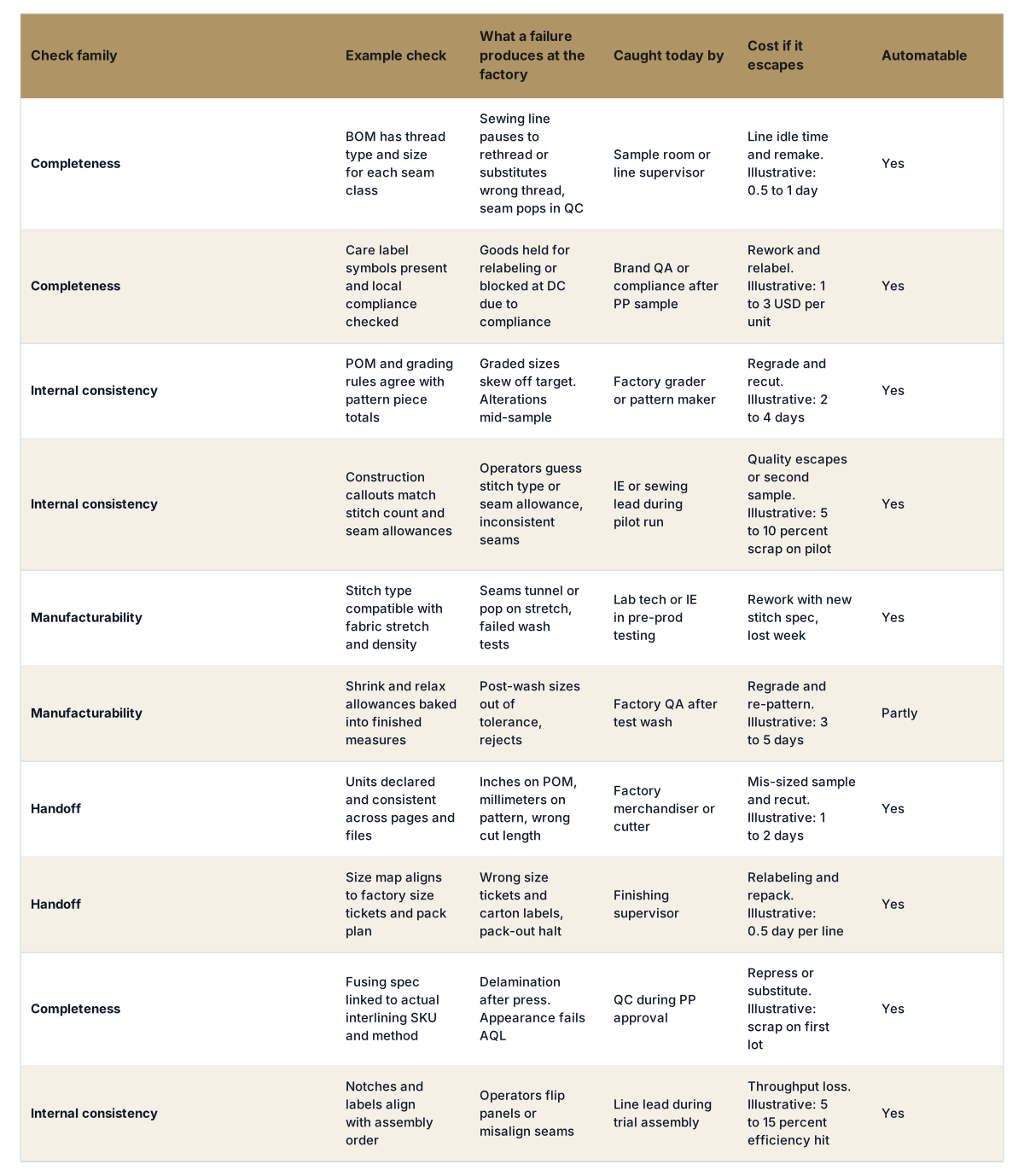
Side-by-side: what gets checked vs what fails on the floor

caption

Check family Example check What a failure produces at the factory Caught today by Cost if it escapes Automatable
Completeness BOM has thread type and size for each seam class Sewing line pauses to rethread or substitutes wrong thread, seam pops in QC Sample room or line supervisor Line idle time and remake. Illustrative: 0.5 to 1 day Yes
Completeness Care label symbols present and local compliance checked Goods held for relabeling or blocked at DC due to compliance Brand QA or compliance after PP sample Rework and relabel. Illustrative: 1 to 3 USD per unit Yes
Internal consistency POM and grading rules agree with pattern piece totals Graded sizes skew off target. Alterations mid-sample Factory grader or pattern maker Regrade and recut. Illustrative: 2 to 4 days Yes
Internal consistency Construction callouts match stitch count and seam allowances Operators guess stitch type or seam allowance, inconsistent seams IE or sewing lead during pilot run Quality escapes or second sample. Illustrative: 5 to 10 percent scrap on pilot Yes
Manufacturability Stitch type compatible with fabric stretch and density Seams tunnel or pop on stretch, failed wash tests Lab tech or IE in pre-prod testing Rework with new stitch spec, lost week Yes
Manufacturability Shrink and relax allowances baked into finished measures Post-wash sizes out of tolerance, rejects Factory QA after test wash Regrade and re-pattern. Illustrative: 3 to 5 days Partly
Handoff Units declared and consistent across pages and files Inches on POM, millimeters on pattern, wrong cut length Factory merchandiser or cutter Mis-sized sample and recut. Illustrative: 1 to 2 days Yes
Handoff Size map aligns to factory size tickets and pack plan Wrong size tickets and carton labels, pack-out halt Finishing supervisor Relabeling and repack. Illustrative: 0.5 day per line Yes
Completeness Fusing spec linked to actual interlining SKU and method Delamination after press. Appearance fails AQL QC during PP approval Repress or substitute. Illustrative: scrap on first lot Yes
Internal consistency Notches and labels align with assembly order Operators flip panels or misalign seams Line lead during trial assembly Throughput loss. Illustrative: 5 to 15 percent efficiency hit Yes

Four-column diagram of the completeness, consistency, manufacturability and handoff check families

What production-ready actually requires

Production-ready is not a vibe or a render. It is a spec that a factory can run without a clarification call. Here are the named checks that make that real, grouped by family, with the failure visible on the floor and who currently catches it when software does not.

Completeness checks

  • BOM stitch and thread coverage. Every seam class in the construction has a thread fiber, ticket size, and color mapped. Failure on the floor: wrong thread and early seam failure. Caught today by: sample room or line supervisor during the first pass.
  • Interlining and fusing method specified. Interlining SKU is linked with temperature, pressure, and dwell time. Failure: delamination after wash or field use. Caught today by: factory QA after pre-production press tests.
  • Labeling and compliance pack complete. Care symbols, country of origin, RN, fiber content, and regional rules checked. Failure: goods blocked or relabeled at distribution. Caught today by: brand compliance or DC receiving.
  • Accessory fit validation. Zippers, snaps, and buttons match seam allowances and gauge. Failure: operator cannot fit hardware, resorts to substitution. Caught today by: trims store or operator at machine.
  • Grading table has no holes. Each size has values for all POM. Failure: grader fills blanks by guess, size curve skews. Caught today by: factory grader.

Internal consistency checks

  • POM vs pattern geometry agreement. Totals like body length equal the sum of panel measures and seam allowances for the target size. Failure: finished garment does not hit stated measures after assembly. Caught today by: pattern maker or QA when measuring the proto.
  • Grading vs POM deltas. The grade rules translate into the same deltas shown in the POM table for all sizes. Failure: sizes drift off curve, XS and XL compress. Caught today by: grader during plotting or the factory on test runs.
  • Construction callouts vs stitch spec. The steps say SSae-1 but the stitch library calls for 401 chainstitch without backing. Failure: poor seam integrity on wovens. Caught today by: line lead when they see blowouts in assembly.
  • Notches, drill holes, and labels vs assembly order. Markings guide the same sequence the operator sheets describe. Failure: reversed parts and asymmetric finish. Caught today by: operator who asks for a correction during pilot.
  • Units and tolerances coherent. Inches do not mix with millimeters, and the tolerance band matches the category norm. Failure: cutters misinterpret tolerance, over trim. Caught today by: merchandiser or cutter when they flag weird numbers.

Manufacturability checks

  • Fabric behavior allowances. Shrink, growth, and torque allowances are explicit and reflected in finished measures. Failure: post-wash out-of-tolerance and rejects. Caught today by: lab tech after wash tests.
  • Machine capability alignment. Selected stitch types and densities can be run on the declared equipment. Failure: skipped stitches or heat damage. Caught today by: IE or maintenance during trial runs.
  • Seam allowances suitable for fabric and operation. SA width and type align with turn, bind, or cover operations. Failure: bulk at seams or unraveling edges. Caught today by: operator who cannot feed the seam without distortion.
  • Trim durability under process. Print, heat transfer, and hardware survive fusing, wash, and press cycles. Failure: peeling or corrosion in QC. Caught today by: QA on PP sample.
  • Marker efficiency check against piece shape. Patterns allow viable markers for the width. Failure: yield loss and unexpected fabric overage. Caught today by: marker maker with a change request.

Handoff checks

  • Unit declaration and propagation. A single unit system is declared and applied across POM, patterns, and BOM. Failure: wrong cut lengths and mis-sized components. Caught today by: factory merchandiser or cutter before cut.
  • Size map to factory tickets. Your XS to 0, S to 2 mapping is explicit and reconciled to ticketing. Failure: wrong labels and pack-out confusion. Caught today by: finishing supervisor when boxes do not match plan.
  • BOM line resolvability. Every line can be sourced to a real supplier SKU or spec. Failure: factory swaps trims or holds the order. Caught today by: trims store or sourcing desk at the factory.
  • Colorway to material mapping. Each colorway references dye lots or lab dips by code. Failure: off-tone panels and mismatched components. Caught today by: fabric QC at receiving or sewing line when mismatches show.
  • Pack plan and cartonization clarity. Ratios, carton labels, and assortments leave no room for interpretation. Failure: rework at final QC. Caught today by: cartonization team at end of line.

To repeat the distinction because budget owners ask it twice: generation speed and validation depth are independent. The F* Word generates a factory-ready tech pack in 8 to 10 minutes, including BOM and construction notes, and generates moodboards upstream as part of the same orchestration. But the thing that protects your calendar is the validation layer that runs before the spec leaves your building. That is the difference between a file and a go signal.

Decision framework: pick checks by failure cost, not by ease

Teams often start automating what looks easy. That is a trap. You should prioritize checks by the cost of failure if they escape, not by the engineering effort. A two-hour effort that prevents a one-week delay is better than a one-day effort that prevents a 30-minute fix.

  1. Rank by line-stop risk and rework duration. Anything that can stall a line or force a recut goes first. Stitch compatibility with fabric and unit consistency across files are high on this list. The cost is measured in days, not minutes.
  2. Pull forward compliance and label checks. These do not stop sewing, but they can block shipment. A compliance hold at the DC can burn a season. Automate care symbol and regional copy checks early.
  3. Lock down POM and grading alignment. The POM-to-pattern-to-grade triangle is where subtle errors hide. Consistency checks here save you recuts and size-curve returns. We break down common POM pitfalls here: BOM, POM, grading.
  4. Focus on resolvability in BOM lines. If the factory cannot buy or pick what you called for without a call, you are running a suggestion, not a spec. Map every line to a supplier code or precise spec.
  5. Validate pack plans and size maps. This is the last mile. It will not save your proto, but it will save your launch. Rework at pack-out is a tax you can remove.

Apply a simple scoring model. Score each check on failure cost, escape likelihood, and frequency. Multiply, then sort. Where data is thin, start with illustrative inputs from the last two seasons. Update quarterly as you collect real escape data. If you need a template and workflow, see AI fashion workflow software.

Revisit the market position while you prioritize. The generation camp will get you a file faster. The storage camp will file it neatly. Neither camp validates. Your budget should land on the validation and orchestration layer that narrows the distance between spec produced and spec accepted without revs. The F* Word operates in that slot, designed to sit on top of your current tools rather than replace them. If you want to see how it integrates with enterprise constraints, read enterprise.

Getting started: an operator's path to coverage in 30 days

Week 1. Define the guardrail set. Pick eight to ten checks from the four families with the highest failure cost. A typical starter set includes unit propagation, stitch compatibility, POM-to-pattern agreement, BOM resolvability, care label completeness, shrink allowance capture, size map to tickets, and pack plan clarity.

Week 2. Wire input sources. Ensure your pattern exports, POM tables, BOM lines, and construction callouts are available to the validator in consistent formats. This is where orchestration matters. The F* Word is built to pull those sources together, generate the factory-ready tech pack in 8 to 10 minutes, and apply validations before release. It also supports moodboard generation as the upstream feeder so context travels with the spec. The tool is not a PLM and not a 3D simulator. It sits between those systems as the validation and orchestration layer.

Week 3. Pilot on one style per category. Pick a knit, a woven, and an outerwear piece. Track revision count, time to factory acceptance, and changes the validator flagged that would have escaped. We maintain a short guide for running a contained trial here: pilot plan.

Week 4. Close the loop. Conduct a post-mortem with your factory partners. Ask what still caused calls. Add two more checks from the backlog based on that feedback. Push coverage to 16 checks. Implement release gating so nothing leaves design review without a green light. When factory comments do arrive, run them through a structured fix loop. If you are formalizing that loop, this explainer helps: tech pack revisions after factory comments.

Governance. Assign owners. VP Product Development or Director of Sourcing own the release gate. Creative leadership signs off that design intent is preserved. Merchandising validates that pack and ticketing match the launch plan. Checks run in minutes. Your people spend time on intent, not clerical chases.

Trajectory. By the end of quarter one, target 24 checks running automatically. By midyear, cover the full 32. Keep the scoring model live and prune checks that never trigger. Add depth where the factory still calls.

Start free at thefword.ai and run one garment through validation before it reaches a factory.

Frequently Asked Questions

Does this replace our PLM or 3D tools?

No. PLM is still your record system and 3D tools or pattern CAD are still your creation systems. The validation and orchestration layer sits between them and the factory handoff. It checks and assembles the output so acceptance is faster and cleaner.

How fast is the end-to-end process once set up?

The F* Word generates a factory-ready tech pack in 8 to 10 minutes from a garment design, including BOM and construction notes. Validations run in the same window because the inputs are orchestrated together. Teams typically release a first-pass spec to a factory within an hour of creative sign-off.

What metrics prove the value of validation?

Track three numbers: revision rounds per style before PP approval, days from spec sent to factory acceptance, and the share of changes caught pre-handoff vs post. Illustrative results in pilots show one to two fewer rounds and a reduction of a week on acceptance, but measure your own baseline and gains.

How do we adapt checks to different factory capabilities?

Parameterize by vendor profile. Machine list, standard seam library, and preferred tolerances should drive pass or warn outcomes. Your validator should bind checks to the target vendor at release so the same spec routes with different rules where needed.

Further Reading

Start building workflows around real brand rules.

Get The F* Word workflow insights in your inbox.