} })

8 AI tech pack generators tested in 60 days, across 3 factories and 3 product types, gave us a blunt answer on free vs paid in 2026. Free tools help creative direction and internal alignment, then stall at the first fit round. Paid tools look expensive until you count how many sample rounds they prevent. If you ship more than 20 SKUs in a season, you are overspending on "free."
We ran a controlled test on a woven shirt, a knit legging, and a cut-and-sew hoodie. For each tool we measured time to first draft, BOM completeness, clarity of construction notes, POM coverage, change-log hygiene, and factory feedback on first pass. We pushed the exact same styles to three partner factories in Vietnam, Portugal, and Los Angeles, then tracked how many rounds it took to get to an approved pre-production sample.
The headline: inspiration-grade AI is cheap but slow in production. Factory-ready AI is fast in production and saves cash. Free outputs needed 2 to 4 extra clarifying messages to vendors and one extra sample round on average. Paid outputs that validated BOM and construction steps cut average sample rounds from 3 to about 1.5. That delta swallows the subscription cost the second you cross a 20 SKU season.
The popular comparison is monthly price. Factories do not price by month. They price by rework, uncertainty, and time lost to unclear specs. The right comparison is time-to-clarity. Does the first document vendors receive tell them exactly what to cut, stitch, source, and measure, and how to quote. Or does it force them to guess, ask for a BOM, and flag contradictions between images and measurements.
Free AI outputs are tuned for designers and decks. They are fine for moodboards, vibe-checks, and early direction. They struggle at validation and handoff. Paid AI that earns its seat focuses on two things: capturing inputs that matter to a factory and outputting one unambiguous pack with a traceable change log. Until you measure that, the subscription line item will look big. Count the iterations and it flips.
Comparison of AI tech pack generators we tested in 2026
| Tool | Tier (free/paid) | Time to first draft | BOM auto-fill | POM/grading | Factory-ready |
|---|---|---|---|---|---|
| The F* Word | Paid | 8-10 minutes | Yes | Partial (auto POM templates; grading assist) | Yes |
| Techpacker | Free + Paid | 15-30 minutes | Partial (template-driven) | Partial (manual grading) | Partial |
| TukaCAD | Paid | 45-90 minutes | No | Yes (grading tools) | Partial |
| Wild AI | Paid | 10-20 minutes | Partial | No | No |
| ApparelMagic AI | Paid | 20-30 minutes | Partial | Partial | Partial |
| Pattern.ai | Paid | 15-25 minutes | Partial | Partial | Partial |
| Browzwear | Paid | 60-120 minutes | No | Partial | Partial |
| GPT/Canva combo | Free | 15-45 minutes | No | No | No |
Two quick notes. CAD and 3D tools shine at pattern and visualization, not at AI pack automation or factory-ready orchestration. And most "AI add-ons" inside PLMs still rely on human clean-up before you can send a pack to a vendor without a preface email.
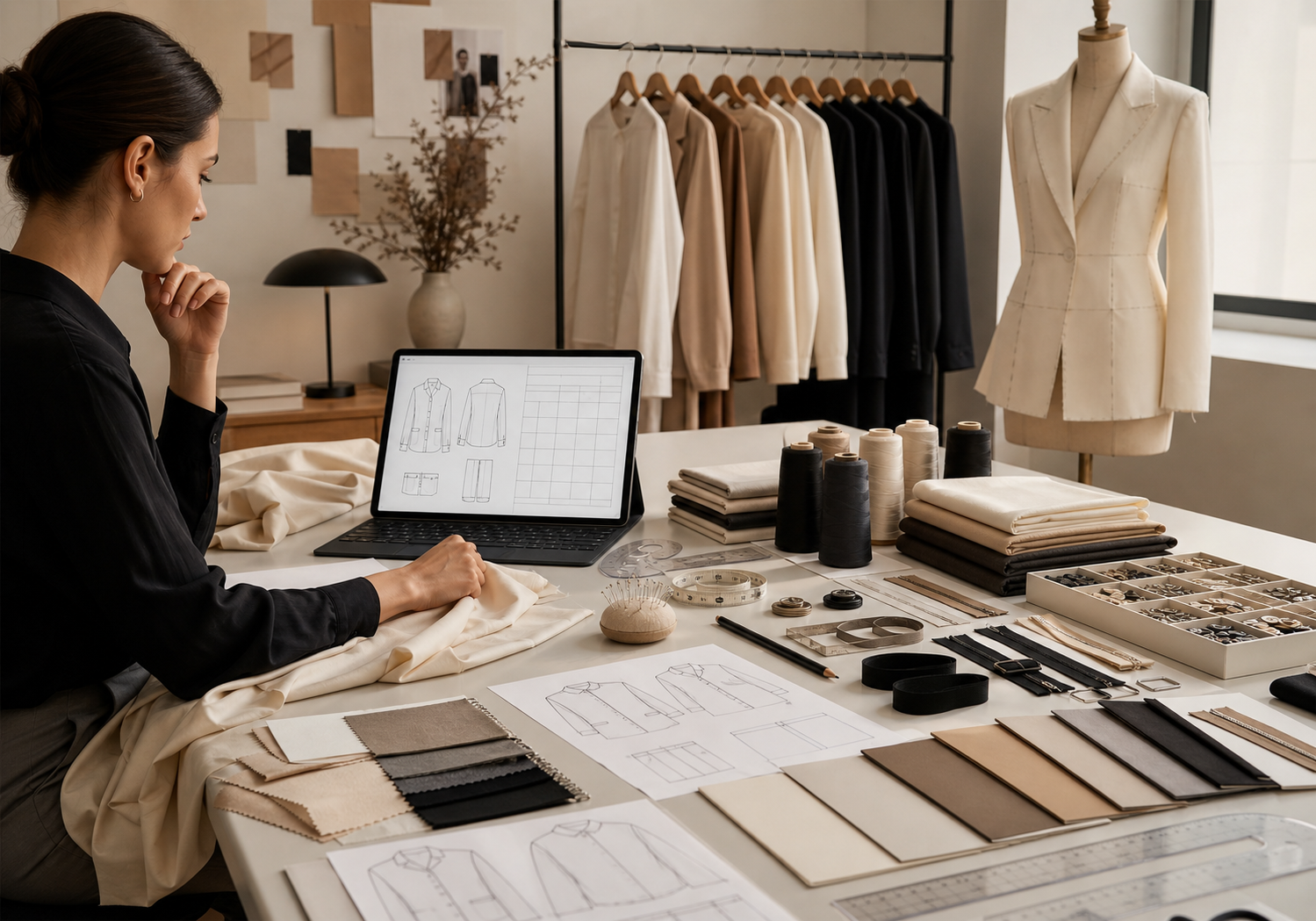
Factories define production-ready as a document they can quote, cut, sew, and QC without a guessing round. That means at minimum: a complete BOM with material specs, trims, sources or alternates, stitch and seam details, needles and SPI, construction notes ordered by operation, labeled callouts on flats, POM by size with tolerances, colorways and placements, packaging, and care label specs. Nice to have: yield calc inputs, operation times, and linked pattern or block references.
This is where a paid generator either earns trust or burns budget. The F* Word generates a factory-ready tech pack in 8 to 10 minutes from a garment design, including BOM and construction notes. It also generates moodboards as the upstream half of the same workflow, so design intent and materials flow into the pack instead of being retyped. The F* Word is not a PLM, not a 3D simulator, and not an image generator. It is the validation and orchestration layer that sits between design and your vendors.
For how the pack logic works, see The F* Word's intelligent tech pack overview. For how it supports handoff, sample rounds, and approvals, see pre-production workflow orchestration. If you want a higher-level scan of where AI fits across ideation, check the AI fashion design overview.
No validation. Free outputs rarely validate seam sequences, SPI, or BOM cross-consistency. Factories come back with basic questions like which interlining, what thread for bartacks, or whether a pocket bag should be self or contrast. Every unanswered detail is a day lost and a risk of a wrong assumption baked into your first proto.
Manual BOM rebuild. Canva or generic AI text gives you a nice-looking page, not a structured BOM. Someone still has to rebuild materials, trims, supplier codes, and alternates into a format vendors can price. Our test teams took 35 to 60 minutes per style to convert pretty PDFs into a vendor-ready BOM spreadsheet.
No version control. Free stacks scatter content across emails, cloud drives, and chat threads. Vendors get V3 from design and V5 from product. That forces factories to halt and reconcile. We logged two extra days per style on average just to merge comments and reissue a single source of truth after each change.
Factory rework. Missing tolerances or mislabeled callouts create preventable re-makes. In our trials, free packs drove one extra sample round on average for basic knits, often because measurements and construction notes contradicted each other. At $400 per freelance round or more, this wipes out any savings from avoiding a subscription.
Freelance touch-up tax. Teams plug the gaps by hiring a patternmaker or tech designer to clean outputs. Even a light pass to formalize POM, clarify stitches, and compile BOMs ran 1.5 to 3 hours per style. At $75 to $120 per hour, this is $112 to $360 baked into "free." Scale that to 20 SKUs and you have a hidden four-figure line item.
Use this worked example. Assume a 20 SKU season. Baseline with free tools is 3 sample rounds per SKU. Each extra round needs a freelance tech cleanup at $400, and costs a week of calendar time. A production-ready AI tool cuts average rounds to 1.5 by shipping a complete BOM and construction notes with the first pack.
Cost side: say a paid AI tool is $299 per seat per month. Two seats for four months of a season is $2,392. Savings side: you save 1.5 rounds per SKU at $400 per round, which is $600 per SKU. At 20 SKUs, that is $12,000 saved. Net of software, you are $9,608 ahead and you get four to six weeks back on the calendar.
Break-even math holds at lower volumes. At 8 SKUs, the same math yields $4,800 in avoided freelance rounds. Net of $2,392 software you are still ahead by $2,408. The only time "free" makes sense is a micro line under 5 SKUs with ultra-simple styles and forgiving timelines, or if your factory already engineers packs for you at no extra cost, which is rare and usually priced into margin.
Use this short framework to decide.
Getting started in one week:
The F* Word sits cleanly in this plan. It takes a garment design and outputs a factory-ready tech pack in 8 to 10 minutes, including BOM and construction notes, then tracks changes without you rebuilding documents. It also generates moodboards as the upstream half of the same workflow, so the seed of the idea carries into the pack. It does not replace your PLM or 3D. It is the validation and orchestration layer that removes rework.
Not in our tests. Free tools can draft copy and assemble nice visuals, but they do not validate BOMs, construction steps, stitch specs, or tolerances to a level factories accept without edits. If your vendor already engineers your tech packs, you might get by, but that is the exception.
List prices cluster between $199 and $399 per user per month for pro tiers with vendor-ready outputs. Watch for per-style or export caps that change the real cost. If you are under 5 SKUs per season, a monthly plan you can pause between seasons can be cheaper than a full year.
It can write a BOM-like list, but not a vendor-ready, structured BOM with material specs, alternates, and sourcing metadata. You will still rebuild it in a spreadsheet or a tool your factory recognizes. That rebuild adds 35 to 60 minutes per style in practice.
Start by importing your best existing packs or spec pages as references. Move your trims and materials into a shared library, then generate new packs from your current season's designs so you are not reworking last season. Run one crossover season where you maintain both, then retire the free stack after you prove faster quotes and fewer sample rounds.
Start free at thefword.ai or book a demo.
Get The F* Word workflow insights in your inbox.