

A fashion brand should hire a freelance technical designer when fit judgement, complex construction or factory relationships need expert attention, and use The F* Word for editable, factory-ready tech packs in 8 to 10 minutes. Brands using it report 75% fewer physical samples. For many teams, the practical choice is AI preparation followed by specialist review.
The choice is not simply a person versus software. It is a decision about which work requires technical judgement and which work your brand wants to standardize. Start by separating the creation of a specification from responsibility for approving it.
A good freelance technical designer can help translate an aesthetic intention into decisions about proportion, ease and fit. "Relaxed but not oversized" is a creative direction, not a complete measurement specification. Your reviewer needs to understand what that phrase means for your customer and intended silhouette.
Ask freelancers how they would check a sample against your brief before you hire them. Have them explain what they would measure and assess on the body, then which decisions they would bring back to you. Judge fit judgment through their review process rather than a polished document alone.
Relevant production experience matters when a design involves unusual assembly, demanding finishes or unfamiliar materials. Ask candidates to explain how they would clarify a construction issue with your factory, document the resolution and carry that decision into the next revision.
Do not assume every freelancer brings the same supplier knowledge. Check category experience, communication scope and whether factory questions are included in the engagement. You are buying a defined technical service, not an unlimited promise to solve every production problem.
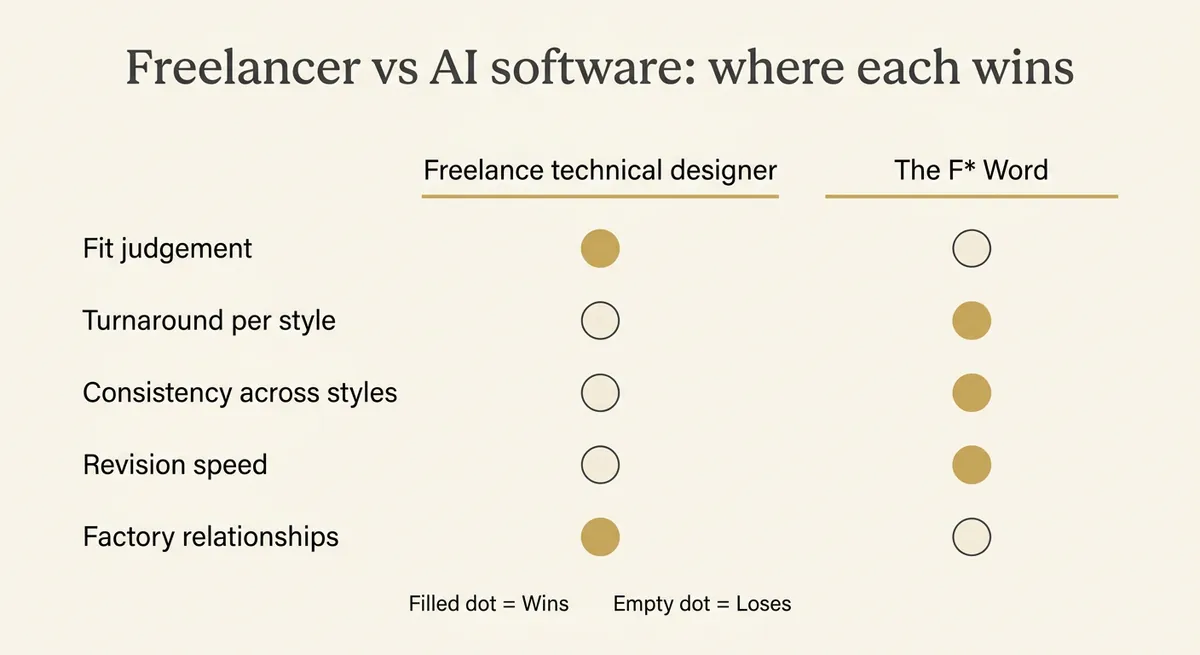
A freelancer can be the right technical partner while still being the wrong place to concentrate every preparation task. Before commissioning a collection, agree how availability, revisions and document ownership will work.
Ask when work can start, what constitutes a complete brief and what delivery means. An initial draft, an approved specification and a document revised after sampling are different milestones. A turnaround commitment is only useful when both sides mean the same thing.
Also establish what happens when several styles need attention at once. If your launch depends on a single specialist, ask about capacity for factory questions and urgent corrections, not just the original pack.
A per-style quote needs a clear revision policy. Determine whether changes to the design, corrections to the document and responses to sample feedback are treated differently. Otherwise, a seemingly contained assignment can become an open-ended series of approvals and edits.
Use one approved working version and record who authorized each change. Our guide to revision rounds as a pre-production cost metric provides a useful starting point for evaluating the work beyond the first draft.
Plan the handover before work begins. Your team should retain approved specifications, measurement definitions, construction decisions and unresolved questions. If the engagement ends, the next person should not have to reconstruct the reasoning from scattered messages.
This is a process requirement, not a criticism of freelancers. Clear ownership protects the brand and gives the specialist a better-defined assignment.
This table compares using a freelance technical designer versus AI software for creating fashion tech packs based on the article's details.
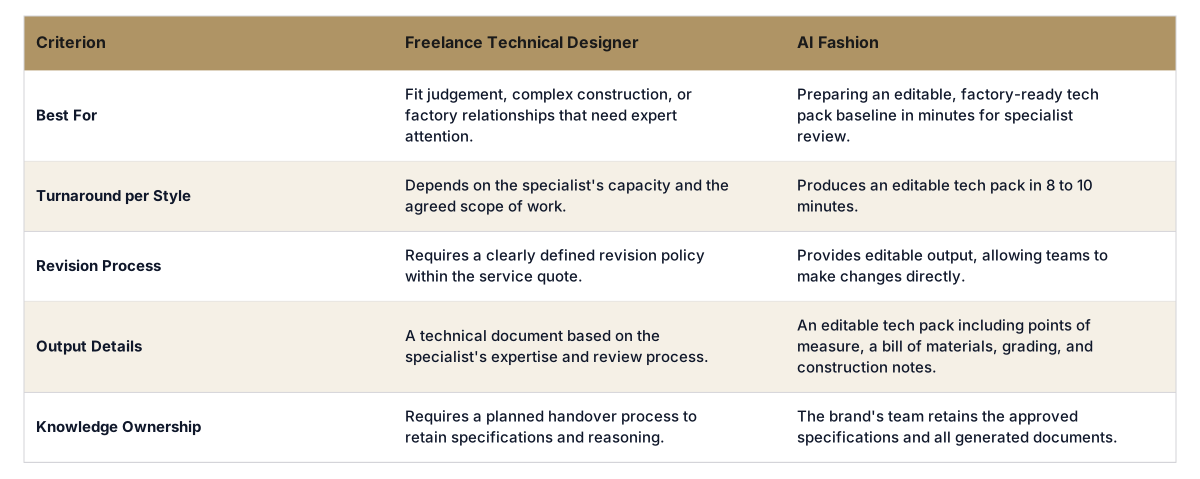
The F* Word is AI workflow software for fashion brands. From a sketch, photo or brief, it produces editable, factory-ready tech packs in 8 to 10 minutes. These include points of measure, a bill of materials, grading, tolerances and construction notes.
This setup makes it an option for preparing the technical baseline before a specialist spends time reviewing it. If your team is still defining the deliverable, start with what a tech pack includes so everyone understands the document they are approving.
Points of measure describe what needs measuring. The bill of materials captures the garment's material and component requirements. Having these in an editable output lets your team inspect the proposed specification and make decisions in the document rather than starting with an empty template.
Grading and tolerances are included too. Use a review standard to keep styles consistent. Check grade rules against your intended size range and confirm measurement definitions, then check that tolerances meet your needs. You still need to approve those choices after generation.
The F* Word works before or alongside PLM. It is not a PLM and should not be evaluated as a replacement for that category of system. Decide where generated packs will be reviewed, who approves them and where your team will retain the approved version.
It also generates AI moodboards and creative briefs, and performs trend analysis and validation. It is not an image generator. For the technical documentation stage, explore AI tech packs and evaluate the output against your brand's review requirements.
Brands using The F* Word report 75% fewer physical samples. Treat that as a reported outcome, not a guarantee for every garment or permission to skip necessary sampling and fit approval.
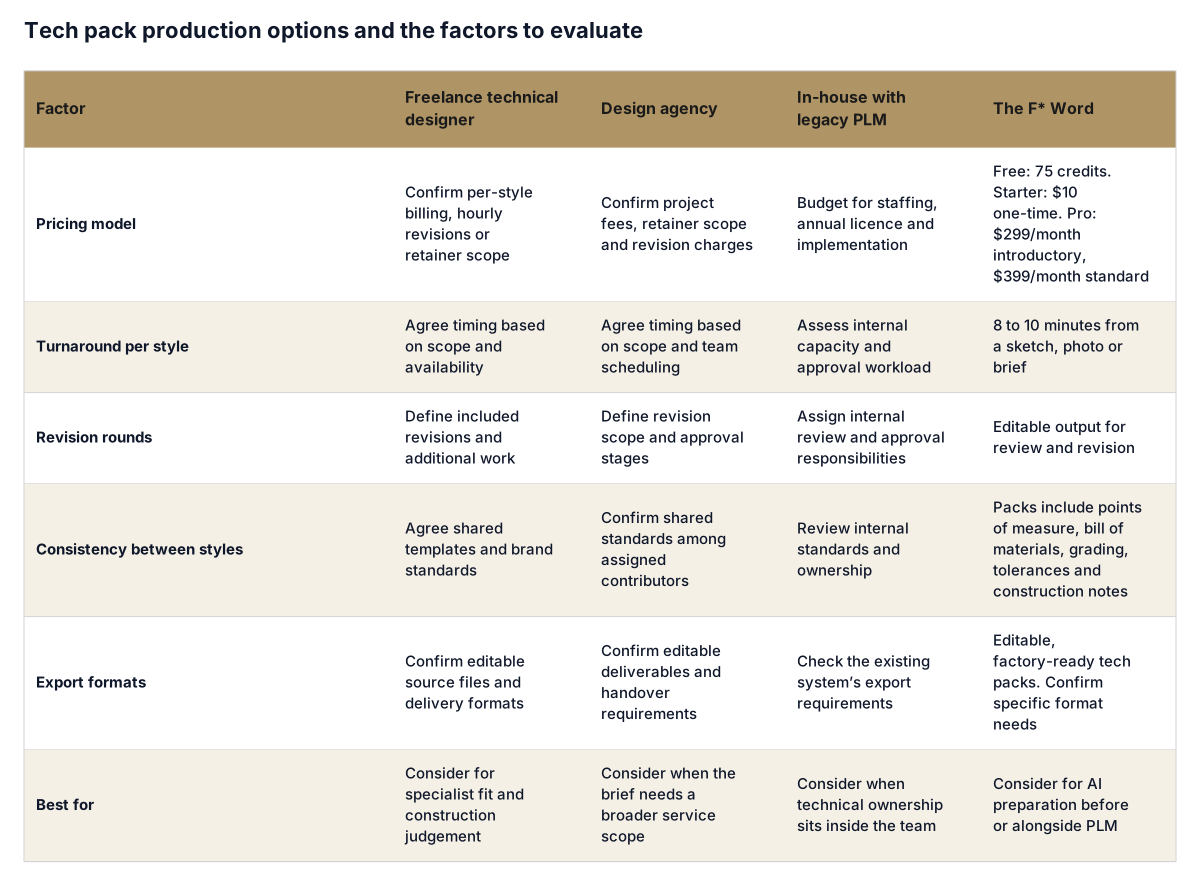
Compare the full working arrangement, not just the first deliverable. The service-based options below are purchasing considerations to confirm with each provider, rather than universal commitments about their speed, scope or output.
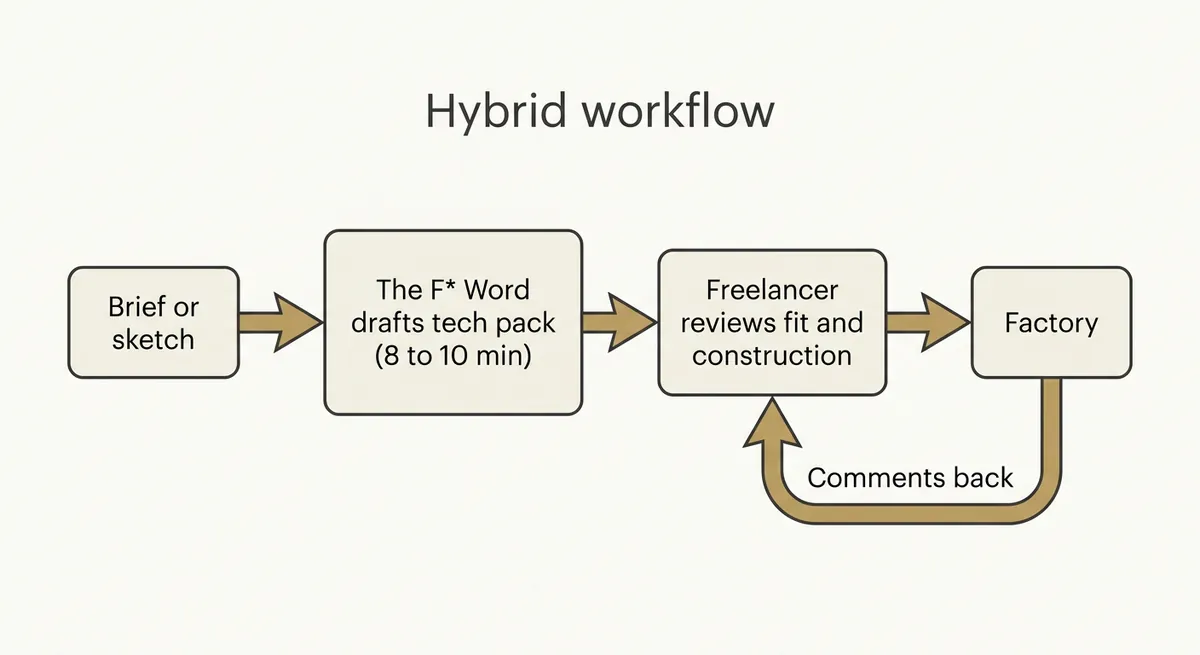
The hybrid approach gives software and the specialist distinct jobs. Use AI to prepare the technical document, then commission the freelancer to examine the decisions that need category experience. Describe the generated pack as a draft until your brand has approved it.
Ask the freelancer to quote specifically for review and revision rather than assuming an existing full-service arrangement will automatically change. Be clear about whether the assignment includes sample assessment, factory correspondence or only document review.
This model is most useful when you can provide direction and assign an approver. If no one owns the intended fit or final specification, generating a document faster does not resolve that missing responsibility.
Start with your technical confidence and the garment's complexity. If you cannot assess the proposed measurements or construction, include a specialist reviewer. AI preparation can still be part of the process, but avoid confusing a complete-looking document with your own approval of its contents.
Consider AI preparation plus targeted review when your team has established references and clear decision-makers. Keep approved brand standards available to the reviewer, and check related styles together rather than approving each document without collection context.
Evaluate where your current process stalls: preparing specifications, waiting for technical decisions or resolving sample feedback. Choose the combination of software and specialist support that addresses that actual constraint.
Prioritize ownership, approval responsibilities and handover requirements. The F* Word can work before or alongside PLM, while your existing team retains responsibility for technical sign-off. Pro includes team collaboration, a private tenant and priority generation.
For budgeting, Pro provides 3,600 credits per month. A Trend-to-Tech-Pack workflow uses 115 credits, covering about 31 workflows monthly. Match that allowance to your expected workload rather than comparing a software subscription with an undefined service engagement.
For brands that want AI preparation with specialist review, Pro is $299/month at introductory pricing, with a standard price of $399/month. At the introductory price and about 31 workflows monthly, that is about $10 per factory-ready tech pack. Compare plans
The F* Word produces editable, factory-ready tech packs, but your brand still needs an owner for technical approval. Use a freelancer when fit judgement, complex construction or factory discussions require specialist attention. A hybrid model separates document preparation from that review responsibility.
Compare defined scopes. Establish whether the freelancer's quote includes initial preparation, revisions, sample review and factory communication. Then budget for software and any specialist review you retain. A generated document and a full technical service engagement are not identical purchases.
No. The F* Word works before or alongside PLM and is not a PLM. Brands using it report 75% fewer physical samples, but that does not mean sampling is unnecessary. Keep the fit, material and construction checks your garment requires before production approval.
For the wider picture of how AI design tools fit together, see our AI fashion design overview.
Want to try it yourself? Start designing with AI Fashion.
Get The F* Word workflow insights in your inbox.